 English
 русский
 Español
 عربى



Automatic Paging Top and Bottom Pouch Labeling Machine: Precision Double-Sided Labeling for Flat Products
2026-09-26
Content
- 1 What Is an Automatic Paging Top and Bottom Pouch Labeling Machine?
- 2 Integrated Workflow from Stacked Products to Finished Labels
- 3 Key Advantages Over Conventional Labeling Methods
- 4 Product Compatibility and Application Areas
- 5 Control System and Intelligent Operating Functions
- 6 Mechanical Construction and Manufacturing Strength
- 7 Customization for Different Products and Lines
- 8 Technical Specifications
- 9 Installation, Setup, and Changeover
- 10 Maintenance and Operational Best Practices
- 11 Why the Machine Is a Strong Choice for Industrial Packaging
- 12 Company Manufacturing and Technical Capabilities
- 13 Frequently Asked Questions
- 13.1 What products can this machine label?
- 13.2 Can it apply labels to both sides of a product?
- 13.3 How does the paging mechanism work?
- 13.4 What is the approximate production speed?
- 13.5 What labeling accuracy can be expected?
- 13.6 Can the machine handle lightweight plastic film and pouches?
- 13.7 Can the machine be used for top labeling only?
- 13.8 Can product dimensions and conveyor width be customized?
- 13.9 What label sizes are supported?
- 13.10 Does the machine prevent labeling when no product is present?
- 13.11 Can printing or coding equipment be added?
- 13.12 What materials are used for the machine structure?
- 13.13 What power supply is required?
- 13.14 How should the machine be tested before purchase?
- 14 Conclusion
- 15 References
- 16 Product: Automatic Paging Top and Bottom Pouch Labeling Machine
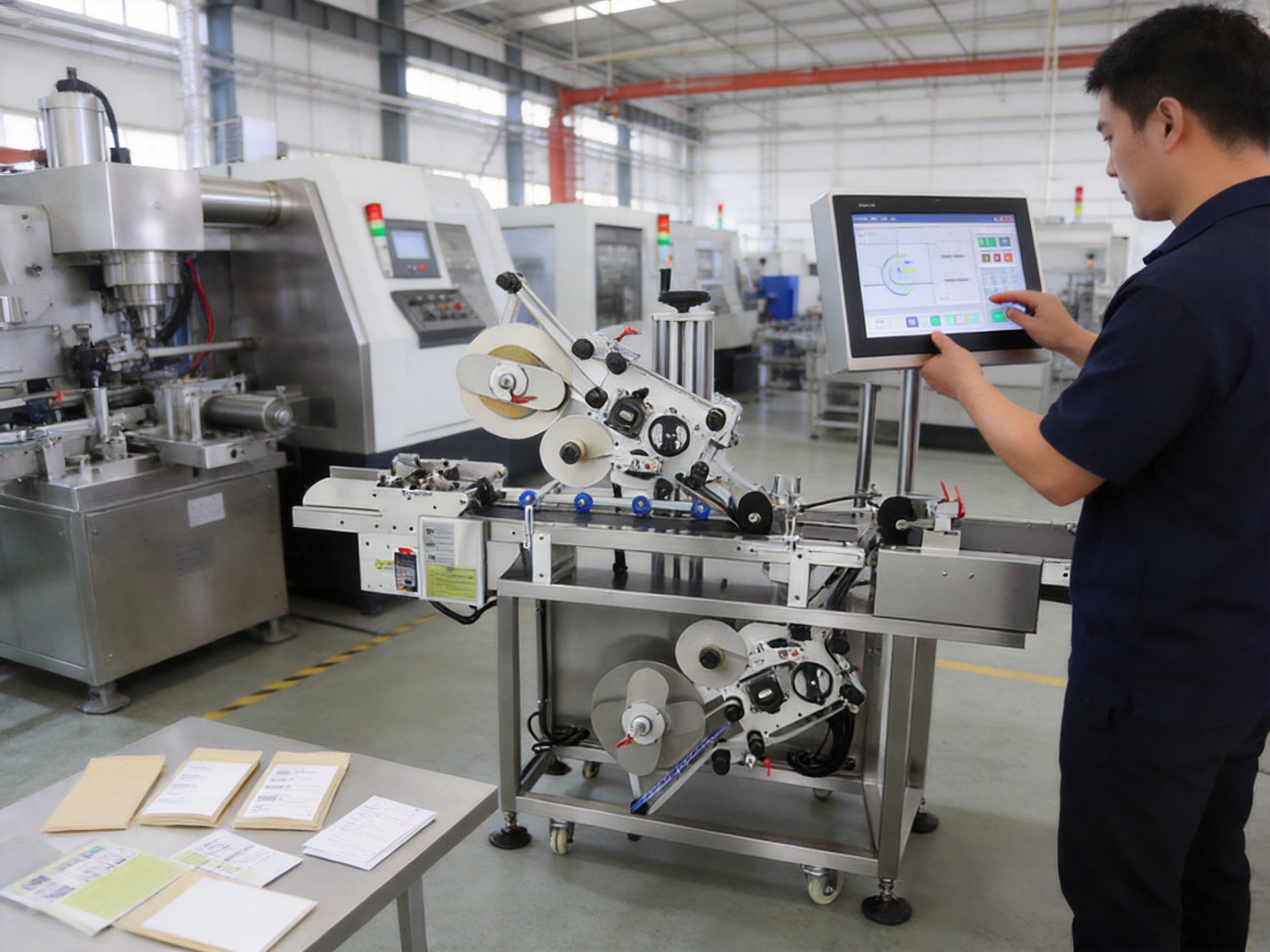
Modern packaging operations increasingly depend on flexible automation that can process different product formats without sacrificing speed, accuracy, or presentation quality. Flat products such as pouches, plastic bags, paper sheets, cards, instruction leaflets, labels, and lightweight packaging components are especially challenging to automate. They can overlap, shift, float, curl, or stick together during feeding and conveying. When labels must be applied to both the top and bottom surfaces, the handling requirements become even more demanding.
The automatic paging top and bottom pouch labeling machine is designed to solve these problems through an integrated process that combines product separation, conveying, detection, label dispensing, and double-sided application. Instead of requiring operators to manually separate individual products and position them for labeling, the machine automatically pages stacked products one by one and transfers them into a controlled labeling path. Labels can then be applied to the top surface, the bottom surface, or both surfaces according to the production requirements.
This type of equipment is suitable for businesses that need dependable labeling of flat and flexible products at a higher throughput than manual or semi-automatic methods can provide. Its applications include packaging bags, PE bags, paper boxes, cards, prepaid cards, membership cards, instruction sheets, film products, leaflets, label cards, anti-counterfeit materials, and other sheet-like items.
By integrating multiple operations into one compact machine, the system helps manufacturers reduce labor requirements, improve label positioning, lower product handling risks, and maintain a more consistent appearance from one production batch to the next. The machine is also designed for integration into existing packaging lines, making it a practical option for companies that are upgrading from manual workstations or isolated labeling equipment.
What Is an Automatic Paging Top and Bottom Pouch Labeling Machine?
An automatic paging top and bottom pouch labeling machine is a continuous labeling system for products that are supplied in a stacked or overlapping group. The term “paging” refers to the process of separating products individually, similar to turning pages in a stack of paper. Once separated, each product is conveyed through the labeling area at a controlled interval so that the labeling heads can apply labels accurately.
The machine is configured for flat products rather than conventional cylindrical containers. A typical production sequence begins when an operator places a stack of bags, cards, paper products, or other flat items into the paging section. A friction-type separation mechanism picks up the products one at a time. The separated product then enters the conveyor, where photoelectric sensors and a control system determine its position and coordinate label dispensing.
The upper labeling head applies a label to the top surface. Depending on the machine configuration, a lower labeling head applies a label to the underside. A vacuum-assisted conveyor can hold thin or lightweight products firmly during this process. Pressing rollers, belts, or wiping mechanisms then help secure the labels and remove air pockets or loose edges.
The entire operation is managed through a PLC control system and a touch screen interface. Operators can adjust conveyor speed, label position, product spacing, sensor timing, and other operating parameters. The result is a coordinated workflow in which product separation and labeling occur automatically without repeated manual positioning.
Integrated Workflow from Stacked Products to Finished Labels
Automatic Product Paging
The first stage is the separation of products from a stack. Flat bags, cards, sheets, and pouches are often difficult to feed because their surfaces can adhere to one another. The friction-type paging mechanism is designed to create enough controlled contact to separate one item at a time while reducing double-feeding.
Paging is essential for accurate labeling. If two products enter the labeling area together, the label may be applied across both products, applied to the wrong position, or missed entirely. By establishing a single-product flow, the paging unit creates a predictable distance between items and gives the detection system a stable signal for each labeling cycle.
The paging section can be adjusted for different product thicknesses and materials. This flexibility is useful when one production line handles a mixture of paper, plastic, film, and laminated products. Product characteristics such as surface friction, stiffness, weight, and flexibility may affect the optimum adjustment, so the ability to fine-tune the feeding mechanism is an important operational advantage.
Controlled Conveying
After separation, the individual product moves along the conveyor toward the labeling heads. Conveyor speed can be adjusted from a slow setup speed to a higher production speed. The specified conveyor speed range is 0 to 50 meters per minute, allowing operators to match the machine to the product dimensions, label size, material properties, and required output.
Controlled conveying helps maintain a stable product path. Inconsistent movement can cause labels to shift from their target position, especially when products are thin or flexible. The conveyor therefore performs more than a transport function; it is part of the positioning system that supports repeatable label placement.
Vacuum-Assisted Product Stabilization
Lightweight products can be lifted by air movement, vibration, or friction from adjacent components. Flexible pouches may also wrinkle or curl as they move. The vacuum-assisted conveyor helps keep the product surface in contact with the conveying area so that it remains stable beneath the labeling head.
This feature is particularly useful for PE bags, plastic films, thin paper sheets, and lightweight cards. By reducing shifting and floating, the vacuum system improves registration accuracy and supports smoother label adhesion. It also makes the process more reliable when the machine is operating at a higher speed.
Top and Bottom Label Application
The machine can be equipped to apply labels to the top surface, bottom surface, or both sides of the product. This configuration gives manufacturers flexibility when product information must be distributed across multiple surfaces. For example, one side may carry a product identification label while the opposite side carries a barcode, QR code, instruction label, or anti-counterfeit label.
Top-and-bottom labeling is more demanding than single-sided labeling because the product must remain aligned as it passes between the upper and lower mechanisms. The machine coordinates detection, label feeding, conveyor movement, and pressing operations so that both labels are applied in the intended locations.
Using separate upper and lower labeling heads also allows the system to be adapted to different label requirements. A company may use both heads for a two-sided application, operate only the upper head for a top-labeling task, or configure the equipment for a specific product line. This flexibility can reduce the need to purchase separate machines for every labeling format.
Detection and Label Timing
Photoelectric detection identifies the arrival of each product and provides a trigger for label dispensing. When the product reaches the preset position, the servo label feeding system releases the label at a controlled speed and distance. This coordination helps maintain consistent spacing between the leading edge of the product and the applied label.
Accurate timing is especially important when product sizes vary or when labels are positioned close to an edge. The touch screen control system allows operators to adjust sensor delay, label output timing, conveyor speed, and other parameters during setup. This makes it possible to compensate for different product materials and production conditions.
Pressing and Finishing
After the label contacts the product, pressing and wiping mechanisms help create complete adhesion. These components can reduce bubbles, wrinkles, lifted corners, and incomplete contact. A clean and stable finish improves both the visual quality and the functional reliability of the label.
For barcode and QR code applications, smooth adhesion is particularly important. Wrinkles or partial lifting can interfere with scanning. For retail packaging, cosmetic products, and printed cards, a flat and accurately positioned label also contributes to a professional appearance.
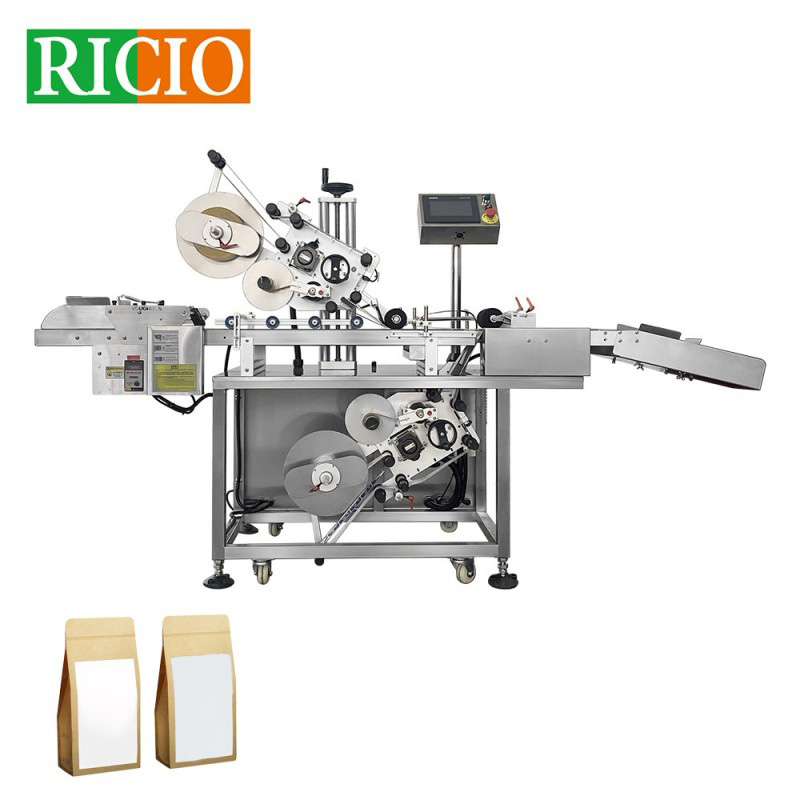
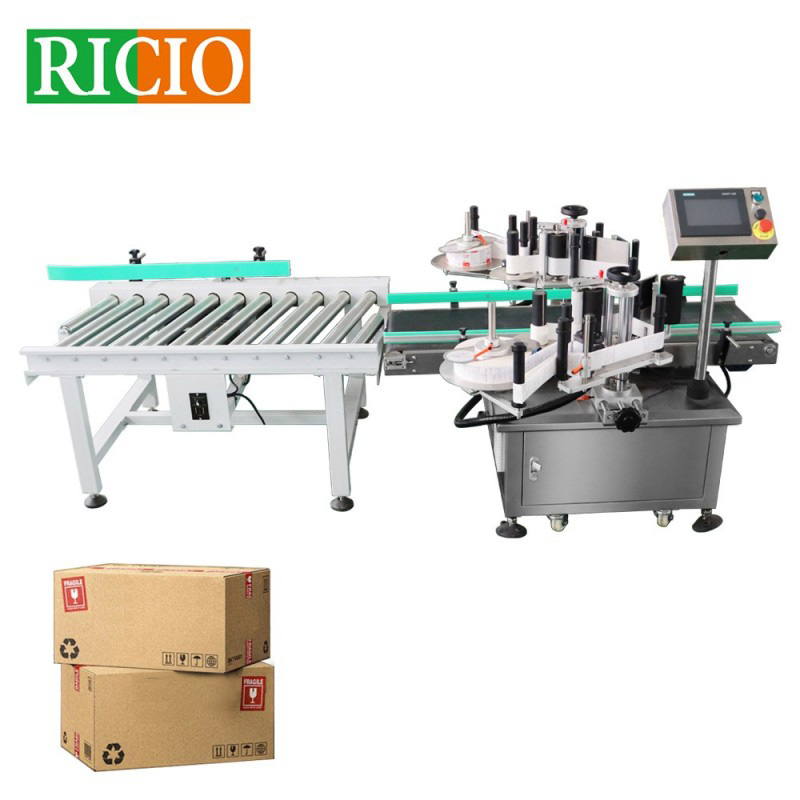
Automatic Paging Top and Bottom Pouch Labeling Machine
Key Advantages Over Conventional Labeling Methods
Higher Productivity Than Manual Labeling
Manual labeling requires workers to pick up each product, separate it from the stack, locate the labeling position, apply the label, and inspect the result. This process is labor-intensive and can become inconsistent during long production shifts. The automatic paging machine performs the separation and labeling steps continuously, helping increase output while reducing repetitive manual tasks.
The stated labeling speed is approximately 150 to 200 sheets per minute, depending on product size, label size, material properties, and operating conditions. Actual production speed should always be confirmed through sample testing, but this capacity provides a substantial improvement over many manual or basic semi-automatic workflows.
More Consistent Label Positioning
Human operators naturally experience variations in hand position, product orientation, and application pressure. Even small differences can become visible when labels are placed near an edge or must line up with printed graphics. Automated sensing and servo-controlled feeding create a more repeatable application process.
The machine is specified with a labeling accuracy of approximately plus or minus 1 millimeter under suitable product conditions. Actual accuracy depends on the product’s softness, hardness, flatness, roundness, surface friction, and dimensional stability. For flat products that are properly prepared and consistently fed, the controlled conveyor and detection system support accurate placement across a production run.
Reliable Handling of Lightweight Materials
Many standard labeling machines are designed for rigid bottles or containers and may not handle thin pouches and sheets effectively. Flexible products can deform when pushed, slide when pulled, or lift due to air movement. The combination of paging, vacuum conveying, and controlled pressing makes this machine better suited to such materials.
The design is particularly advantageous for products that cannot be easily gripped by conventional mechanical clamps. Rather than relying on strong physical pressure that could damage the product, the system uses a controlled conveying surface and vacuum assistance to stabilize the material during labeling.
Flexible Single-Sided or Double-Sided Operation
Manufacturers often need to label different products in the same facility. One item may require a top label only, while another may require labels on both surfaces. A system that can switch between these configurations offers a greater return on investment than a dedicated single-purpose machine.
The automatic paging top and bottom pouch labeling machine supports flexible use of its upper and lower labeling heads. This adaptability is useful for changing product specifications, seasonal packaging, promotional cards, shipping documents, instruction sheets, and multi-stage identification processes.
Reduced Labeling Waste
Incorrectly positioned labels create direct material waste and may also require the product to be reworked or discarded. Automatic detection, no-product-no-labeling logic, label detection, and automatic correction functions help reduce the number of labels dispensed when no product is present or when a fault occurs.
Waste reduction is important for expensive specialty labels, security labels, serialized labels, and custom-printed labels. It also helps manufacturers meet sustainability targets by reducing unnecessary consumption of label stock and packaging materials.
Improved Production Control
The PLC and touch screen interface provide operators with a central point for machine management. Production counting allows teams to monitor output, compare actual production with scheduled targets, and identify stoppages. Fault alarms provide alerts when a sensor, label roll, conveyor, or other operating condition requires attention.
Energy-saving standby can reduce unnecessary consumption during short pauses. Parameter protection helps prevent unauthorized or accidental changes to important settings. Together, these functions make the equipment more suitable for organized industrial production than a basic standalone applicator.
Product Compatibility and Application Areas
Plastic Bags and Flexible Pouches
Plastic bags, PE bags, and other flexible pouches commonly require product identification, barcode, logistics, promotional, or regulatory labels. Their low weight and flexible structure make manual handling slow and automated feeding difficult. The paging section and vacuum conveyor help separate and stabilize these products during the labeling process.
For bags containing little or no product at the time of labeling, maintaining a flat surface is important. The conveyor can help keep the material positioned so the label is applied without excessive wrinkling or displacement. The precise configuration should be determined through sample testing because film thickness, static electricity, seal design, and surface finish can all affect performance.
Paper Sheets, Boxes, and Instruction Materials
Paper sheets, folded instruction materials, small cartons, and inserts may be labeled for product identification, batch control, assembly guidance, or logistics. These products are often supplied in stacks and are therefore suitable for automatic paging.
The machine can separate the items and apply labels without requiring a worker to place each sheet individually. This can be valuable in pharmaceutical packaging, electronics assembly, stationery production, and fulfillment operations where instructions or inserts must be identified before entering another process.
Cards and Security Materials
Prepaid cards, membership cards, paper cards, plastic cards, and anti-counterfeit materials can require accurate application of identification labels, security seals, barcode labels, and QR code labels. The flat and consistent format of cards is well suited to conveyor-based labeling, provided the paging system is adjusted to the card thickness and surface properties.
For security-related applications, the ability to add a barcode reader or QR code reader can provide an additional control step. A reader can be used to recognize printed information, verify data, or support traceability within a broader production workflow.
Logistics and Fulfillment Products
Flat mailers, shipping pouches, document envelopes, and logistics cards may require labels containing routing information, tracking codes, customer data, or handling instructions. Automatic labeling can help fulfillment facilities process a larger volume of items while maintaining consistent placement.
Optional printing and coding equipment can extend the machine’s function beyond label application. A hot coding machine or inkjet printer may be added for dates, batch numbers, variable text, or other production information. This creates a more integrated path from product feeding to identification and dispatch.
Food, Pharmaceutical, and Daily Chemical Packaging
In food packaging, labels may communicate product information, promotional data, traceability codes, or handling instructions. Pharmaceutical and healthcare packaging often requires carefully controlled identification, batch information, and supporting documents. Daily chemical and cosmetics industries may use labels for product details, warnings, promotional content, and barcode tracking.
Because the machine is built with SUS304 stainless steel and T6 aluminum alloy in its main housing and structural components, it is suitable for environments where corrosion resistance, durability, and ease of cleaning are important. Hygiene and validation requirements vary by application, so the final configuration should be reviewed against the relevant plant standards.
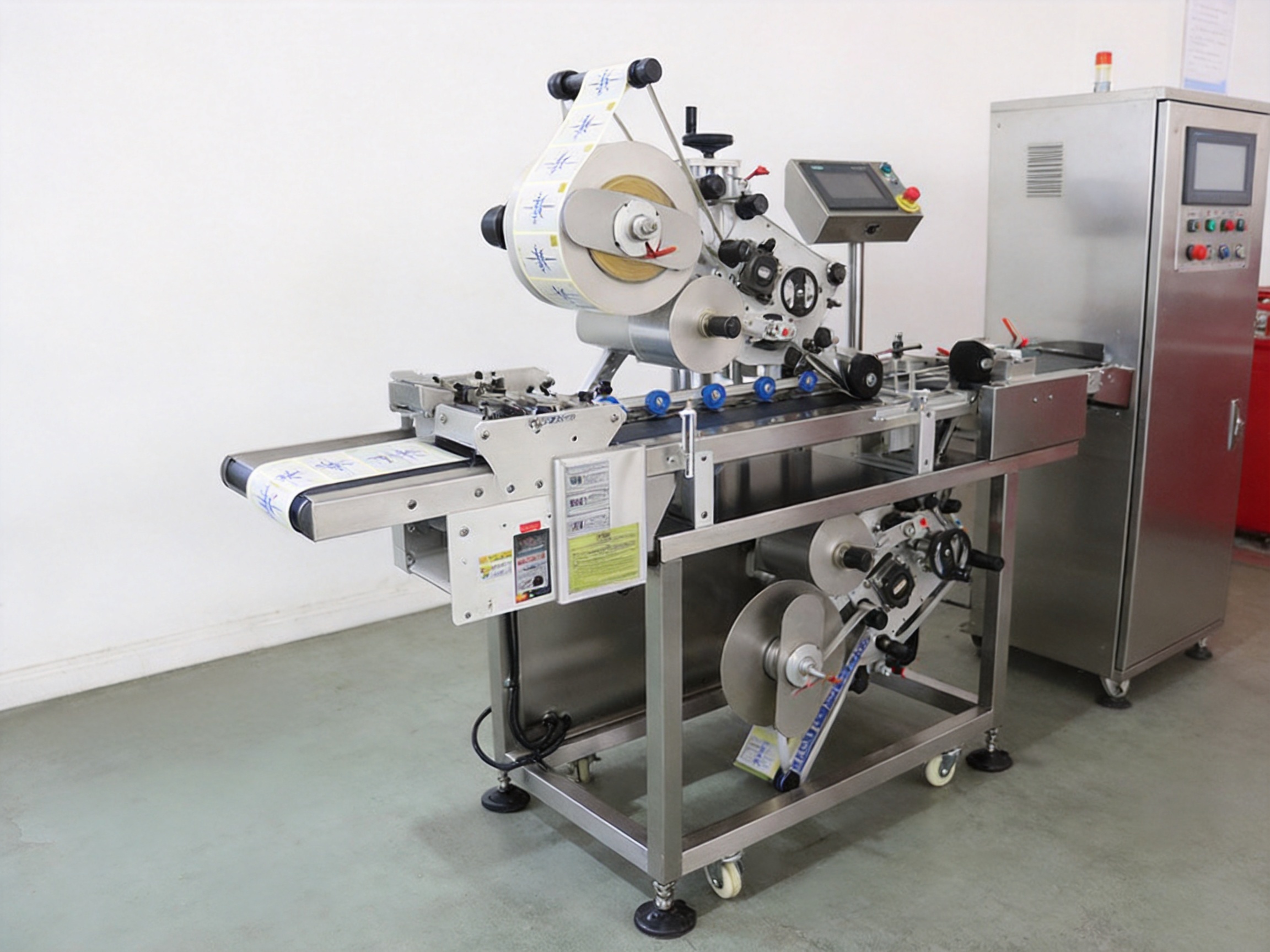
Control System and Intelligent Operating Functions
PLC-Based Coordination
The PLC control system coordinates paging, detection, conveyor movement, label dispensing, and alarm responses. This centralized control architecture allows the machine to execute a repeatable sequence rather than relying on disconnected manual adjustments.
When a product is detected, the PLC can calculate or apply the appropriate timing for label release. It can also monitor whether the product is present, whether the label has been dispensed, and whether an abnormal condition has occurred. This coordinated control improves the stability of the overall process.
Touch Screen Interface
The touch screen interface allows operators to view settings and make adjustments without extensive mechanical intervention. Common parameters may include product delay, label length, label spacing, conveyor speed, sensor sensitivity, and operating mode.
A well-organized interface also simplifies product changeover. Once the correct settings for a product and label combination have been established, they can be recorded or protected for future use, depending on the control configuration. This reduces setup time when production switches between different sizes.
No-Product-No-Labeling Function
The no-product-no-labeling function prevents the machine from dispensing a label when the expected product is absent. This is a simple but valuable feature because it limits wasted labels during gaps in the product flow or temporary feeding interruptions.
For high-value labels, serialized labels, or labels printed with variable information, avoiding unnecessary dispensing can significantly reduce operating costs. It also helps keep the labeling area cleaner and easier to monitor.
Label Detection and Automatic Correction
Label detection systems help identify missing labels, label gaps, or abnormal label feeding conditions. Automatic correction functions can assist with maintaining the intended label position when minor deviations occur. These functions improve production continuity and reduce the need for constant operator intervention.
Detection performance depends on the label material, backing paper, transparency, printing, and contrast. A transparent label sensor may be selected as an optional module when standard photoelectric detection is not sufficient for a specific label structure.
Fault Alarms and Production Counting
Fault alarms notify operators when the machine encounters conditions such as product blockage, label depletion, sensor errors, or abnormal movement. Early notification helps reduce the duration of stoppages and supports preventive maintenance.
Production counting gives supervisors a simple way to monitor output. Count data can be compared with work orders, shift targets, and production schedules. Although counting alone does not replace a complete manufacturing execution system, it provides useful operational information at the machine level.
Mechanical Construction and Manufacturing Strength
The performance of a labeling machine depends not only on its software and sensors but also on the accuracy and durability of its mechanical structure. Label position can be affected by frame vibration, roller runout, loose components, uneven surfaces, and inconsistent assembly. For this reason, manufacturing capability is an important factor when comparing equipment suppliers.
Shanghai Ruixiao Packaging Technology Co., Ltd., operating under the RICIO brand, has developed from an equipment assembly background into a source manufacturer with in-house precision machining capabilities. The company’s production resources include CNC machining centers and an experienced technical team. This gives the manufacturer greater control over the production of important machine components than a business that depends entirely on external fabrication.
In-house machining can support closer control of dimensions, mounting surfaces, shafts, brackets, guide components, and other parts that influence labeling stability. It can also make it easier to respond to custom requirements, such as modified conveyor widths, special product guides, alternative labeling head positions, or application-specific structures.
The company manages the process from core component machining through complete machine assembly and commissioning. This integrated approach helps reduce communication gaps between design, machining, assembly, and final testing. It also makes it easier to identify the source of a problem when a customized machine requires adjustment.
Manufacturing and quality processes are carried out in accordance with the ISO 9001 international quality system. A quality management framework supports consistent documentation, process control, inspection, corrective action, and traceability. These practices are especially important for packaging equipment because a small mechanical inconsistency can affect thousands of products during a production shift.
The machine housing uses SUS304 stainless steel and T6 aluminum alloy. SUS304 offers corrosion resistance and a smooth, cleanable surface, while T6 aluminum alloy provides a strong but relatively lightweight structural material. The combination supports a balance between rigidity, service life, cleanability, and ease of installation.
Advantages of Source Manufacturing
Source manufacturing offers several potential advantages over purely trading-based supply. First, the manufacturer can participate directly in mechanical design and component selection. Second, technical staff can evaluate product samples and recommend suitable feeding and labeling configurations. Third, custom modifications can be handled with fewer intermediaries. Fourth, after-sales troubleshooting can be supported by personnel familiar with the original design and manufacturing process.
These advantages are valuable when labeling flat products because applications can vary significantly. A bag with a smooth film surface behaves differently from a porous paper sheet. A rigid plastic card requires different paging pressure from a thin instruction leaflet. A two-sided label application may need different guide clearance and conveyor support from a top-only application.
By combining equipment development, precision machining, assembly, commissioning, and technical support, the manufacturer is better positioned to adapt the machine to those differences.
Customization for Different Products and Lines
Product compatibility is not determined by a single dimension. It depends on length, width, thickness, stiffness, weight, surface material, static behavior, label position, and the way products are stacked. For this reason, the product size range of the machine can be customized according to customer requirements.
The conveyor width can also be customized according to customer-provided samples. This is important because a conveyor that is too narrow may not support the product adequately, while a conveyor that is too wide may allow shifting. Proper width selection helps keep the product aligned under the labeling heads.
Special product sizes can be accommodated through changes to guides, paging components, conveyor dimensions, sensor positions, and labeling head locations. The label length range is specified as 15 to 300 millimeters, with special sizes available by customization. Label height is specified as 10 to 150 millimeters.
Before production, customers should provide representative product samples and label rolls whenever possible. Sample testing can determine whether the product requires vacuum assistance, whether the label sensor can detect the material correctly, and whether the top and bottom labels can be positioned without interference.
Optional Printing and Identification Modules
The machine can be configured with optional modules such as a hot coding machine, inkjet printer, transparent label sensor, barcode reader, or QR code reader. These options allow manufacturers to combine labeling with printing, coding, recognition, and traceability.
A hot coding machine may be used for batch numbers, dates, or simple variable information. An inkjet printer can provide more flexible printing on products or labels. Barcode and QR code readers can verify product information or connect the labeling process with a traceability system.
These modules can help reduce the number of separate production stations. Fewer transfers between machines can lower handling time and reduce the risk of products being mixed, damaged, or incorrectly matched with labels.
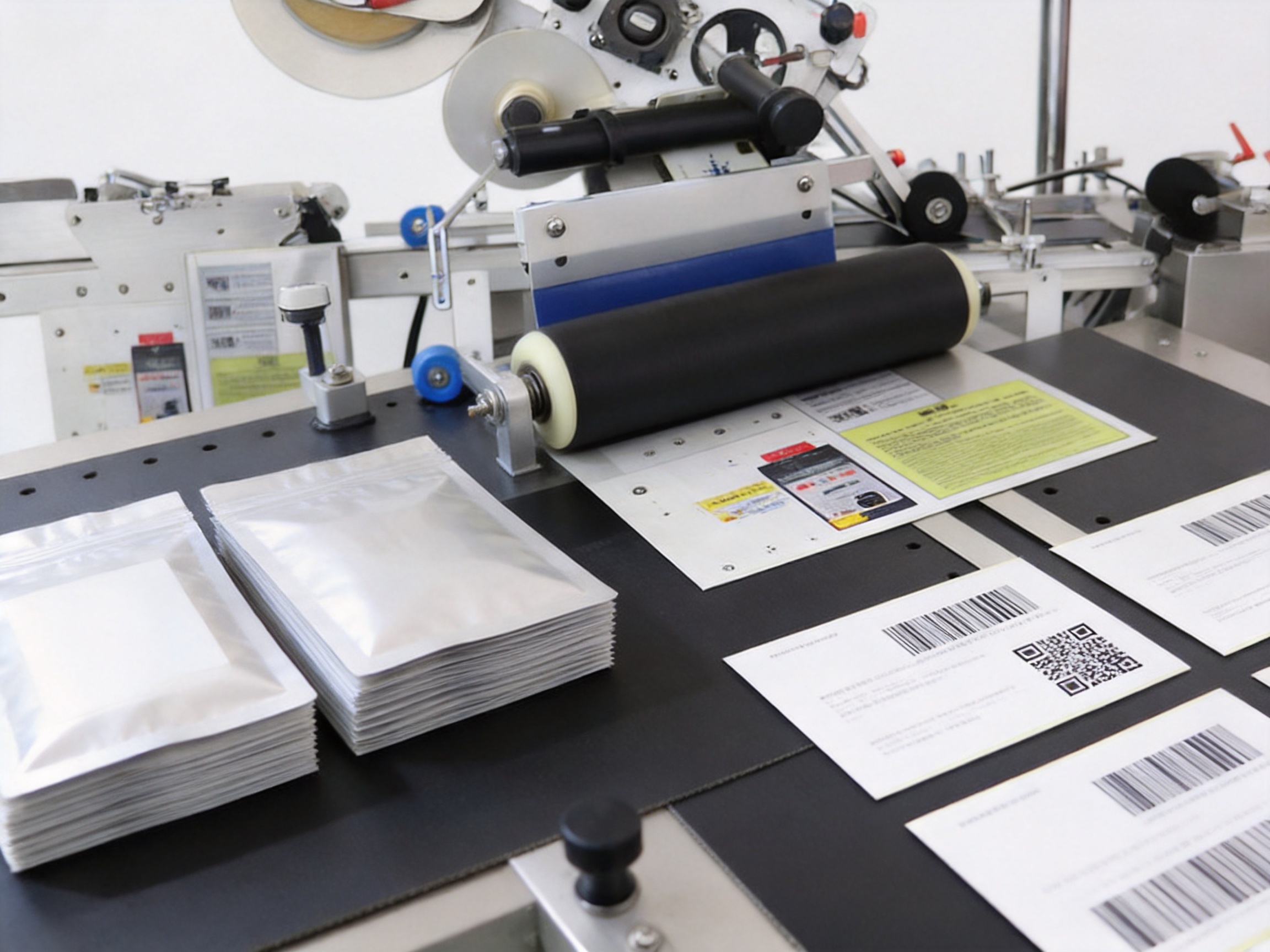
Technical Specifications
| Specification | Details |
| Machine type | Automatic paging top and bottom pouch labeling machine |
| Power supply | AC 220 V, 50/60 Hz, single-phase |
| Power consumption | 1,200 W |
| Labeling speed | Approximately 150–200 sheets per minute, depending on product and label conditions |
| Labeling accuracy | Approximately ±1 mm under suitable product conditions |
| Conveyor speed | 0–50 meters per minute, adjustable |
| Product size range | Customizable according to customer requirements |
| Label height | 10–150 mm |
| Label length | 15–300 mm; special sizes can be customized |
| Label roll inner diameter | Minimum 76 mm |
| Label roll outer diameter | Maximum 300 mm |
| Net weight | Approximately 200 kg |
| Packaging dimensions | Approximately 2,200 × 750 × 1,500 mm |
| Conveyor width | Customizable according to customer-provided samples |
| Main structural materials | SUS304 stainless steel and T6 aluminum alloy |
| Control system | PLC control with touch screen operation |
The figures above provide a general reference for equipment planning. Actual performance may change according to product dimensions, product spacing, surface friction, label material, label adhesive, label shape, environmental conditions, and operator settings. A sample test is recommended before final confirmation of the machine configuration.
Installation, Setup, and Changeover
The compact structure of the machine makes it suitable for installation in existing packaging lines. Before installation, the customer should confirm available floor space, electrical supply, product flow direction, operator access, ventilation, and the location of upstream and downstream equipment.
The machine requires a stable and level installation surface. Proper leveling helps prevent unwanted vibration and supports consistent conveyor movement. The electrical supply should match the required AC 220 V, 50/60 Hz, single-phase specification. The operating area should also provide adequate space for label roll replacement, cleaning, inspection, and maintenance.
During initial setup, operators should adjust the paging mechanism to match product thickness and surface behavior. The product guides should support the item without excessive friction. Sensors should be positioned so that they detect the leading edge consistently. Labeling heads should then be aligned with the required top and bottom application positions.
Changeover begins with removing the previous product and label material, followed by adjustment of guides, sensor locations, label head positions, and operating parameters. The touch screen interface simplifies electronic adjustment, while mechanical guides and supports must be set according to the new product dimensions.
For frequently changed products, it is useful to document standard settings for each format. Operators can record conveyor speed, sensor delay, label position, paging adjustment, and other relevant values. This reduces setup time and helps different shifts achieve similar results.
Maintenance and Operational Best Practices
Regular cleaning is essential for consistent labeling. Adhesive residue, paper dust, film fragments, and product debris can accumulate around rollers, sensors, paging components, and label dispensing edges. Such contamination may affect product detection, label release, or label adhesion.
Operators should inspect the conveyor surface and vacuum openings regularly. If the vacuum path becomes blocked, lightweight products may no longer remain stable. Sensors should be kept clean and correctly aligned. Label rolls should be installed without excessive tension or lateral movement, and the backing paper should follow the intended path through the dispensing mechanism.
Mechanical fasteners, belts, rollers, and guide components should be checked according to a planned maintenance schedule. Unusual noise, vibration, inconsistent product spacing, or changes in label accuracy may indicate wear or misalignment. Early maintenance can prevent a minor adjustment issue from becoming a production stoppage.
Operators should also confirm that the selected label material is compatible with the product surface and application environment. Adhesive performance can change with temperature, humidity, surface energy, and contamination. A machine can apply a label accurately, but correct adhesion ultimately depends on the relationship between the label adhesive and the product material.
Safety procedures should be followed during cleaning, adjustment, and maintenance. Moving components, label rollers, and conveyor mechanisms should be stopped before hands are placed near the operating area. Electrical maintenance should be performed by qualified personnel.
Why the Machine Is a Strong Choice for Industrial Packaging
The main value of the automatic paging top and bottom pouch labeling machine is its combination of feeding and labeling functions. Many labeling problems begin before the label reaches the product. If the item is not separated, centered, and stabilized correctly, even a high-quality label applicator cannot guarantee a satisfactory result.
This machine addresses the complete sequence. It separates stacked products, controls their movement, detects their position, applies one or two labels, presses the labels onto the surface, and monitors production conditions. The integrated workflow reduces the number of manual interventions required between a stack of products and a finished labeled item.
Compared with a single-sided machine, its top-and-bottom capability provides greater application flexibility. Compared with a manual workstation, its automatic paging and continuous conveyor improve productivity. Compared with a basic friction conveyor, its vacuum assistance gives lightweight products greater stability. Compared with an equipment supplier that only assembles standard parts, the manufacturer’s in-house machining and integrated commissioning capabilities support deeper customization.
The machine is also suitable for companies that expect their packaging requirements to evolve. Optional readers, printers, and coding units can extend the equipment’s usefulness. Adjustable speed and customizable product dimensions make it possible to adapt the system to new products rather than replacing the entire machine whenever a format changes.
Company Manufacturing and Technical Capabilities
Shanghai Ruixiao Packaging Technology Co., Ltd. specializes in the research, development, and manufacture of labeling machinery. Its product range includes syringe labeling machines, round bottle labeling machines, square bottle labeling machines, double-sided labeling systems, high-speed labeling equipment, and real-time print-and-apply systems.
The company is headquartered in Shanghai, China, and has developed its manufacturing capabilities through the acquisition and development of precision machinery resources. With CNC machining centers and an experienced technical team, the company can manage important stages of component production internally.
This manufacturing model supports product consistency and engineering responsiveness. Core parts can be machined according to the intended assembly requirements, while the technical team can evaluate the interaction between mechanical components, sensors, control systems, and labeling materials. Complete machine assembly and commissioning allow the finished equipment to be tested as an integrated system rather than as a collection of unrelated components.
The company follows the ISO 9001 international quality system and exports labeling equipment to more than 40 countries and regions. Its market experience covers food and beverage, pharmaceutical and healthcare, daily chemical and cosmetics, chemical packaging, electronics, stationery, logistics, and plastic packaging applications.
For customers purchasing customized labeling equipment, these capabilities are important because a machine must be evaluated according to its intended product and production environment. A manufacturer with experience across multiple industries can draw on a wider range of application knowledge when recommending paging, conveying, sensing, and labeling solutions.
Frequently Asked Questions
What products can this machine label?
The machine is designed for flat products such as plastic bags, PE bags, paper sheets, paper boxes, cards, prepaid cards, membership cards, instruction sheets, film sheets, label cards, leaflets, and similar products. Product compatibility depends on size, thickness, flexibility, surface condition, and stacking behavior.
Can it apply labels to both sides of a product?
Yes. The machine can be configured to apply labels to the top surface, the bottom surface, or both surfaces. The upper and lower labeling heads can be used according to the product’s labeling requirements.
How does the paging mechanism work?
The paging mechanism uses controlled friction to separate products from a stack and feed them individually toward the conveyor. This prevents multiple products from entering the labeling area together and creates a consistent flow for detection and labeling.
What is the approximate production speed?
The stated labeling speed is approximately 150 to 200 sheets per minute. Actual speed depends on sheet size, label dimensions, product material, spacing, product flatness, and the required labeling accuracy.
What labeling accuracy can be expected?
The reference accuracy is approximately plus or minus 1 millimeter under suitable product conditions. Actual accuracy may be affected by product softness, hardness, flatness, surface friction, dimensional variation, and label characteristics.
Can the machine handle lightweight plastic film and pouches?
Yes. The vacuum-assisted conveyor is designed to help stabilize lightweight and thin products during conveying and labeling. Sample testing is recommended because film thickness, static electricity, surface finish, and pouch construction can affect feeding performance.
Can the machine be used for top labeling only?
Yes. The upper labeling head can be used independently when the product requires only a top label. The lower head can remain inactive or be configured for a different application, depending on the final machine design.
Can product dimensions and conveyor width be customized?
Yes. The product size range and conveyor width can be customized according to customer requirements and product samples. Customization may also include guide structures, sensor positions, label head locations, and other product-contact components.
What label sizes are supported?
The reference label height range is 10 to 150 millimeters, while the reference label length range is 15 to 300 millimeters. Special label sizes may be possible after engineering review and sample testing.
Does the machine prevent labeling when no product is present?
Yes. The no-product-no-labeling function is designed to prevent unnecessary label dispensing when the expected product is missing. This helps reduce label waste and improves process control.
Can printing or coding equipment be added?
Optional equipment may include a hot coding machine, inkjet printer, barcode reader, QR code reader, or transparent label sensor. These modules can support variable information, traceability, recognition, and code verification.
What materials are used for the machine structure?
The housing and structural parts use SUS304 stainless steel and T6 aluminum alloy. These materials provide durability, corrosion resistance, and relatively easy cleaning for industrial packaging environments.
What power supply is required?
The reference power supply is AC 220 V, 50/60 Hz, single-phase, with power consumption of approximately 1,200 W. Electrical requirements should be confirmed against the final machine configuration.
How should the machine be tested before purchase?
Customers should provide representative products, labels, and information about the intended production speed. Testing should examine paging reliability, product spacing, top and bottom label alignment, adhesion quality, sensor performance, changeover time, and compatibility with any optional printers or readers.
Conclusion
The automatic paging top and bottom pouch labeling machine provides a comprehensive solution for labeling stacked flat products. Its integrated paging, conveying, detection, vacuum stabilization, and upper and lower labeling functions address the main difficulties associated with bags, cards, sheets, pouches, and other lightweight materials.
With a reference throughput of 150 to 200 sheets per minute, adjustable conveyor speed, approximately plus or minus 1 millimeter labeling accuracy, PLC control, touch screen operation, production counting, label detection, automatic correction, and no-product-no-labeling functionality, the machine is designed for dependable industrial use.
Its advantages are particularly clear when compared with manual labeling or single-function equipment. It can reduce repetitive labor, improve label consistency, limit waste, support single-sided or double-sided applications, and handle a broad range of flat products. Optional printing and reading modules further expand its role in coding, verification, and traceability workflows.
The manufacturer’s advanced capabilities add another important advantage. In-house CNC machining, integrated assembly and commissioning, experienced technical personnel, ISO 9001-based quality management, and international application experience support the production of customized and reliable labeling equipment. For companies seeking to improve flat-product packaging automation, this machine offers a practical combination of productivity, flexibility, precision, and long-term manufacturing support.
References
1. ISO 9001: Quality Management Systems—Requirements.
2. General principles of industrial labeling equipment design and automated product handling.
3. Packaging machinery practices for product feeding, conveyor control, label dispensing, and label verification.
4. Manufacturer-provided technical specifications for the automatic paging top and bottom pouch labeling machine.
5. Manufacturer-provided information on CNC machining, machine assembly, commissioning, quality management, and labeling equipment applications.
Product: Automatic Paging Top and Bottom Pouch Labeling Machine

related products
related News
 +86 13681850339
 sales@raxpack.com
 Building 6, No. 477 Tiefeng Road, Baoshan District, Shanghai, China
- Tabletop Labeling Machine
- Round Bottle Labeling Machine
- Automatic Tube Labeling Machine
- Pouch Labeling Machine
- Rotary Labeling Machine
- Syringe Labeling Machine
- Top Labeling Machine
- Single Side Sticker Labeling Machine
- Double Side Labeling Machine
- Bucket Labeling Machine
- Bottom Labeling Machine
- Corner Label Applicator
- Waist Sealing Labeling Machine
- Square Bottle Labeling Machine
