 English
 русский
 Español
 عربى



Automatic Round Bottle Positioning Labeling Machine: Precision, Flexibility, and Efficient Packaging Automation
2026-10-02
Content
- 1 Introduction
- 2 What Is an Automatic Round Bottle Positioning Labeling Machine?
- 3 Core Operating Principle
- 4 Key Technical Specifications
- 5 Major Advantages of the Machine
- 6 Advantages Over Less Specialized Labeling Equipment
- 7 Manufacturing Strengths of Shanghai Ruixiao Packaging Technology Co., Ltd.
- 8 Application Areas
- 9 Label and Container Compatibility
- 10 Installation and Production Considerations
- 11 Quality Control and Performance Verification
- 12 Maintenance and Long-Term Reliability
- 13 Why Manufacturer Capability Matters
- 14 Frequently Asked Questions
- 14.1 What products can the machine label?
- 14.2 What is the standard bottle diameter range?
- 14.3 What bottle height can the machine handle?
- 14.4 How fast does the machine operate?
- 14.5 What labeling precision can be expected?
- 14.6 Can the machine label bottles of different sizes?
- 14.7 Can the conveyor width be customized?
- 14.8 What label roll dimensions are supported?
- 14.9 What type of air supply is required?
- 14.10 Is the machine suitable for manual loading?
- 14.11 Can the machine be integrated into a complete packaging line?
- 14.12 Why is product testing important?
- 14.13 What industries commonly use this type of equipment?
- 14.14 How should the machine be maintained?
- 14.15 What information should be supplied when requesting a quotation?
- 15 Conclusion
- 16 References
- 17 Product: Automatic Round Bottle Positioning Labeling Machine
Introduction
Round containers are widely used across the food and beverage, pharmaceutical, healthcare, cosmetics, daily chemical, and chemical packaging industries. Bottles, jars, cans, vials, and other cylindrical products often require labels to be applied at a precise height and orientation. Although the basic principle of applying a self-adhesive label appears simple, achieving consistent results at production speed requires accurate product positioning, reliable bottle handling, stable label dispensing, and careful control of the labeling process.
The automatic round bottle positioning labeling machine, model RXL-DW, is designed to address these requirements. It is a specialized solution for round bottle labeling applications where the position of the label matters as much as the adhesion itself. The machine can apply labels to round bottles, jars, cans, and other cylindrical containers while helping manufacturers maintain a professional appearance, repeatable positioning, and efficient production flow.
With a compact footprint, adjustable operating speed, broad bottle diameter range, customizable conveyor width, and a rated labeling precision of up to ±1 mm under suitable product conditions, this equipment is suitable for small and medium-sized production lines as well as businesses seeking a practical upgrade from manual labeling. Its positioning structure is particularly valuable for products that include a logo, printed mark, front-facing design, barcode, product name, or other visual element that must appear in a repeatable location.
Manufactured by Shanghai Ruixiao Packaging Technology Co., Ltd., the machine reflects the company’s experience in research, development, precision machining, machine assembly, and commissioning. The company’s in-house manufacturing capabilities support closer control over important mechanical components and allow the equipment to be adapted for different products, label sizes, and production requirements.
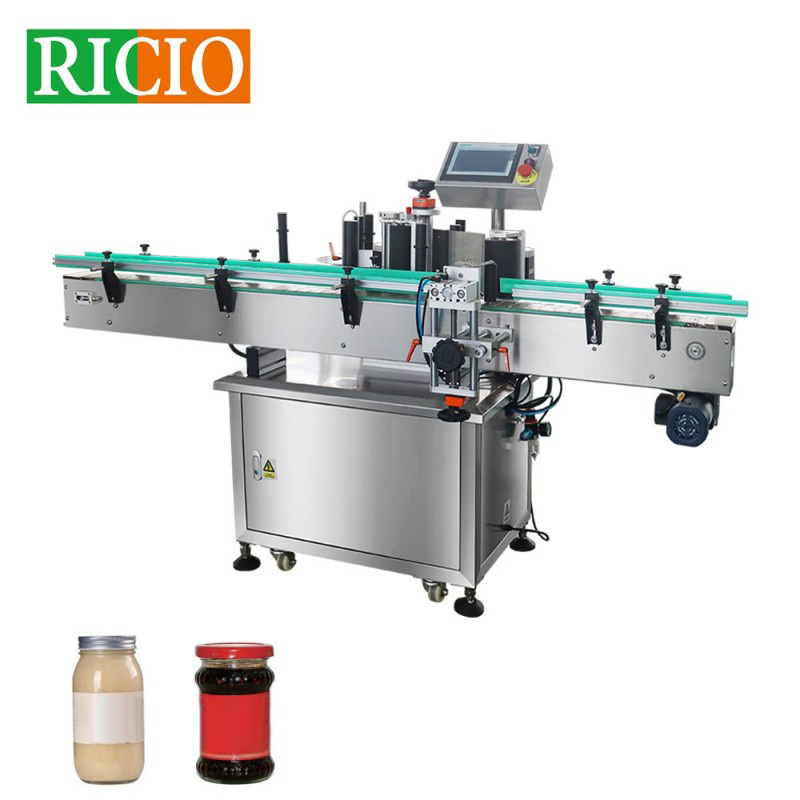
Automatic Round Bottle Positioning Labeling Machine
What Is an Automatic Round Bottle Positioning Labeling Machine?
An automatic round bottle positioning labeling machine is a packaging machine that automatically transfers cylindrical containers through a labeling station, identifies or controls their position, dispenses a pressure-sensitive label, and presses the label onto the product surface. Unlike a basic wrap-around labeler that may apply a label wherever the bottle enters the labeling area, a positioning model is designed to achieve a more controlled relationship between the bottle and the label.
This distinction is important for containers with a defined front side or a specific orientation requirement. A bottle may have a molded handle, seam, cap feature, embossed mark, printed symbol, or existing visual reference. In these cases, simply applying a label around the bottle is not enough. The container must first be stabilized and positioned before the label is released and pressed onto the surface.
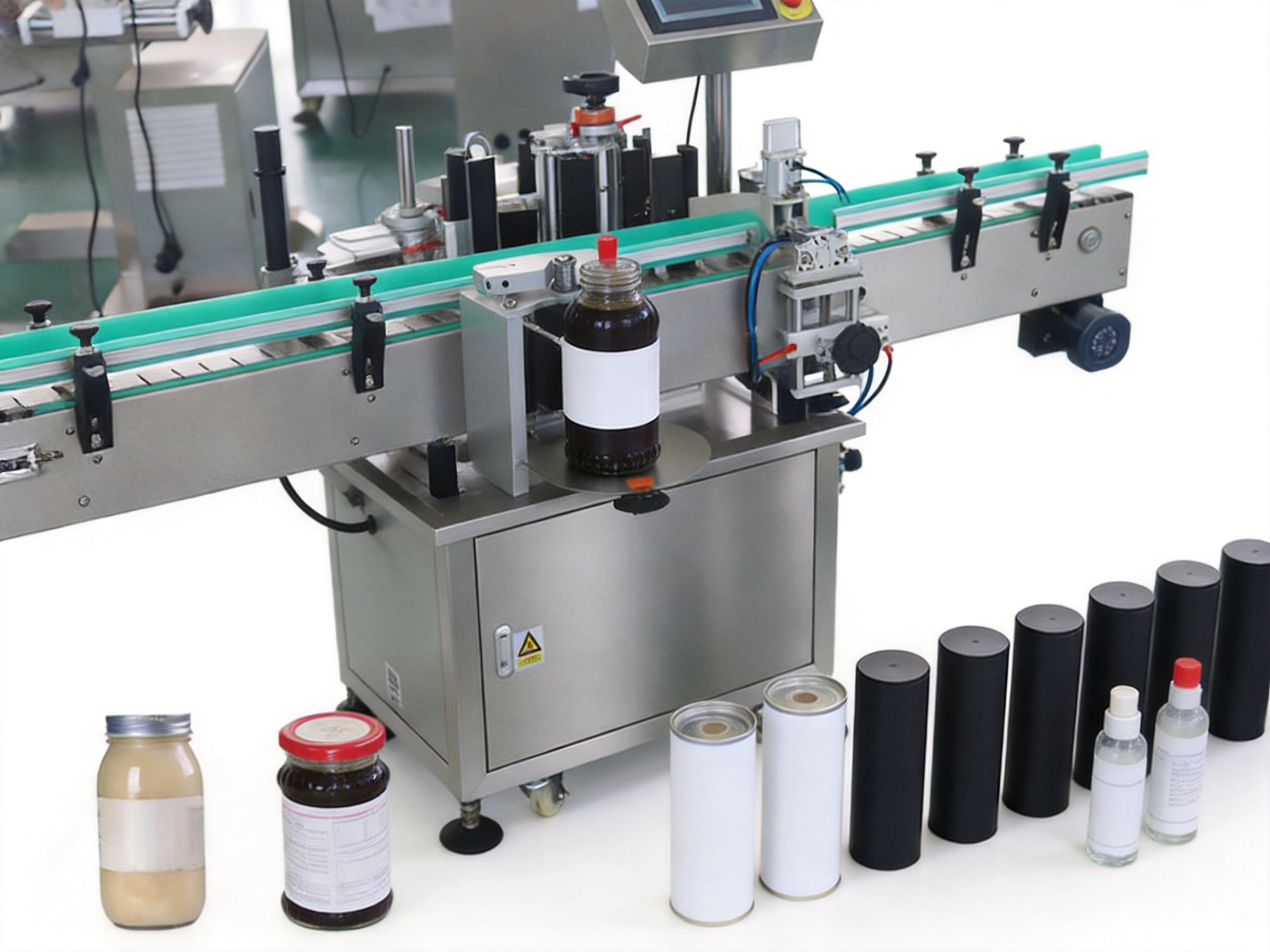
The RXL-DW is intended for round products with an outer diameter of approximately 30 to 130 mm. The height range is generally 100 to 300 mm, although the machine can be configured according to the user’s product requirements. The labeling speed is approximately 30 to 40 bottles per minute, with actual performance depending on the object, label length, bottle material, product stability, and positioning requirements.
The machine uses self-adhesive labels supplied on a roll. The standard label roll has an inner diameter of 76 mm and an outer diameter of up to 300 mm. Labels can be supplied in a range from approximately 20 to 150 mm in height and 15 to 300 mm in length, with customized specifications available for suitable applications.
Positioning Compared with Basic Round Bottle Labeling
A conventional round bottle labeling machine may be sufficient when a label can be placed at any rotational position. For example, a plain cylindrical container with no front-facing design may only need a label to be wrapped around its circumference. A positioning labeling machine provides a higher level of control when the label must align with a particular part of the bottle.
This capability can improve visual consistency across a production batch. It can also help prevent labels from covering a molded feature, barcode, cap mark, opening, or existing printed information. For brands that rely on a uniform shelf appearance, accurate positioning supports a more professional final product.
Core Operating Principle
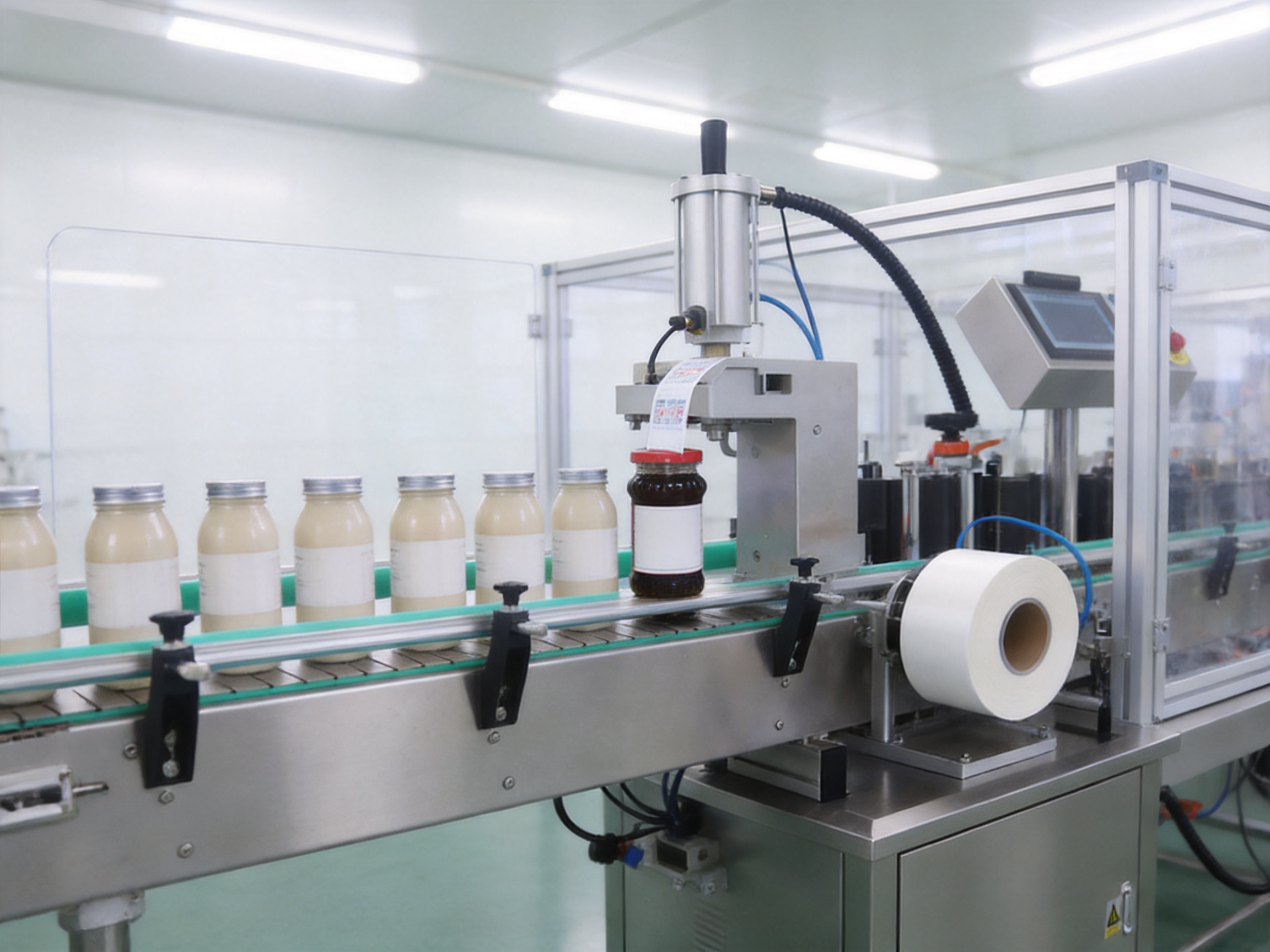
The labeling process begins when bottles are placed on the conveyor or transferred from an upstream machine. The conveyor guides the products toward the labeling area while maintaining a suitable distance between containers. A sensing and positioning system detects the product and coordinates the timing of the labeling action.
The bottle is stabilized by the product-handling mechanism. Depending on the bottle design and selected configuration, a clamping or positioning structure controls the rotational condition of the container. The label roll unwinds through the label supply path, and the label sensor detects the gap between individual labels. The label is then peeled from the backing material and delivered to the bottle at the correct moment.
As the bottle moves through the application zone, an applicator roller, pressing component, or related contact structure applies the label to the cylindrical surface. The product may rotate during the operation so that the label wraps smoothly around the bottle. The final result depends on coordinated movement between the conveyor, bottle positioning parts, label dispensing mechanism, and pressing components.
After labeling, the container continues along the conveyor to an inspection station, accumulation area, packing machine, or downstream process. The system can be incorporated into a wider packaging line, subject to the layout, product characteristics, and interface requirements of the user’s facility.
Why Timing and Position Control Matter
Label placement depends on the relationship between product movement and label release. If a label is released too early or too late, it may be positioned too high, too low, too far to one side, or at an incorrect rotational angle. Inconsistent product spacing can create similar problems. A stable conveyor and coordinated control system therefore play an important role in achieving repeatable results.
Product hardness and roundness also influence performance. A rigid, uniformly cylindrical bottle generally provides more predictable results than a soft, flexible, tapered, or irregular container. For this reason, the stated precision of ±1 mm should be understood in relation to the actual bottle, label, adhesive, and operating conditions. Proper testing and commissioning are recommended before final production approval.
Key Technical Specifications
Specification | Standard Information |
Model description | RXL-DW automatic round bottle positioning labeling machine |
Power supply | AC 220 V, 50/60 Hz, single phase |
Alternative power | 110 V or 380 V options may be considered with a suitable power supply converter device |
Power consumption | 1.0 kW |
Labeling speed | Approximately 30–40 bottles per minute, adjustable according to product and label conditions |
Labeling precision | Up to approximately ±1 mm, depending on product hardness, roundness, and other characteristics |
Air pressure | 0.4–0.6 MPa |
Machine net weight | Approximately 200 kg |
Bottle outer diameter | Approximately 30–130 mm |
Bottle height | Approximately 100–300 mm, according to user requirements |
Label height | Approximately 20–150 mm |
Label length | Approximately 15–300 mm, with customization available |
Label roll inner diameter | 76 mm |
Label roll outer diameter | Up to approximately 300 mm |
Minimum label spacing | At least 3 mm |
Minimum label thickness | At least 8 μm |
Backing paper thickness | At least 5 μm, with suitable tensile strength |
Packaging dimensions | Approximately 2000 × 1300 × 1500 mm |
Conveyor width | Can be customized or adjusted according to the end user’s products |
These specifications provide a practical starting point for application evaluation. The final machine configuration should be confirmed after reviewing product drawings, sample bottles, label samples, line speed, conveyor integration, and the required label position. Product testing is especially important when the container is flexible, tapered, unusually tall, highly polished, or fitted with a difficult-to-handle cap.
Major Advantages of the Machine
Accurate Label Positioning
The most important advantage of the RXL-DW is its focus on positioning. It is designed not only to place a label on a round bottle but also to help control where the label appears on the bottle. This is useful for products with a front-and-back layout, a visual registration point, or a strict packaging presentation requirement.
Consistent positioning reduces variation between individual products. This can be valuable in industries where labels carry important information, where barcodes must remain easy to scan, or where brand graphics must face the same direction on the retail shelf. It also reduces the need for operators to manually correct labels after application.
Wide Product Diameter Range
The standard diameter range of approximately 30 to 130 mm allows the machine to serve many cylindrical containers. It can be used for a variety of bottles, jars, cans, and similar products rather than being limited to one narrow container size. When a large diameter change is required, a replacement bottle clamping mold may be necessary. This approach allows the machine to maintain suitable product control while supporting different product formats.
A broad working range can improve equipment utilization for manufacturers that produce several product sizes. Instead of purchasing an independent labeler for every bottle diameter, a company may use one adaptable platform with product-specific change parts and adjustments.
Adjustable Operating Speed
The machine offers a typical speed of 30 to 40 bottles per minute. The adjustable operating speed allows users to balance output, label quality, product stability, and operator requirements. Not every product benefits from running at the maximum speed. A slower setting may be preferable for soft bottles, long labels, difficult adhesives, or products requiring careful positioning.
For small and medium-sized manufacturers, this speed range can provide a useful level of automation without requiring the cost, floor space, and complexity of a high-speed industrial line. It can also be suitable for production expansion when a business is moving beyond manual labeling but does not yet need a very high-output system.
Compact Footprint
Packaging floors are often constrained by existing machinery, storage areas, inspection stations, and personnel access routes. The machine’s compact design helps users integrate automatic labeling into limited production spaces. Its packaging dimensions are approximately 2000 × 1300 × 1500 mm, although the final installation area should also include space for operation, maintenance, label-roll replacement, product loading, and safe access.
A compact footprint can be especially useful for contract packers, laboratories, small factories, and production workshops that need automation without a major facility reconstruction. The equipment can be positioned as a standalone machine or evaluated as part of a wider conveyor-based packaging arrangement.
Flexible Label Specifications
The machine is designed for a range of label dimensions, including label heights of approximately 20 to 150 mm and lengths of approximately 15 to 300 mm. This flexibility supports different graphic layouts, information panels, barcode labels, promotional labels, and wrap-around formats.
The label roll can have an inner diameter of 76 mm and an outer diameter of up to approximately 300 mm. Larger rolls can help reduce the frequency of roll replacement, while suitable label spacing and backing-paper strength support stable feeding through the machine. The recommended minimum label spacing is 3 mm, with the actual label construction to be confirmed during testing.
Customizable Conveyor Width
The conveyor width can be customized or adjusted according to the end user’s products. This is an important practical feature because cylindrical containers vary in diameter, height, weight, base geometry, and surface condition. A conveyor that is correctly matched to the product improves stability and reduces unnecessary movement during the labeling cycle.
Customization may also help the equipment connect more effectively with upstream filling, capping, coding, inspection, or accumulation systems. The correct conveyor arrangement should be selected after reviewing the complete line layout rather than considering the labeling machine in isolation.
Moderate Power Consumption
With a stated power consumption of approximately 1.0 kW, the machine is designed to provide automatic labeling without the energy demand associated with much larger high-speed systems. Power consumption will vary with operating conditions and auxiliary equipment, but the standard rating provides a useful reference for facility planning and electrical installation.
Suitability for Multiple Industries
Round containers are common across many industries. In food and beverage packaging, the machine may be used for bottles, jars, sauces, beverages, condiments, and specialty products. In pharmaceutical and healthcare packaging, it may support bottles, containers, and selected cylindrical products that require controlled labeling. In cosmetics and daily chemical packaging, it can be considered for creams, liquids, personal-care products, cleaners, and other packaged goods.
Chemical packaging applications may also benefit from the machine’s ability to handle different cylindrical formats, provided that the container materials, label adhesive, environmental conditions, and safety requirements are compatible with the equipment. Every application should be evaluated individually, especially when products are corrosive, volatile, hazardous, or supplied in unusual containers.
Advantages Over Less Specialized Labeling Equipment
Compared with Manual Labeling
Manual labeling depends heavily on operator skill, attention, fatigue level, and the physical design of the container. Even experienced operators may place labels at different heights or rotational positions over a long production run. Manual application also makes it difficult to maintain consistent output when demand increases.
Automatic positioning labeling provides a repeatable process. The machine controls the product path and label release, while operators can focus on loading, inspection, material preparation, and other production tasks. Automation can reduce repetitive labor and help establish a more consistent packaging standard.
Compared with Basic Wrap-Around Labelers
A basic wrap-around labeler may apply labels effectively to standard cylindrical bottles, but it may not provide the same degree of control over the rotational position of the container. For products that require front-facing alignment, this difference can be significant.
The RXL-DW is designed for applications in which positioning matters. Its clamping and positioning arrangement can help control product orientation before or during label application. This makes it more appropriate for products with a defined presentation side, provided that the bottle geometry and positioning reference are suitable.
Compared with Oversized High-Speed Systems
High-speed labeling machines may be appropriate for large-scale production, but they can require greater investment, more floor space, more complex integration, and higher production volumes to justify their cost. A small or medium-sized manufacturer may not need such capacity.
The RXL-DW offers a more balanced solution for businesses that need automatic performance, controlled label positioning, and product flexibility at a moderate production speed. Its compact format and adjustable operation can help users automate a key packaging stage without immediately adopting a highly complex system.
Compared with Single-Format Equipment
Machines designed around one bottle size can be efficient for dedicated production but may be less useful when a manufacturer produces several formats. A machine with an approximately 30 to 130 mm diameter range and adjustable conveyor configuration offers greater potential for product diversification.
Although change parts and setup adjustments may be required for different products, a flexible labeling platform can reduce the need for separate equipment. This may support better use of production space and improve the long-term value of the machine.
Manufacturing Strengths of Shanghai Ruixiao Packaging Technology Co., Ltd.
The performance of a labeling machine depends not only on its control program but also on the quality of its mechanical construction. Product handling, label feeding, positioning, and pressing require components that are manufactured and assembled accurately. Shanghai Ruixiao Packaging Technology Co., Ltd. has developed its production capabilities from equipment assembly toward in-house precision machining and complete machine manufacturing.
The company was built on the acquisition of Shanghai Zhenbao Machinery Parts Factory. This background provided a foundation in mechanical component production and helped support the development of an integrated manufacturing process. Rather than relying exclusively on external parts and final assembly, the company operates with internal machining capabilities for important components.
In-House Precision Machining
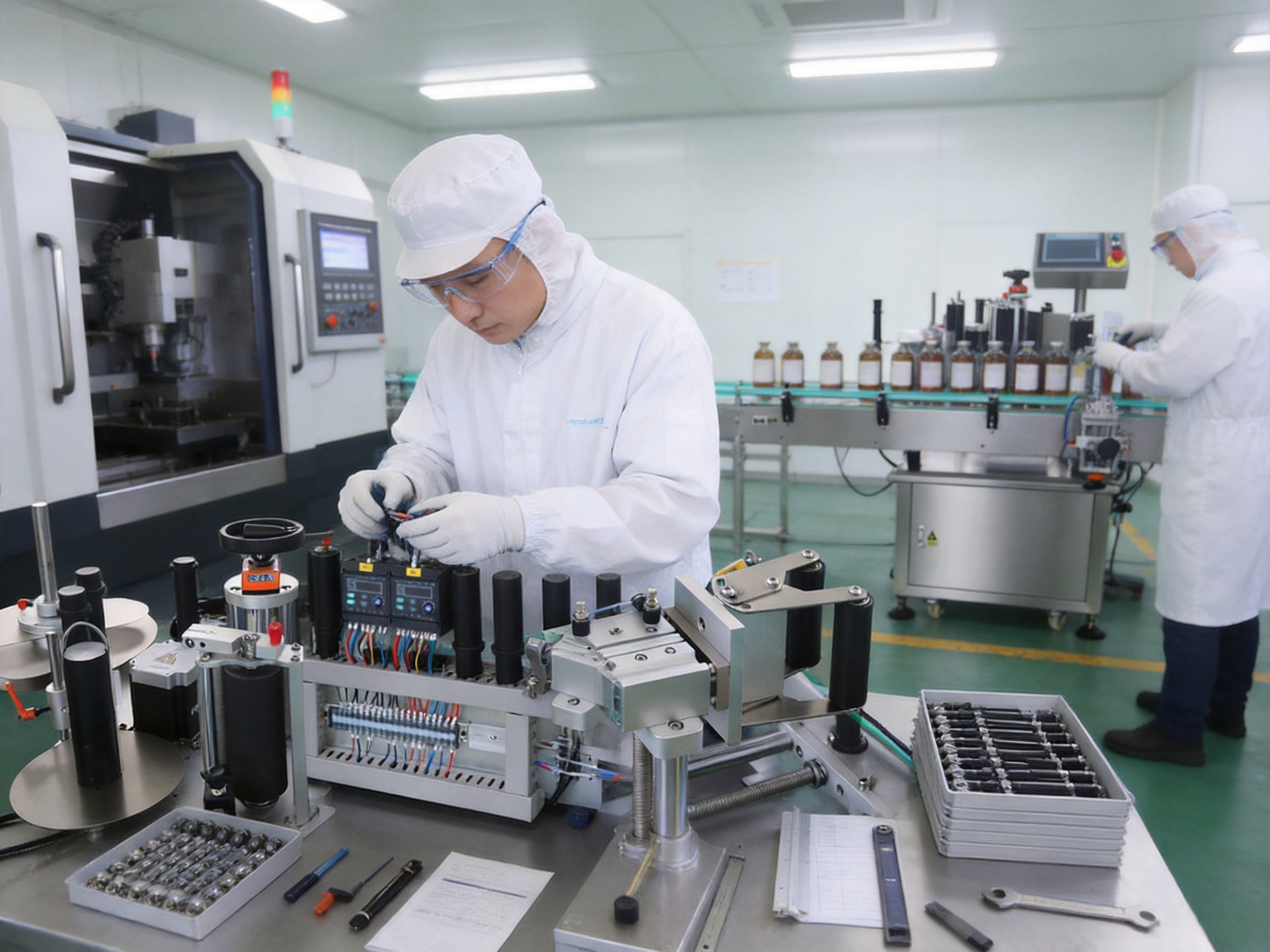
The company operates multiple CNC machining centers. Computer numerical control machining can support repeatable production of mechanical components with controlled dimensions and consistent geometry. In a labeling machine, accurate component production is important for conveyor alignment, roller installation, product guides, clamping systems, brackets, shafts, and other parts that influence movement and positioning.
In-house machining can also improve communication between design, production, and service teams. When a component requires modification for a specific bottle or label application, engineering and manufacturing personnel can work more directly on the required adjustment. This can be an advantage over a supply chain in which every custom change must pass through several external vendors.
Control from Components to Complete Equipment
Shanghai Ruixiao Packaging Technology Co., Ltd. manages a process that includes core component machining, machine assembly, and commissioning. This type of vertical coordination can help connect mechanical design with final machine performance. It allows the production team to examine how individual components behave as part of the complete labeling system rather than evaluating them only as separate parts.
Assembly quality is particularly important in labeling machinery. A small alignment error in a guide rail, roller, sensor bracket, or label path can affect product stability and label placement. A controlled assembly process helps reduce such risks and supports more reliable commissioning before shipment.
ISO 9001 Quality System
The company manages production and related processes in accordance with the ISO 9001 international quality system. A quality management system provides a framework for documenting procedures, controlling production activities, reviewing requirements, and improving consistency. Certification or compliance with a quality system does not replace application testing, but it demonstrates an organized approach to manufacturing and quality control.
For international buyers, a structured quality system can be an important consideration. It indicates that the manufacturer is working toward repeatable processes rather than treating each machine as an entirely informal or unrecorded project. This is valuable when equipment must be reproduced, modified, serviced, or integrated into multiple production locations.
Technical Team and Commissioning Experience
Labeling performance is influenced by mechanical design, electrical control, pneumatic operation, sensor positioning, label material, bottle geometry, and operator settings. A technically experienced team is therefore needed to commission the complete machine rather than simply assemble its components.
Commissioning may include product trials, label path adjustment, sensor setup, conveyor alignment, clamping adjustment, speed testing, and verification of label placement. These steps help determine whether the selected configuration is suitable for the customer’s actual bottle and label combination. A manufacturer with experience across different industries can draw on a broader range of application knowledge when addressing new projects.
Application Areas
Food and Beverage Packaging
Food and beverage companies commonly use cylindrical bottles, jars, cans, and containers. Labels may carry product names, nutrition information, ingredients, production codes, barcodes, brand graphics, and regulatory information. A clean and consistently positioned label can improve shelf presentation and support downstream scanning or inspection.
For food products, the selected label material and adhesive should be suitable for the storage environment. Condensation, refrigeration, moisture, oil, and temperature changes can influence adhesion. The machine can apply the label, but the complete packaging result also depends on correct material selection and surface preparation.
Pharmaceutical and Healthcare Products
Pharmaceutical and healthcare containers often require clear, controlled, and repeatable labeling. A bottle may need a label placed at a defined height so that dosage information, product identification, lot information, or barcode data remains visible. Positioning can also support visual inspection and improve the consistency of a regulated packaging process.
Applications in this sector require careful attention to validation, cleaning, traceability, and applicable regulatory procedures. The suitability of the machine should be reviewed against the user’s production environment and quality requirements. Product trials should confirm that labels remain legible, securely attached, and correctly positioned throughout the intended storage and handling process.
Cosmetics and Daily Chemical Products
Cosmetic bottles and daily chemical containers frequently rely on attractive label presentation. Products may include skin-care bottles, shampoo containers, lotions, cleaners, and personal-care products. Because these packages are often displayed directly to consumers, uneven or twisted labels can negatively affect perceived quality.
The RXL-DW can be considered for cylindrical products in this category when the bottle shape, label material, and production speed are compatible. Position control is useful for packaging with a front logo, decorative graphic, or carefully designed label layout.
Chemical Packaging
Chemical products may be packaged in small or medium-sized cylindrical containers that require product identification, hazard information, handling instructions, and batch details. A stable labeling process can help maintain clear presentation across a production lot.
Before selecting the machine for chemical applications, the user should evaluate the product’s physical and chemical properties, container material, label adhesive, ventilation, operator safety, and applicable regulations. The standard machine should not be assumed suitable for every hazardous environment without a complete technical and safety review.
Label and Container Compatibility
Successful labeling requires compatibility among the bottle, label, adhesive, backing paper, and machine settings. The stated label thickness is at least 8 μm, while the backing paper is specified at a minimum of 5 μm with suitable tensile strength. These values provide general equipment references, but the actual label construction should be tested on the machine.
Very thin labels may be more sensitive to stretching, wrinkling, static electricity, and peeling behavior. Very rigid labels may require different pressing conditions. The adhesive must be suitable for the bottle surface, which may be glass, PET, HDPE, metal, or another material. Surface treatments, dust, moisture, oil, and condensation can all affect the final bond.
Bottle roundness is equally important. A truly cylindrical product allows the label to travel smoothly around the surface. Tapered bottles, oval containers, recessed areas, shoulder transitions, ribs, seams, and irregular bases may require special handling or a different labeling method. The product height and diameter should be measured at the actual labeling zone rather than relying only on nominal container dimensions.
Recommended Pre-Order Information
Before finalizing a machine configuration, the buyer should provide bottle samples or accurate drawings, label samples, label-roll dimensions, the desired label position, production speed, and any special orientation requirements. Photographs alone may not be sufficient for products with complex geometry.
It is also useful to provide information about the upstream and downstream equipment. The labeling machine may need to receive products from a filler or capper and discharge them to a coding machine, inspection system, cartoner, or packing line. Understanding these interfaces helps the manufacturer determine conveyor height, product spacing, transfer direction, and control signals.
Installation and Production Considerations
Electrical and Pneumatic Requirements
The standard electrical supply is AC 220 V, 50/60 Hz, single phase. Alternative electrical arrangements such as 110 V or 380 V may be considered when a suitable power supply converter device is used. The customer should confirm local electrical standards before ordering so that the machine can be prepared correctly.
The required air pressure is approximately 0.4 to 0.6 MPa. The compressed-air source should be clean, dry, and sufficiently stable for the machine’s pneumatic components. If the factory air supply fluctuates significantly or contains moisture and contaminants, suitable filtration and regulation should be installed.
Space and Operator Access
The packaging size is approximately 2000 × 1300 × 1500 mm. The actual installation plan should include additional clearance around the equipment. Operators need access to the label roll, adjustment points, control interface, product guides, and cleaning areas. Space may also be required for spare label rolls and rejected products.
The floor should be level and strong enough to support the machine and any connected conveyors. The line layout should allow safe movement of personnel and should avoid creating unnecessary obstacles near loading and discharge points.
Changeover and Adjustment
When changing from one bottle format to another, operators may need to adjust guides, conveyor width, clamping components, sensor positions, label height, and pressing elements. Large diameter changes may require replacement of the bottle clamping mold. The exact changeover procedure depends on the final configuration and the products involved.
Clear adjustment scales, documented settings, and sample products can help shorten changeover time. For manufacturers with frequent product changes, it is useful to record successful settings for each bottle and label format. This creates a repeatable setup reference for different production orders.
Operator Training
Operators should understand the label path, emergency procedures, product adjustments, roll replacement, sensor functions, pneumatic requirements, and basic fault diagnosis. Training should also cover how to identify common defects such as wrinkles, skewed labels, incomplete wrapping, poor adhesion, double labeling, missing labels, and incorrect positioning.
Good training helps prevent avoidable production problems. Many labeling defects are caused by incorrect label loading, unsuitable product spacing, contaminated bottle surfaces, incorrect sensor settings, or excessive speed rather than by a fundamental machine failure.
Quality Control and Performance Verification
Performance verification should be based on the customer’s actual product rather than only on general machine specifications. A suitable trial may include several bottle materials, label batches, operating speeds, and environmental conditions. The evaluation should examine both the appearance of the label and the consistency of its position.
Important quality checks may include label height, rotational angle, wrap overlap, edge alignment, adhesion, wrinkle formation, barcode readability, and the presence or absence of missing labels. The product should also be observed after handling and storage to confirm that the adhesive remains effective.
The stated precision of approximately ±1 mm is dependent on product characteristics, hardness, and roundness. It should therefore be treated as an application reference rather than an unconditional result for every container. Flexible bottles may deform under clamping pressure, while uneven bottles may rotate inconsistently. A production acceptance standard should be agreed after testing.
Common Labeling Problems and Their Causes
Labels that wrinkle may be caused by an unsuitable label material, excessive speed, uneven bottle surfaces, poor roller pressure, or an incorrect label path. Labels that shift vertically may indicate a guide adjustment problem, unstable product movement, or inconsistent bottle height.
A label that is applied at the wrong rotational position may result from inaccurate product orientation, an unsuitable positioning reference, sensor timing, or excessive movement during transfer. Inconsistent spacing between bottles can also affect application timing.
Labels that lift at the edges may be caused by dust, oil, moisture, low surface energy, unsuitable adhesive, or insufficient pressing. These issues should be assessed systematically rather than corrected only by increasing machine speed or pressure.
Maintenance and Long-Term Reliability
Regular maintenance supports stable labeling performance and extends the useful life of the machine. Operators should inspect the label path, rollers, sensors, product guides, clamping components, conveyor surface, pneumatic connections, and electrical cables. Label scraps and adhesive residue should be removed before they accumulate.
The label roll should be installed correctly and kept aligned with the machine’s supply path. Damaged or deformed rolls can cause feeding problems. Sensors should be kept clean and protected from excessive dust, adhesive contamination, or misalignment.
Mechanical fasteners, bearings, belts, and moving components should be inspected according to the maintenance schedule. Pneumatic regulators and filters should be checked to ensure that air pressure remains within the required range. Any abnormal noise, vibration, product movement, or change in label accuracy should be investigated promptly.
Preventive Maintenance Benefits
Preventive maintenance is generally more effective than waiting for a breakdown during production. Scheduled inspection can identify worn rollers, loose guides, damaged cables, air leaks, or sensor problems before they cause a large quantity of rejected product.
Maintenance records can also help identify recurring problems. If a certain bottle format repeatedly requires adjustment, the production team may need a dedicated change part, a revised setting, a different label specification, or an improvement to the product-handling arrangement.
Why Manufacturer Capability Matters
A labeling machine is a combination of mechanical, electrical, pneumatic, and software-related functions. A supplier that only resells standard equipment may have limited ability to modify the machine for unusual bottles or label requirements. A manufacturer with design and machining capabilities can often provide a more direct path from application review to equipment adaptation.
Shanghai Ruixiao Packaging Technology Co., Ltd. combines research and development with manufacturing, assembly, and commissioning. Its source-manufacturer background supports direct attention to the machine’s mechanical structure and product handling components. Multiple CNC machining centers provide a basis for producing precision parts, while the technical team contributes application experience from different packaging industries.
The company supplies labeling solutions for syringes, round bottles, square bottles, double-sided applications, high-speed labeling, and real-time print-and-apply systems. This broader product experience can be useful when a customer’s application eventually expands beyond one type of cylindrical bottle labeler.
The company exports equipment to more than 40 countries and regions. International experience can support communication about electrical standards, shipping preparation, documentation, remote assistance, and different production environments. However, the machine should still be specified according to the individual application, because export experience does not eliminate the need for product testing and local installation planning.
Frequently Asked Questions
What products can the machine label?
The machine is designed primarily for round bottles, jars, cans, and other cylindrical containers. Typical applications may include food, beverage, pharmaceutical, healthcare, cosmetic, daily chemical, and chemical packaging products. Final suitability depends on the bottle material, shape, size, surface, label, and required production speed.
What is the standard bottle diameter range?
The standard bottle outer diameter range is approximately 30 to 130 mm. When a large diameter change is required, replacement of the bottle clamping mold may be necessary. The final usable range should be confirmed using actual product samples.
What bottle height can the machine handle?
The general bottle height range is approximately 100 to 300 mm. This range may be adjusted according to the user’s product and the final machine configuration.
How fast does the machine operate?
The typical labeling speed is approximately 30 to 40 bottles per minute. The actual output depends on bottle size, label length, product stability, label material, positioning accuracy, operator loading, and the requirements of connected equipment.
What labeling precision can be expected?
The stated precision is approximately ±1 mm under suitable product conditions. Actual results depend on product hardness, roundness, surface characteristics, label construction, and machine adjustment. Application testing is recommended to establish the final acceptance standard.
Can the machine label bottles of different sizes?
Yes, the machine can support different cylindrical product formats within its working range. Adjustments to the guides, conveyor, sensors, clamping components, and label settings may be required. Large diameter changes may require a replacement clamping mold.
Can the conveyor width be customized?
Yes. The conveyor can be customized or adjusted according to the end user’s products. The required width and transfer arrangement should be confirmed during technical evaluation and line planning.
What label roll dimensions are supported?
The standard label roll inner diameter is approximately 76 mm, and the outer diameter is approximately 300 mm. The label height range is approximately 20 to 150 mm, while label length is approximately 15 to 300 mm. Custom specifications may be considered after testing.
What type of air supply is required?
The machine requires air pressure of approximately 0.4 to 0.6 MPa. The compressed air should be clean, dry, and stable, with suitable filtration and regulation where necessary.
Is the machine suitable for manual loading?
The machine can be used in a production arrangement where an operator loads products onto the conveyor, subject to the final configuration. It can also be evaluated for connection with upstream equipment. The preferred arrangement depends on production volume, available space, and the desired level of automation.
Can the machine be integrated into a complete packaging line?
Yes, it can be considered for integration with filling, capping, coding, inspection, accumulation, packing, or other conveyor-based equipment. Interface details such as conveyor height, product spacing, transfer direction, and control signals should be confirmed in advance.
Why is product testing important?
Product testing verifies whether the bottle, label, adhesive, clamping method, sensor arrangement, and speed are compatible. It also helps determine the correct machine adjustments and confirms the achievable positioning accuracy for the customer’s specific product.
What industries commonly use this type of equipment?
Common industries include food and beverage, pharmaceuticals, healthcare, cosmetics, daily chemicals, and chemical packaging. The actual application must be reviewed for product safety, label adhesion, container geometry, and regulatory requirements.
How should the machine be maintained?
Maintenance should include cleaning the label path and sensors, checking rollers and guides, inspecting pneumatic connections, verifying conveyor alignment, removing adhesive residue, and reviewing moving components. A preventive maintenance schedule should be established according to operating hours and production conditions.
What information should be supplied when requesting a quotation?
The buyer should provide bottle samples or drawings, bottle material, diameter, height, label samples, label-roll dimensions, desired label location, required speed, power supply, air supply, production layout, and any special orientation or inspection requirements. This information allows the machine to be configured more accurately.
Conclusion
The automatic round bottle positioning labeling machine is a practical solution for manufacturers that need reliable labeling of cylindrical containers with improved control over label placement. Its key strengths include a positioning-focused design, adjustable speed of approximately 30 to 40 bottles per minute, a broad bottle diameter range, flexible label dimensions, customizable conveyor width, compact installation requirements, and a rated precision of approximately ±1 mm under suitable conditions.
Compared with manual labeling and less specialized wrap-around equipment, the machine can provide more consistent placement and a more professional appearance. Compared with oversized high-speed systems, it offers a balanced option for small and medium-sized production lines that need automation without excessive complexity. Its adaptability also makes it suitable for businesses producing several round bottle formats.
The machine’s value is supported by the manufacturing capabilities of Shanghai Ruixiao Packaging Technology Co., Ltd. The company combines research and development, CNC machining, mechanical assembly, commissioning, technical support, and quality-system management. Its source-manufacturer approach allows greater attention to precision components and application-specific adjustments.
As with any labeling system, the best results depend on correct product evaluation, suitable label materials, stable compressed air, accurate setup, operator training, and preventive maintenance. When these factors are properly managed, the RXL-DW can help manufacturers improve labeling consistency, reduce repetitive manual work, strengthen packaging presentation, and build a more efficient cylindrical product packaging process.
References
1. International Organization for Standardization. ISO 9001 Quality Management Systems—Requirements.
2. Packaging Machinery Manufacturers Institute. Principles of Automated Packaging Equipment Selection and Integration.
3. Automatic Identification and Data Capture Industry Guidance. Considerations for Barcode Positioning, Print Quality, and Package Presentation.
4. Pressure-Sensitive Tape Council. General Principles of Pressure-Sensitive Label Adhesion and Application.
5. Technical product specifications supplied for the RXL-DW automatic round bottle positioning labeling machine.
6. Manufacturer information concerning precision machining, machine assembly, commissioning, quality management, and packaging automation applications.
Product: Automatic Round Bottle Positioning Labeling Machine

related products
-
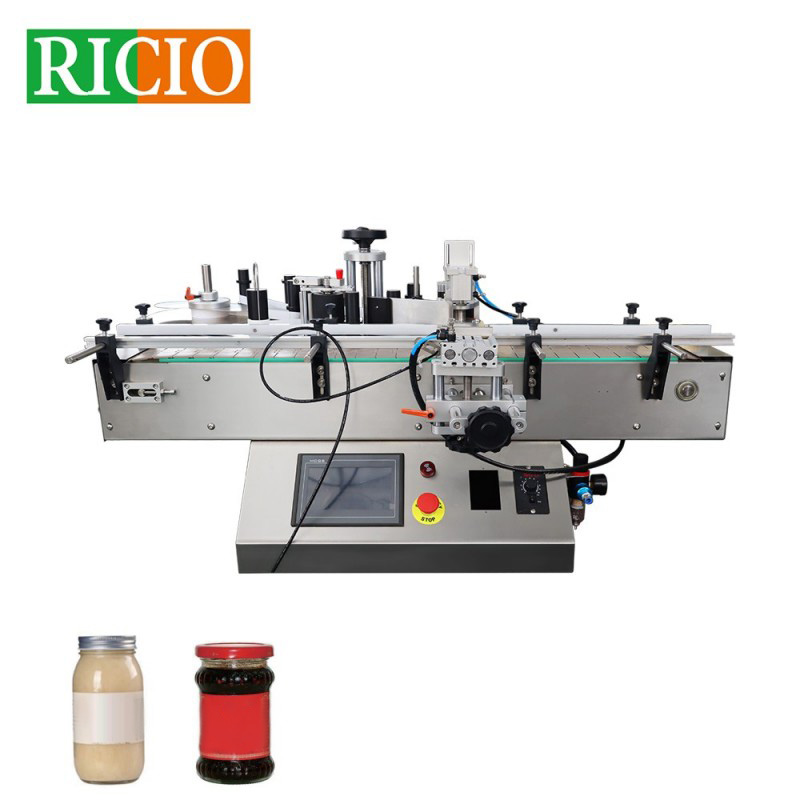
Automatic Round Bottle Positioning Tabletop Labeling Machine
-
Automatic Round Bottle Positioning Labeling Machine
-
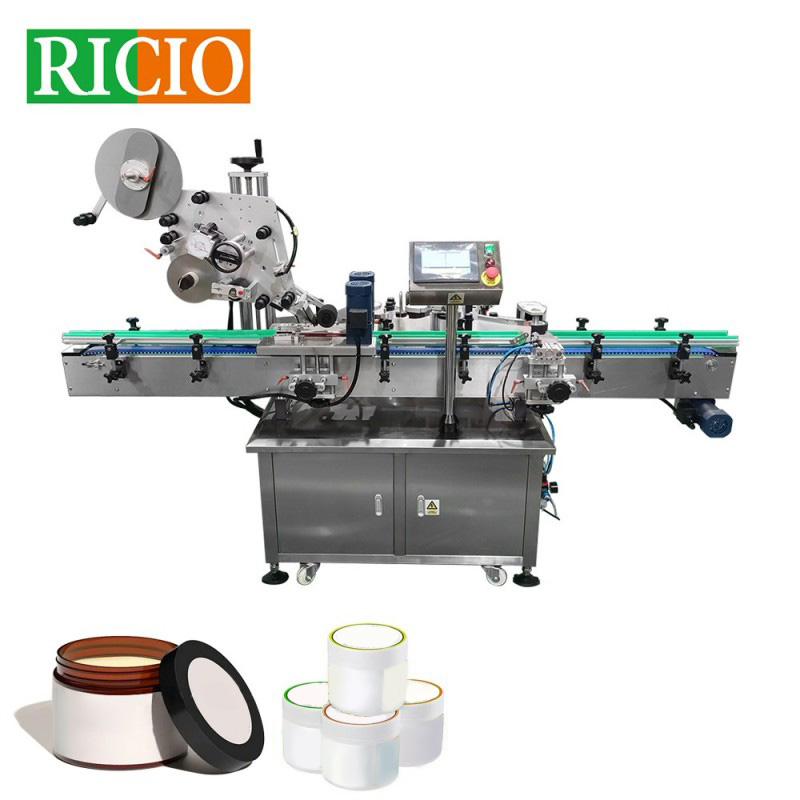
Automatic Round Bottle Side and Top Labeling Machine
-
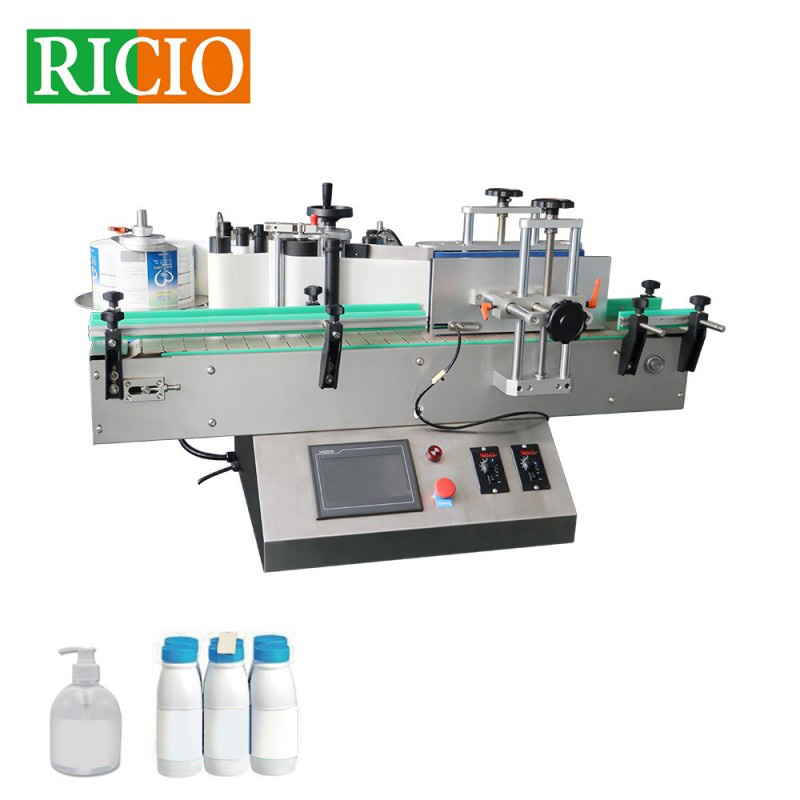
Automatic Round Bottle Tabletop Labeling Machine
-
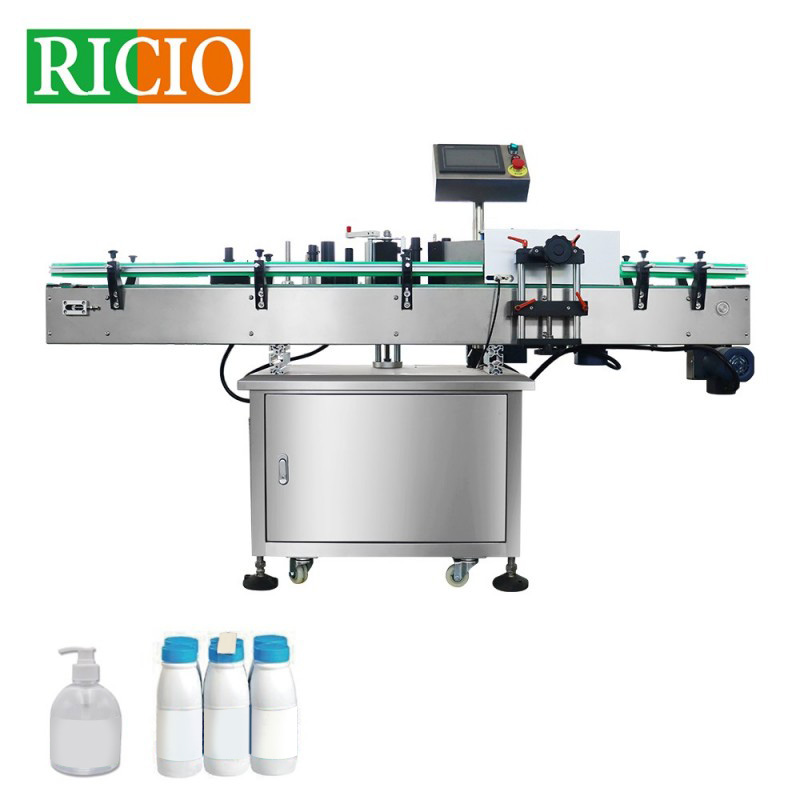
Automatic Round Bottle Labeling Machine
-
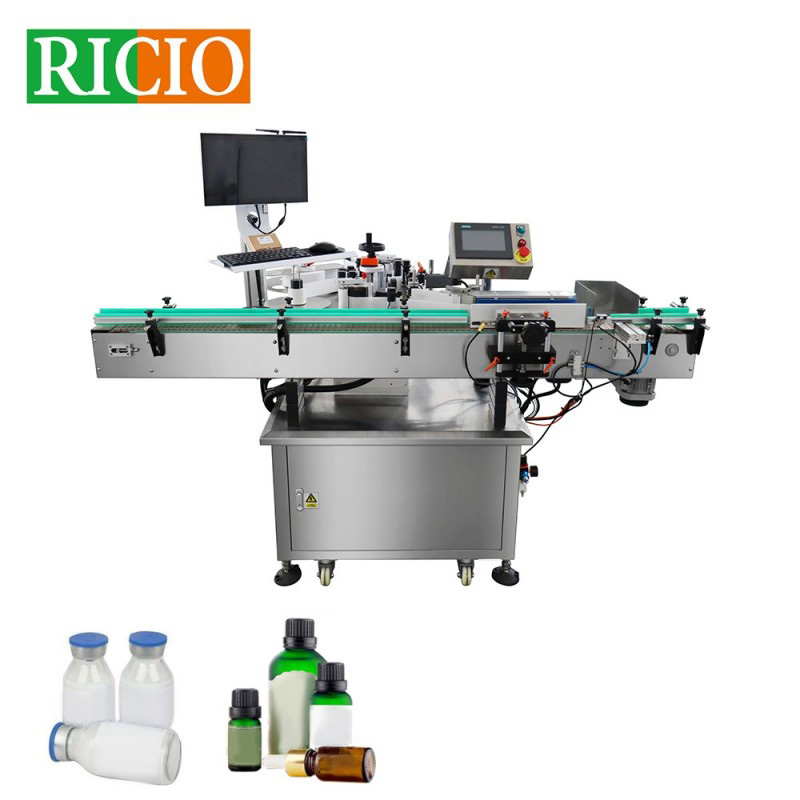
Automatic High Speed Vertical Round Bottle Labeling Machine
related News
 +86 13681850339
 sales@raxpack.com
 Building 6, No. 477 Tiefeng Road, Baoshan District, Shanghai, China
- Tabletop Labeling Machine
- Round Bottle Labeling Machine
- Automatic Tube Labeling Machine
- Pouch Labeling Machine
- Rotary Labeling Machine
- Syringe Labeling Machine
- Top Labeling Machine
- Single Side Sticker Labeling Machine
- Double Side Labeling Machine
- Bucket Labeling Machine
- Bottom Labeling Machine
- Corner Label Applicator
- Waist Sealing Labeling Machine
- Square Bottle Labeling Machine
