 English
 русский
 Español
 عربى



Automatic Conical Pail Labeling Machine: Precision, Flexibility, and Production Efficiency for Industrial Pail Packaging
2026-11-15
Content
- 1 Why Pail Labeling Requires Specialized Equipment
- 2 Integrated Automatic Labeling Process
- 3 Key Advantages Over Manual and General-Purpose Labeling Methods
- 4 Application Range and Product Compatibility
- 5 Performance and Technical Specifications
- 6 Intelligent Control and Operator Convenience
- 7 Mechanical Design for Durability and Maintenance
- 8 Manufacturing Strengths and Engineering Capabilities
- 9 Optional Functions for Expanded Production Lines
- 10 Quality, Safety, and Production Management Benefits
- 11 Installation and Application Recommendations
- 12 How to Select the Correct Configuration
- 13 Frequently Asked Questions
- 13.1 What types of products can this machine label?
- 13.2 Can it label tapered pails?
- 13.3 How does the machine manage the pail handle?
- 13.4 Can the machine apply more than one label?
- 13.5 What is the approximate labeling speed?
- 13.6 What is the expected labeling accuracy?
- 13.7 What are the standard product dimensions?
- 13.8 What label sizes can be used?
- 13.9 Does the machine prevent labeling when no pail is present?
- 13.10 Can the machine print batch or date information?
- 13.11 Is the machine suitable for chemical packaging?
- 13.12 Can the machine be integrated into an existing production line?
- 13.13 Why should customers provide product samples?
- 13.14 What should be checked during routine maintenance?
- 14 Conclusion
- 15 References
- 16 Product: Automatic Conical Pail Labeling Machine
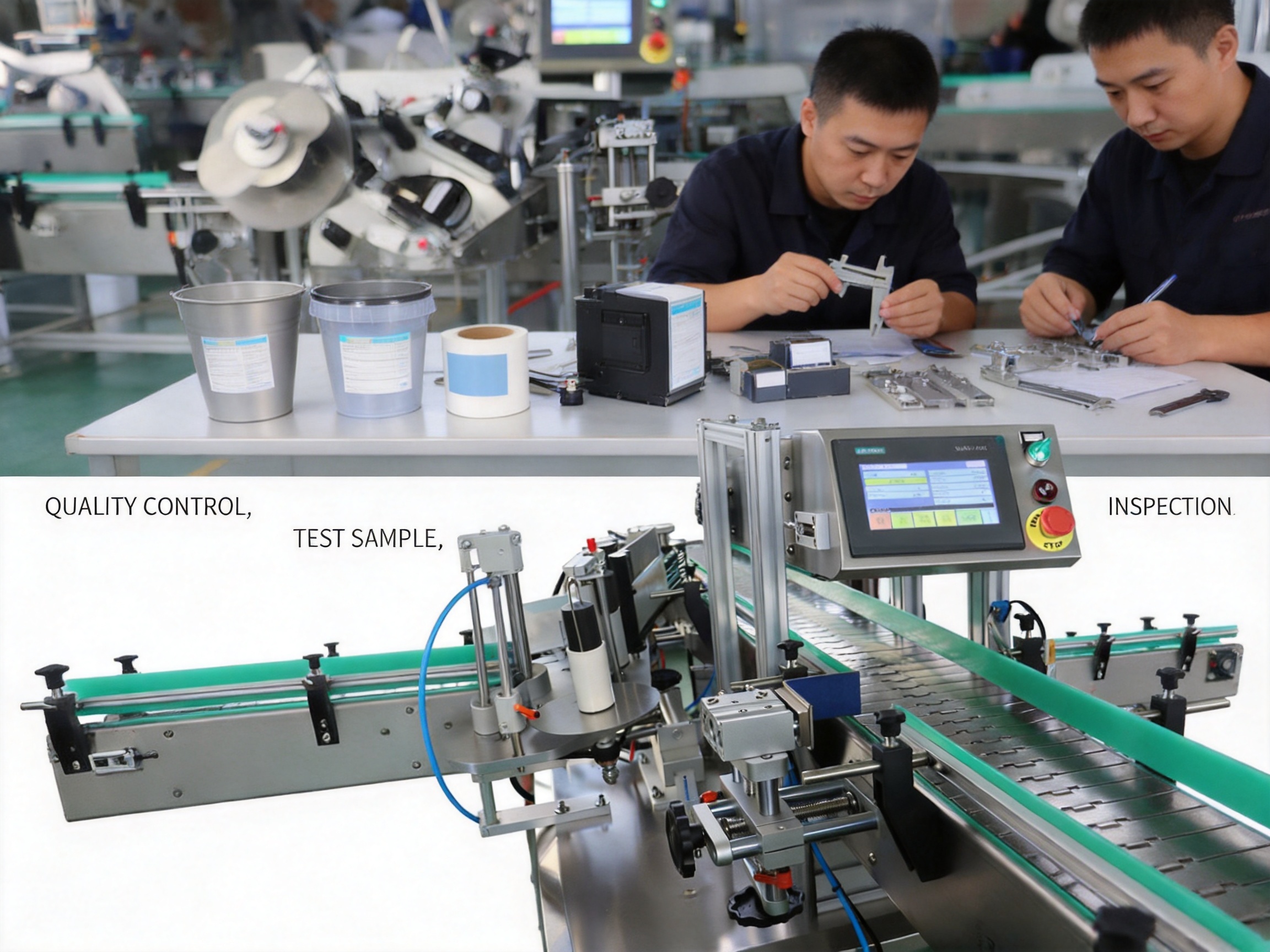
Automatic labeling is an essential part of modern pail and drum packaging. Paint, coatings, lubricants, chemicals, food ingredients, adhesives, pharmaceutical materials, and daily chemical products are frequently packaged in round or conical containers that require clear, accurately positioned, and firmly attached labels. Although pail labeling may appear simple, it involves several technical challenges that are not present when labeling flat cartons or regular cylindrical bottles.
A pail can have a tapered body, a curved surface, a movable handle, a pressed lid, and a label position that must align with a front panel, edge, seam, or designated orientation. The container may also vary in diameter, height, material hardness, and surface condition. These factors can cause label skewing, wrinkles, edge lifting, bubbles, inconsistent positioning, or missed applications when labeling is performed manually or with equipment designed for standard bottles.
The automatic conical pail labeling machine is developed specifically for these demanding applications. It combines conveying, handle lifting, product detection, rotary positioning, label dispensing, and label pressing in one continuous system. The machine is designed for round pails, tapered pails, small and medium-sized drums, and other handled containers that require stable positioning and repeatable label application.
With adjustable mechanisms, intelligent photoelectric detection, rotary product control, and a touch-screen operating interface, the machine provides a practical solution for manufacturers seeking to improve labeling speed and consistency. Its structure is also designed for different production environments, including chemical, food, pharmaceutical, coating, lubricant, and daily chemical packaging lines.
Why Pail Labeling Requires Specialized Equipment
Pails are often more difficult to label than conventional bottles because their geometry and accessories interfere with the labeling process. A conical pail may have a larger diameter at the top than at the bottom, causing the label surface to change continuously as the product rotates. If the labeling head is not correctly positioned, the label may not make uniform contact with the container.
The handle presents another important challenge. Handles can rest against the side of the pail, swing into the label area, or block the label from reaching the intended position. A conventional labeling machine may not have enough clearance or control to manage the handle. As a result, manual intervention may be required, reducing line efficiency and increasing the possibility of inconsistent labeling.
Many industrial pails also require a specific label orientation. The label may need to face the front of the packaging line, align with the lid opening, avoid the handle, or match a previously printed mark. A simple wrap-around labeling process cannot guarantee this positioning unless the product is first detected and rotated to a known reference point.
Surface conditions can also vary. Some pails are made from plastic, while others are produced from metal or composite materials. Some surfaces are smooth and rigid, while others are slightly flexible or textured. The label adhesive, product diameter, label length, and application pressure must work together to create a stable result.
For these reasons, a dedicated conical pail labeling machine can provide advantages over general-purpose bottle labelers or manually operated stations. Its mechanisms are selected according to the shape, size, handle arrangement, and label location of pail products.
Integrated Automatic Labeling Process
The machine is designed as a continuous automatic system rather than a collection of independent manual operations. Products can be transferred from an upstream filling, lid pressing, or inspection station, or operators can place pails onto the conveyor manually. Once the pail enters the machine, each step is coordinated through sensors, drive systems, and control logic.
Product Infeed and Conveying
The conveyor guides each pail into the working area and helps maintain a stable position during the labeling cycle. Conveyor parameters can be adjusted according to the product size, label size, and required production speed. This controlled transfer reduces the need for operators to align each pail individually.
The infeed section can be connected with other packaging equipment when required. Depending on the production line, the labeling machine may receive pails from a filling machine, lid pressing machine, capping station, weighing system, inspection unit, or accumulation conveyor. It can also operate as a stand-alone machine for smaller production environments.
Handle Lifting and Support
Before labeling, the pail passes through a handle-lifting mechanism. This mechanism raises or supports the handle so that it does not interfere with the label application area. Managing the handle at the beginning of the process is important because it prevents contact between the handle and the label head, reduces product movement, and creates a more predictable labeling surface.
The handle support arrangement can be adjusted for different pail structures and handle positions. This flexibility is valuable for manufacturers who package multiple product sizes or use pails with different handle designs. Rather than requiring a separate manual operation, handle management becomes part of the automatic cycle.
Product Detection
Photoelectric sensors detect the arrival of each pail and send a signal to the control system. The no-product-no-label function prevents the machine from dispensing a label when a container is absent. This feature reduces label waste and helps prevent adhesive labels from being released onto the conveyor or machine components.
Detection signals can also coordinate the movement of the rotary positioning system, labeling head, and pressing mechanism. When combined with adjustable timing parameters, the sensors help the operator adapt the machine to different pail dimensions and line speeds.
Rotary Positioning
After detection, the rotary platform lifts and supports the pail while the drum rotating mechanism holds and rotates the container. This process gives the machine control over the pail’s orientation and allows the label to be placed at a defined position.
A positioning sensor identifies the preset labeling point. Depending on the product and label design, the machine can apply a label to a front area, rear area, edge, body surface, or a fixed circumferential location. This is a major advantage over equipment that simply applies labels as products pass in a straight line without orientation control.
Label Dispensing and Application
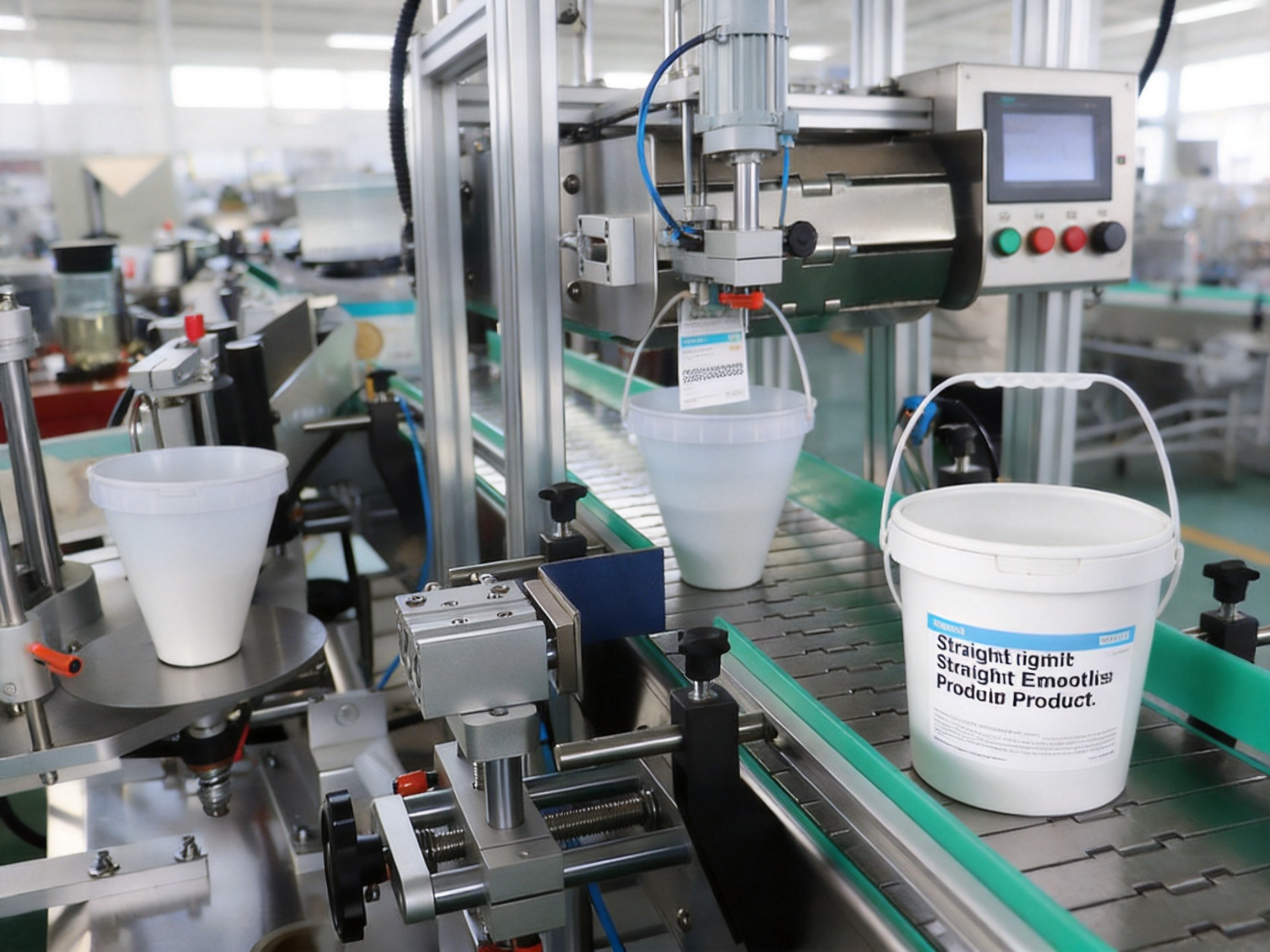
Once the correct position is identified, the labeling unit dispenses the label and applies it to the pail. The label head can be adjusted in multiple directions, including forward and backward, left and right, up and down, and angular orientation. These adjustments allow the machine to accommodate different label heights, label lengths, pail diameters, and tapered surfaces.
The controlled dispensing process helps ensure that the label begins at the intended location. It also supports applications involving one label, two labels, front-and-back labels, or labels that must maintain a fixed circumferential relationship to the pail handle or lid.
Label Pressing and Smoothing
After the label is placed, the pressing mechanism smooths the label against the pail surface. Pressing is especially important for tapered or curved containers because the label must conform to the changing surface profile. Proper pressure helps reduce wrinkles, air bubbles, edge lifting, and incomplete adhesion.
The pressing process also improves the visual quality of the finished package. A smooth label with a consistent position gives the pail a more professional appearance and helps ensure that required product information, warning symbols, barcodes, and brand graphics remain easy to read.
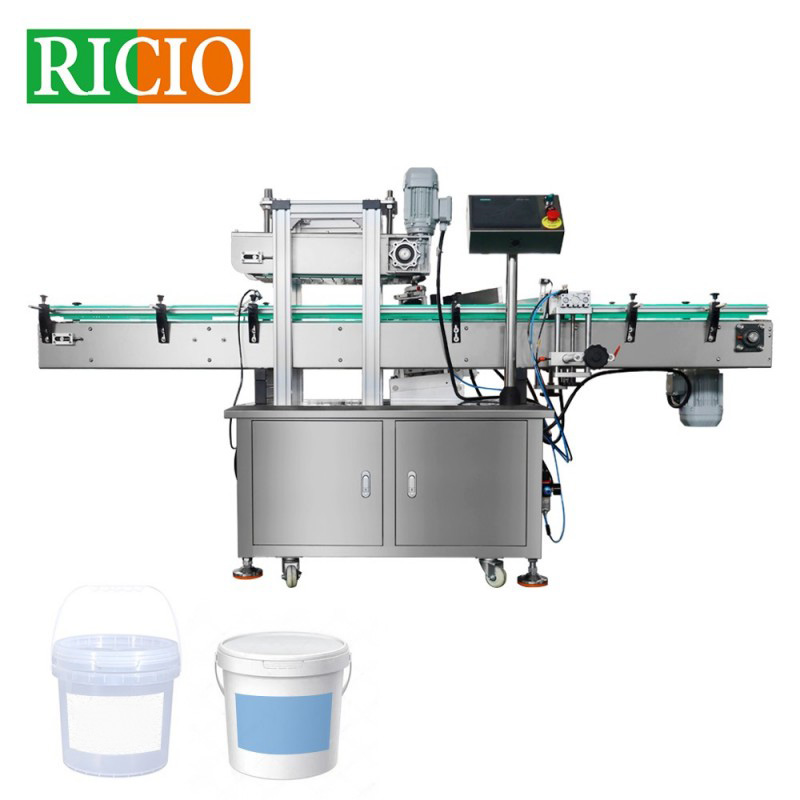
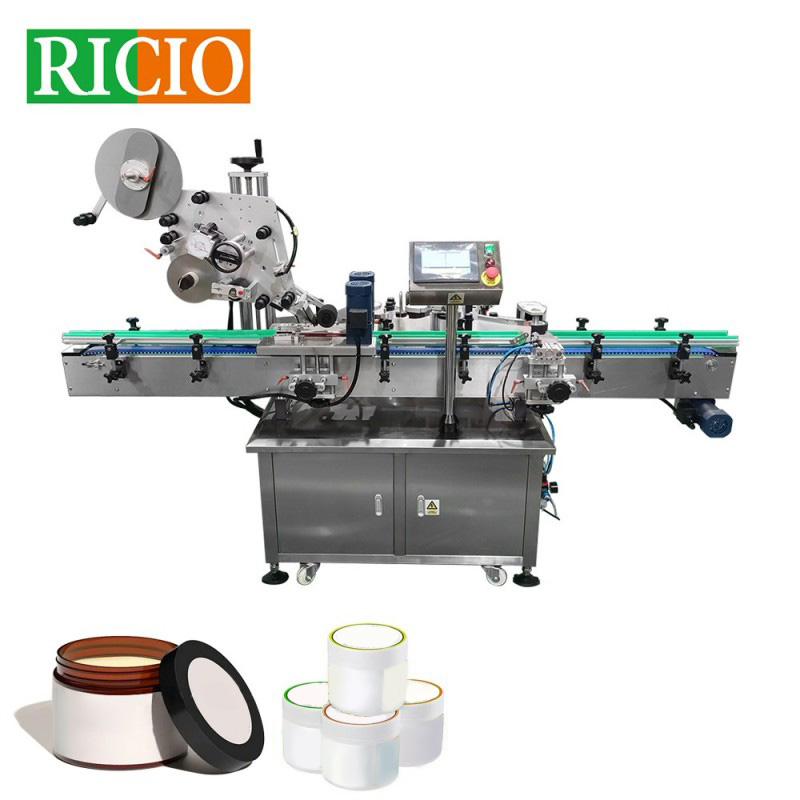
Automatic Conical Pail Labeling Machine
Key Advantages Over Manual and General-Purpose Labeling Methods
The automatic conical pail labeling machine is intended to address the limitations commonly associated with manual labeling, semi-automatic equipment, and labeling machines designed primarily for regular cylindrical products.
Improved Label Position Consistency
Manual operators may place labels at slightly different heights or angles, particularly during long production runs. Fatigue, changes in work rhythm, and variations in how each pail is held can result in visible differences between packages. The machine uses product detection, rotary positioning, and preset parameters to establish a more repeatable label location.
The stated labeling accuracy can reach approximately plus or minus 1.5 millimeters, depending on product dimensions, roundness, hardness, softness, and other application conditions. Actual results depend on the container and label materials, but automatic positioning provides a more controlled foundation than manual application.
Better Compatibility with Tapered Containers
Many standard round-bottle labelers are optimized for containers with a relatively uniform diameter. A conical pail changes diameter along its height, which affects contact pressure and label alignment. The machine’s adjustable labeling head, rotary support, and pressing structure are designed to handle this type of product more effectively.
Adjustment in multiple directions allows the operator to match the labeling unit to the pail’s height, taper, and target label area. This makes the equipment more suitable for pails that are not perfectly cylindrical.
Reduced Handle Interference
Handle management is a dedicated part of the operating sequence. By lifting and supporting the handle before labeling, the machine reduces the likelihood that the handle will obstruct the label, touch the adhesive surface, or cause the pail to rotate unpredictably.
This function can reduce manual intervention and make the labeling process more stable for handled containers. It is particularly useful for paint pails, coating containers, lubricant pails, and other products that use wire, plastic, or rigid integrated handles.
Lower Label Waste
The no-product-no-label function prevents unnecessary label dispensing when a pail is not present. Sensors can also support label detection and automatic correction. These features help reduce material losses caused by empty cycles, missed applications, or incorrect label release.
Lower label waste can be commercially important when labels use premium materials, multiple colors, variable data, security features, or special adhesives. It also contributes to more efficient use of production materials.
Flexible Labeling Configurations
The machine can be configured for different labeling requirements. Depending on the product sample and production plan, it can support single-label application, double-label application, front-and-back labeling, edge labeling, or fixed circumferential positioning.
This flexibility allows one platform to serve multiple packaging formats. Manufacturers may be able to change pail sizes or label arrangements through mechanical adjustment and parameter changes rather than purchasing a completely separate system for every product.
Higher Labor Productivity
Manual pail labeling requires an operator to pick up or position each container, align the label, apply pressure, and inspect the result. The automatic machine performs these tasks in a coordinated sequence. Operators can therefore focus on loading, quality monitoring, material replenishment, and broader production supervision.
Automation is particularly valuable when labeling must continue for several hours or when production volumes fluctuate. A machine-based process can provide a more consistent working rhythm and reduce dependence on individual operator technique.
Improved Packaging Appearance
A label that is straight, smooth, and correctly positioned improves the overall appearance of the pail. This matters in retail packaging, industrial product identification, warehouse management, transportation, and customer quality evaluations.
Consistent placement is also useful when several labels must work together. For example, a front label, rear label, safety label, and barcode label may need to maintain a defined relationship to each other. Rotary positioning and controlled application make these arrangements more achievable.
Application Range and Product Compatibility
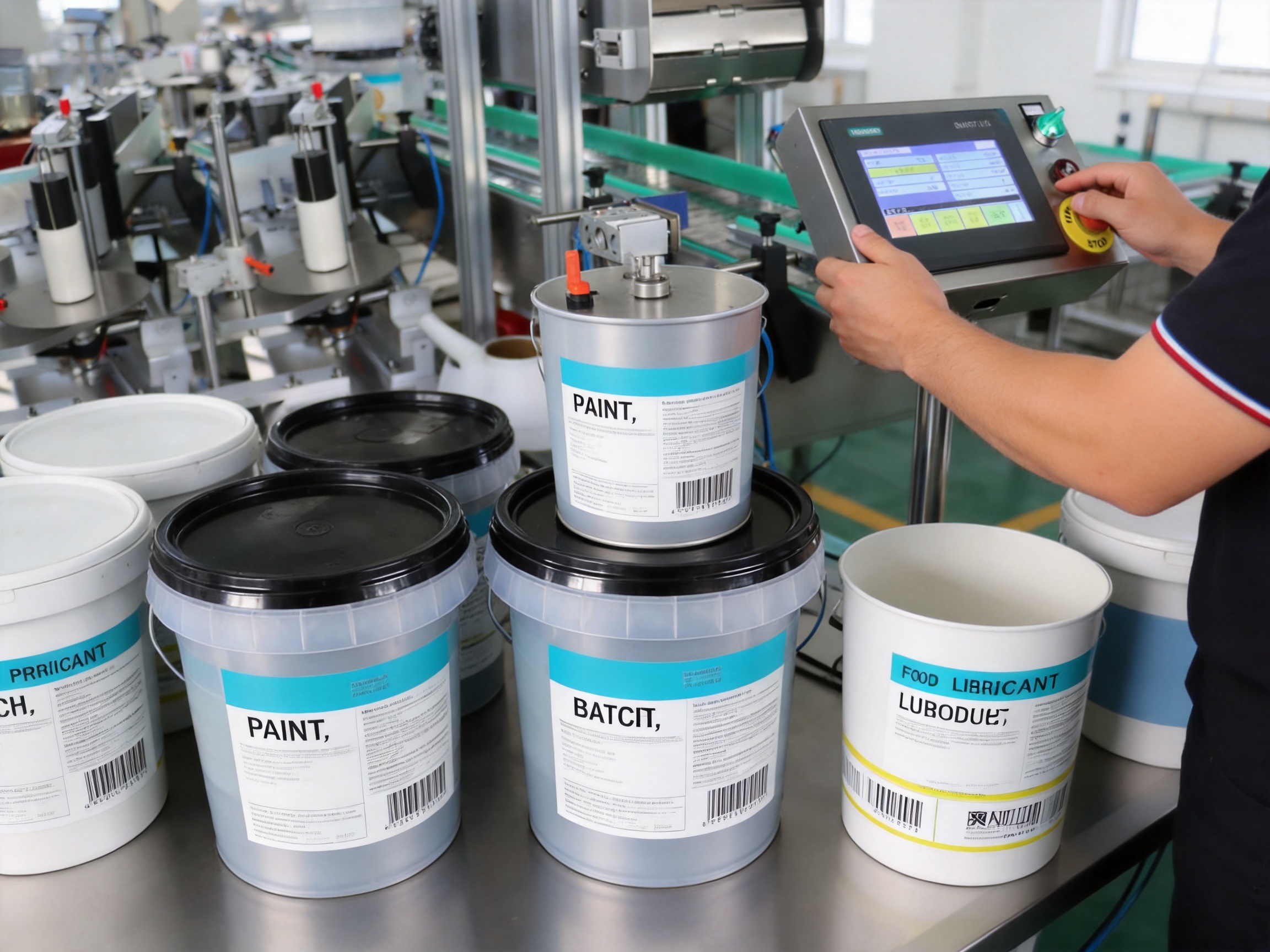
The automatic conical pail labeling machine is intended for round pails, tapered pails, small and medium-sized drums, and other handled products with suitable dimensions. Typical applications include paint pails, coating drums, lubricant containers, chemical drums, food ingredient containers, adhesive pails, pharmaceutical containers, toy product pails, and daily chemical packaging.
In the coating and paint industries, the machine can apply labels to containers that carry product names, color information, technical data, safety instructions, batch numbers, and regulatory markings. In the lubricant industry, labels may contain viscosity grades, application instructions, performance classifications, and barcode information.
Chemical packaging often requires clear hazard communication and traceability. A well-positioned label helps keep warning information visible and supports reliable identification during storage and transportation. Food ingredient and pharmaceutical packaging may also require clean, repeatable labeling with controlled machine surfaces and easy cleaning procedures.
Container compatibility should always be confirmed using actual samples. Variations in pail roundness, surface finish, material flexibility, lid height, handle design, and label adhesive can affect machine performance. The system can be customized according to user-provided products and labeling requirements.
Typical Product Size Range
The standard product diameter range is approximately 150 to 400 millimeters, while the product height range is approximately 200 to 500 millimeters. Special sizes may be considered through customized mechanical configuration.
The supported label height is approximately 10 to 150 millimeters, and the label length is approximately 15 to 300 millimeters. These dimensions provide flexibility for small identification labels, broad body labels, and larger front-facing graphics. The final specification should be selected according to the container geometry and the label’s adhesive and backing materials.
Performance and Technical Specifications
The machine provides an adjustable labeling speed of approximately 10 to 25 pails per minute. Actual speed depends on the pail diameter, container height, label length, label position, product spacing, and overall production rhythm. A smaller label on a stable container may allow a faster cycle, while large labels or complex positioning requirements may require a slower setting.
The equipment uses an AC 220-volt, 50/60-hertz power supply as a standard configuration, with variations available when required. Its listed power consumption is approximately 1,000 watts. Compressed air requirements are approximately 0.4 to 0.6 megapascals.
The approximate net weight is 250 kilograms. The listed packaging dimensions are approximately 2,000 millimeters in length, 800 millimeters in width, and 1,300 millimeters in height. These values should be considered during factory layout planning, transportation planning, and installation access reviews.
| Specification | Typical Value | Application Note |
| Machine type | Automatic conical pail labeling machine | Designed for round and tapered pails and small to medium drums |
| Product diameter | Approximately 150–400 mm | Special sizes can be evaluated for customization |
| Product height | Approximately 200–500 mm | Adjustment depends on the product sample |
| Label height | Approximately 10–150 mm | Selected according to the label and application area |
| Label length | Approximately 15–300 mm | Longer or special labels may require customization |
| Labeling speed | Approximately 10–25 pieces per minute | Adjustable according to product and label conditions |
| Labeling accuracy | Approximately ±1.5 mm | Depends on product geometry and material properties |
| Power supply | AC 220 V, 50/60 Hz | Other electrical standards may be considered |
| Power consumption | Approximately 1,000 W | Actual consumption depends on operating conditions |
| Air pressure | Approximately 0.4–0.6 MPa | Required for pneumatic mechanisms where configured |
| Inner film diameter | Minimum approximately 76 mm | Confirm label roll compatibility before production |
| Outer film diameter | Maximum approximately 300 mm | Depends on label roll construction and machine setup |
| Net weight | Approximately 250 kg | Used for installation and logistics planning |
| Packaging size | Approximately 2,000 × 800 × 1,300 mm | Confirm final dimensions with the selected configuration |
Intelligent Control and Operator Convenience
The machine is equipped with a touch-screen human-machine interface. The interface allows operators to set operating parameters, adjust speed, select functions, and manage product recipes. A clear control system can simplify changeovers when the production line handles several pail sizes or label designs.
Operators can adjust timing, product spacing, labeling position, label dispensing conditions, and other relevant parameters. Once an approved configuration has been established, it can be used as a reference for future production. Parameter permission protection can help prevent unauthorized changes that might affect labeling quality.
Production counting functions provide visibility into output quantity. Automatic stop functions can be used when a target quantity is reached or when a fault condition occurs. Production quantity reminders help operators monitor progress during a shift, while power-saving standby functions can reduce unnecessary operation during temporary interruptions.
Photoelectric detection supports automatic coordination between product movement and labeling. The no-product-no-label function reduces waste, while label detection and correction functions can help identify abnormal label conditions. These features contribute to better process control without requiring constant manual adjustment.
Changeover Considerations
When changing from one pail model to another, operators should verify product diameter, height, handle position, label height, label length, label roll dimensions, and desired orientation. Mechanical guides and labeling head positions may require adjustment. The control interface can then be updated with the relevant speed and timing parameters.
A practical changeover procedure should include a small trial run. Operators can inspect label position, adhesion, pressing quality, handle clearance, and product stability before releasing the machine for full production. This approach helps prevent large quantities of incorrectly labeled pails.
Mechanical Design for Durability and Maintenance
The main machine body is constructed from stainless steel and aluminum alloy materials. Stainless steel offers resistance to corrosion and supports routine cleaning, while aluminum alloy components can provide a balance between structural strength and manageable machine weight.
This material selection is suitable for environments where the equipment may be exposed to dust, adhesive residue, product splashes, cleaning agents, or frequent handling. Chemical, food, pharmaceutical, and daily chemical facilities often require equipment surfaces that are durable and relatively easy to maintain.
The machine’s integrated structure also helps organize the labeling process within a defined working area. Conveying, product holding, label dispensing, and pressing mechanisms are coordinated rather than installed as unrelated workstations. This can simplify line planning and reduce the floor space associated with multiple manual stations.
Routine maintenance should include cleaning adhesive residue, checking sensor alignment, inspecting belts and rollers, verifying pneumatic pressure, checking label roll installation, and examining the pressing components for wear. Operators should also confirm that the handle-lifting system moves smoothly and that the rotary platform holds the container securely without damaging the pail surface.
Maintenance schedules should be adapted to the production environment. A facility handling dusty powders may need more frequent cleaning around sensors and conveyors, while a facility using aggressive chemical products may require closer inspection of exposed metal surfaces and protective components.
Manufacturing Strengths and Engineering Capabilities
The equipment is manufactured by Shanghai Ruixiao Packaging Technology Co., Ltd., operating under the RICIO identity. The company specializes in the research, development, and manufacturing of labeling machinery for multiple industries and product formats.
Its manufacturing background developed from the acquisition of Shanghai Zhenbao Machinery Parts Factory. This history has supported the company’s transition from equipment assembly toward source manufacturing and in-house precision machining. The ability to manage core component production internally can provide greater control over dimensional accuracy, component compatibility, and production scheduling.
The company operates multiple CNC machining centers and has an experienced technical team. CNC machining is important for labeling machinery because rollers, shafts, brackets, sensor mounts, guide components, and drive-related parts must be manufactured with suitable dimensional consistency. Accurate components contribute to smoother movement and more stable adjustment during machine operation.
In-house machining can also make it easier to modify or customize components for unusual pail shapes, special label positions, additional labeling heads, or customer-specific line arrangements. Instead of relying entirely on standard purchased parts, the manufacturer can evaluate the machine structure and make engineering changes according to sample products and production requirements.
The company manages the process from core component machining to complete machine assembly and commissioning. This full-process capability helps connect design decisions with actual equipment performance. Assembly technicians can verify how machined parts, sensors, drives, pneumatic systems, and control components operate together before shipment.
Production and quality management are conducted in accordance with the ISO 9001 international quality system. A structured quality system supports documented procedures, process control, inspection activities, corrective action, and traceability. For customers purchasing industrial automation equipment, these practices provide a more systematic basis for evaluating manufacturing reliability.
Customization as a Manufacturing Advantage
Pail products are rarely identical across all industries. A paint manufacturer may use a tapered plastic pail with a movable handle, while a chemical producer may use a metal drum with a rigid lid and different surface characteristics. The label may be narrow, wide, single-sided, double-sided, or positioned close to an edge.
The manufacturer’s ability to customize machine configuration according to user-provided samples is therefore important. Customization may include conveyor width, product holding components, handle-lifting structures, rotary positioning parts, labeling head arrangement, pressing tools, sensor locations, coding devices, and rejection systems.
Sample-based engineering also allows the manufacturer to evaluate the actual pail and label combination before finalizing the machine. This can reveal issues related to taper, surface curvature, label stiffness, adhesive behavior, lid interference, and handle movement. A sample trial is especially valuable when the requested accuracy is strict or when multiple label positions must be coordinated.
Optional Functions for Expanded Production Lines
The automatic conical pail labeling machine can be equipped with optional modules according to production requirements. These options allow the base labeling platform to develop into a more complete packaging and traceability station.
Thermal Coding Printer
A thermal coding printer can add production dates, expiration dates, batch numbers, lot codes, or other variable information. This option is useful when information must be printed directly onto a label or compatible packaging surface during the labeling process.
Inkjet Printer
An inkjet printer can support variable coding and identification requirements. Depending on the selected ink system and product surface, it may be used for batch information, traceability codes, manufacturing details, or other data that changes from one production run to another.
Automatic Feeding Device
An automatic feeding device can reduce the need for operators to place individual pails onto the conveyor. It may be integrated with upstream equipment or used to organize products before they enter the labeling station. Automatic feeding is useful when the line is designed for higher continuity and reduced manual handling.
Automatic Collection Device
An automatic collection device can receive labeled pails after they pass through the application and inspection process. This can help organize finished products and transfer them to palletizing, packing, storage, or subsequent inspection operations.
Additional Labeling Unit
An additional labeling unit can support two-label or multi-label applications. For example, one unit may apply a main body label while another applies a rear, side, warning, or traceability label. The final arrangement depends on the product design and the required relationship between labels.
Unlabeled Product Rejection System
A rejection system can remove products that have not received a label or that fail a defined detection condition. This can prevent incorrectly labeled pails from moving to the next packaging stage. Rejection can be particularly valuable in automated lines where manual inspection of every product is not practical.
Quality, Safety, and Production Management Benefits
Consistent label positioning supports more than appearance. Labels often carry regulatory warnings, handling instructions, product grades, barcodes, and traceability information. If a label is applied too close to an edge, folded, or partially detached, important information may become difficult to read or scan.
Automated positioning helps reduce these risks by applying the label within a defined process window. The product detection and label detection functions also provide basic process safeguards. When combined with operator inspection and appropriate quality procedures, the machine can contribute to a more reliable packaging operation.
Handle management improves operational safety by reducing the need for operators to reach into the labeling area to move handles manually. The machine should still be operated according to appropriate safety procedures, including guarding, emergency-stop use, air-pressure management, electrical isolation, and training for authorized personnel.
Production counting and automatic stopping assist with shift management. Supervisors can compare planned and actual output, identify recurring interruptions, and coordinate material replenishment. Parameter protection can reduce the likelihood of accidental changes during production.
Installation and Application Recommendations
Before installation, the manufacturer should receive representative samples of the pails, labels, and any lids or handles that affect the labeling area. The sample set should include normal products and, where possible, products showing the expected range of dimensional variation.
Important information includes pail diameter, height, taper angle, material, weight, handle position, label dimensions, label material, adhesive type, backing roll dimensions, desired label position, required production speed, and the relationship between the label and any lid or handle feature.
The installation area should provide adequate floor space around the machine for operation, maintenance, label roll replacement, inspection, and cleaning. The electrical supply and compressed-air system should meet the required specifications. The floor should be sufficiently level and stable to support accurate equipment alignment.
After installation, commissioning should include conveyor alignment, sensor adjustment, handle-lifting verification, rotary positioning tests, label dispensing tests, and pressing inspection. The machine should be tested at gradually increasing speeds rather than immediately operated at maximum capacity.
Operators should inspect several consecutive pails during commissioning. The inspection should confirm label height, horizontal position, orientation, adhesion, surface smoothness, handle clearance, and product flow. If the machine is configured for multiple labels, the relationship between each label should also be checked.
How to Select the Correct Configuration
The correct machine configuration depends on the product rather than the label alone. Buyers should begin by identifying the pail geometry and the required labeling result. A cylindrical pail with a stable sidewall may need a different holding and pressing arrangement from a strongly tapered pail with a flexible surface.
The number of labels is also important. A single front label may require one dispensing and pressing sequence, while front-and-back labels may require rotary positioning or multiple labeling heads. If a label must avoid the handle or align with a lid opening, the positioning system must be configured accordingly.
Production speed should be based on the complete process. A machine rated for 10 to 25 pieces per minute may operate at different speeds depending on label length, product spacing, and the time required to rotate and press each pail. Buyers should evaluate the desired output together with the actual sample product.
Finally, the future product plan should be considered. If a manufacturer expects to add new pail sizes, batch coding, inspection, or automatic collection, it may be beneficial to select a configuration that allows additional modules or adjustment range.
Frequently Asked Questions
What types of products can this machine label?
The machine is designed for round pails, conical pails, small and medium-sized drums, and similar handled containers. Typical products include paint, coatings, lubricants, chemicals, food ingredients, adhesives, pharmaceuticals, toys, and daily chemical products.
Can it label tapered pails?
Yes. The machine is specifically designed for conical and tapered pail products. Its adjustable labeling head, rotary support, positioning system, and pressing mechanism help it accommodate changes in surface diameter and curvature.
How does the machine manage the pail handle?
The product enters a handle-lifting mechanism that raises or supports the handle before labeling. This helps keep the handle away from the label application area and reduces interference during positioning and pressing.
Can the machine apply more than one label?
Yes. Depending on the final configuration, the machine can support single labels, double labels, front-and-back labels, or fixed circumferential label positions. An additional labeling unit can be added for certain multi-label applications.
What is the approximate labeling speed?
The adjustable speed is approximately 10 to 25 pails per minute. The actual capacity depends on the pail size, label dimensions, label position, product spacing, and required rotary positioning cycle.
What is the expected labeling accuracy?
The listed accuracy is approximately plus or minus 1.5 millimeters. Actual performance depends on product size, roundness, hardness, softness, surface condition, label material, and the selected operating speed.
What are the standard product dimensions?
The approximate supported product diameter is 150 to 400 millimeters, with a product height of approximately 200 to 500 millimeters. Special dimensions may be evaluated for customized equipment.
What label sizes can be used?
The approximate label height range is 10 to 150 millimeters, and the approximate label length range is 15 to 300 millimeters. Final compatibility depends on the product surface and labeling arrangement.
Does the machine prevent labeling when no pail is present?
Yes. The photoelectric detection system supports no-product-no-label operation. This function helps prevent unnecessary label dispensing and reduces label waste during empty conveyor cycles.
Can the machine print batch or date information?
Optional thermal coding printers and inkjet printers can be added for production dates, batch numbers, lot codes, traceability information, and other variable data.
Is the machine suitable for chemical packaging?
Yes. The stainless steel and aluminum alloy construction, adjustable labeling functions, and support for handled pails make it suitable for many chemical, coating, paint, lubricant, and adhesive packaging applications. The exact configuration should be reviewed according to the product and operating environment.
Can the machine be integrated into an existing production line?
It can be supplied as a stand-alone unit or arranged for connection with upstream and downstream equipment. Automatic feeding, collection, coding, additional labeling, and rejection functions can be considered for a more automated line.
Why should customers provide product samples?
Sample testing allows the machine configuration to be matched to the actual pail diameter, taper, handle design, surface material, label adhesive, and label position. It helps identify potential interference and supports more reliable commissioning.
What should be checked during routine maintenance?
Routine checks should include sensor cleanliness and alignment, label roll installation, conveyor and roller condition, pressing components, pneumatic pressure, rotary holding action, handle-lifting movement, adhesive residue, and general machine cleanliness.
Conclusion
The automatic conical pail labeling machine provides a specialized solution for one of the more demanding areas of industrial packaging. Its value comes from combining product conveying, handle lifting, detection, rotary orientation, label dispensing, and pressing in one coordinated process.
Compared with manual labeling or general-purpose equipment, the machine offers stronger compatibility with tapered containers, better control of label position, reduced handle interference, lower label waste, and improved production consistency. Adjustable mechanisms allow the system to accommodate different pail diameters, heights, taper shapes, label sizes, and label arrangements.
The touch-screen control system, production counting, automatic stop, standby functions, parameter protection, and photoelectric detection further support efficient daily operation. Optional coding, feeding, collection, additional labeling, and rejection functions allow the machine to grow with a manufacturer’s automation requirements.
Its manufacturing advantages are supported by in-house precision machining, CNC production capabilities, experienced technical personnel, full-process assembly and commissioning, and quality management based on the ISO 9001 system. These capabilities are important when customers require customized machine structures, sample-based engineering, and stable performance across different pail formats.
For manufacturers seeking to improve label placement, reduce manual errors, protect packaging appearance, and increase pail labeling efficiency, this equipment offers a practical and customizable foundation for automated packaging production. Proper sample testing, configuration selection, installation, and maintenance will help ensure that the machine delivers reliable results for the intended pail and label combination.
References
1. Product technical information for the automatic conical pail labeling machine, including operating functions, dimensions, speed, accuracy, and compatible product ranges.
2. Manufacturing and company profile information concerning labeling machinery research, development, CNC machining, assembly, commissioning, and quality management.
3. General principles of pressure-sensitive label application for curved, tapered, and handled containers.
4. Industrial packaging equipment practices for product detection, rotary positioning, label dispensing, pressing, coding, and rejection.
5. ISO 9001 quality management principles as applied to machinery manufacturing and process control.
Product: Automatic Conical Pail Labeling Machine

related products
related News
 +86 13681850339
 sales@raxpack.com
 Building 6, No. 477 Tiefeng Road, Baoshan District, Shanghai, China
- Tabletop Labeling Machine
- Round Bottle Labeling Machine
- Automatic Tube Labeling Machine
- Pouch Labeling Machine
- Rotary Labeling Machine
- Syringe Labeling Machine
- Top Labeling Machine
- Single Side Sticker Labeling Machine
- Double Side Labeling Machine
- Bucket Labeling Machine
- Bottom Labeling Machine
- Corner Label Applicator
- Waist Sealing Labeling Machine
- Square Bottle Labeling Machine
