 English
 русский
 Español
 عربى



Automatic Conical Pail Labeling Machine: Precision, Flexibility, and Efficient Drum Packaging
2026-10-08
Content
- 1 Why Conical Pails Require Specialized Labeling Equipment
- 2 Integrated Operating Principle
- 3 Main Advantages Compared with Basic Labeling Solutions
- 4 Technical Specifications
- 5 Application Range
- 6 Human-Machine Interface and Production Management
- 7 Mechanical Design and Adjustment Capability
- 8 Manufacturing Strengths and Engineering Capabilities
- 9 Installation, Changeover, and Operation
- 10 Quality Control and Maintenance
- 11 Optional Functions for Expanded Automation
- 12 How to Select the Correct Configuration
- 13 Economic and Operational Value
- 14 Safety and Responsible Operation
- 15 Frequently Asked Questions
- 15.1 What types of containers can this machine label?
- 15.2 Can it label tapered pails?
- 15.3 How does the machine prevent the handle from interfering with the label?
- 15.4 Can the machine apply two labels?
- 15.5 What labeling speed can be achieved?
- 15.6 What label sizes are supported?
- 15.7 Does the machine require compressed air?
- 15.8 Can a date or batch code be printed during labeling?
- 15.9 Does the machine label every time it detects a gap in the product flow?
- 15.10 How accurate is the label placement?
- 15.11 Can the equipment be connected to a complete packaging line?
- 15.12 Why is sample testing important?
- 15.13 What manufacturing capabilities support this machine?
- 16 Conclusion
- 17 References
- 18 Product: Automatic Conical Pail Labeling Machine
In industries that package paint, coatings, lubricants, chemicals, food ingredients, adhesives, and other products in pails or drums, labeling is more than a finishing operation. The label identifies the product, communicates regulatory information, supports traceability, and contributes directly to the appearance and perceived quality of the package. When labeling is performed manually or with equipment designed only for straight-sided containers, manufacturers may encounter uneven label placement, wrinkling, edge lifting, label waste, inconsistent orientation, and production delays.
The automatic conical pail labeling machine is designed to address these challenges. It provides an integrated solution for conveying, handle lifting, product detection, rotary positioning, label dispensing, and label pressing. Its structure is intended for round pails, tapered pails, small drums, and similar handled containers whose shape and accessories make labeling more complicated than labeling a standard bottle.
Unlike a basic wrap-around labeler, this equipment is designed around the practical characteristics of pail products. A conical pail may have a changing diameter from top to bottom, a projecting handle, a curved body, and a specific orientation requirement. The machine must therefore control the container carefully while coordinating the label dispensing and pressing actions. The result is a more consistent labeling process with reduced dependence on manual positioning.
This article explains the operating principles, major advantages, technical capabilities, applications, manufacturing strengths, adjustment methods, maintenance considerations, and purchasing factors associated with an automatic conical pail labeling machine. It also examines why a machine developed by an experienced labeling machinery manufacturer can provide greater long-term value than a basic or heavily standardized alternative.
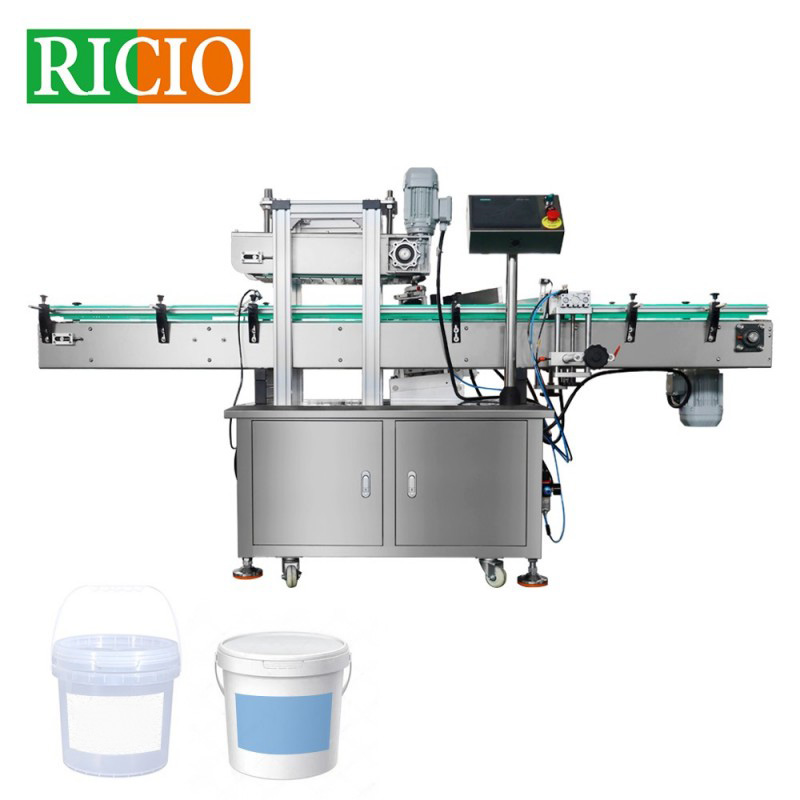
Automatic Conical Pail Labeling Machine
Why Conical Pails Require Specialized Labeling Equipment
Round pails are often treated as simple cylindrical containers, but many products used in industrial and consumer packaging are not perfectly cylindrical. Their bodies may taper from the base toward the opening, include a reinforced rim, contain a hinged or movable handle, or have a surface that changes in curvature. These features affect how a pressure-sensitive label contacts the container.
On a straight-sided bottle, the distance between the label applicator and the product remains relatively constant. On a conical pail, that distance changes as the container rotates. If the labeling head is not correctly positioned, the label may be applied with unequal pressure, causing wrinkles, bubbles, skewing, or an incomplete bond. The problem becomes more noticeable when the label is long, wide, rigid, or made from a material with limited flexibility.
The handle creates another challenge. It may fall across the intended labeling area, interfere with the conveyor, or touch the label before the adhesive has bonded properly. Manual operators may need to lift or reposition the handle before every application. This increases labor requirements and makes the result dependent on operator consistency.
Many pail products also require the label to appear at a defined location. A front label may need to align with the handle, lid opening, printed markings, or a second label on the opposite side. If positioning is based only on conveyor timing, small differences in product spacing and rotation can lead to visible errors. A positioning sensor and controlled rotary mechanism provide a more reliable way to locate the required application point.
For these reasons, specialized pail labeling equipment must combine several functions. It needs to stabilize the product, manage the handle, recognize the container, rotate it to the correct position, dispense the label at the correct moment, and press the label onto a changing surface. The automatic conical pail labeling machine integrates these functions into one continuous operating sequence.
Integrated Operating Principle
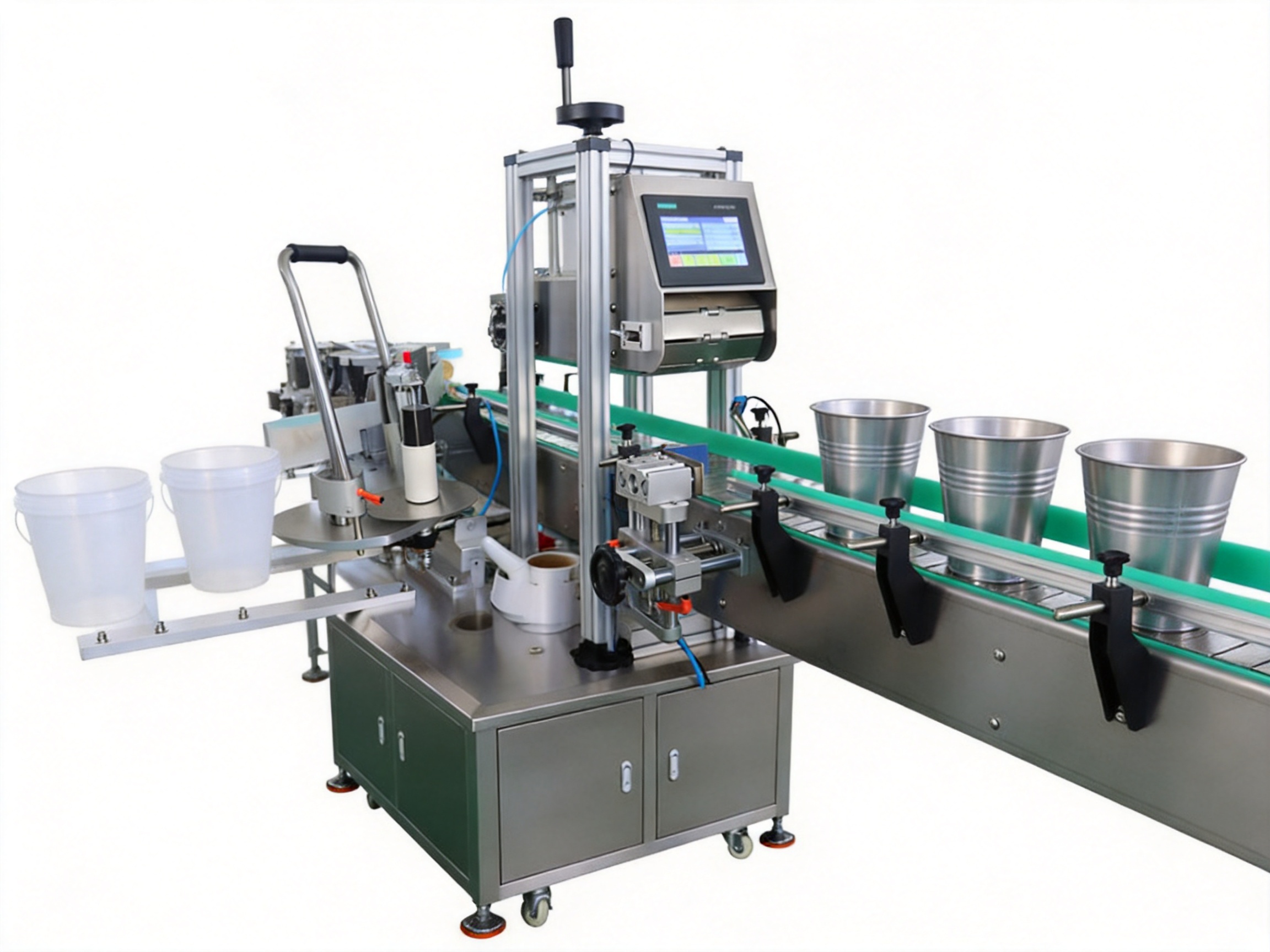
The machine can receive pails from an upstream packaging station or allow an operator to place them manually onto the conveyor. Once a pail enters the infeed area, the conveying system transfers it toward the handle-lifting and positioning section. Product sensors detect the container and send signals to the control system.
The handle-lifting mechanism raises or supports the handle so that it does not obstruct the application area. This is especially important when the label is placed near the upper part of the pail or when the handle naturally rests against the body. By controlling the handle before labeling, the machine reduces interference and creates a more predictable application condition.
After detection, the rotary platform or lifting mechanism positions the pail securely. The drum rotating assembly holds the container and turns it according to the selected labeling program. Depending on the required configuration, the machine can locate a fixed point, apply one label, apply two labels, or complete a front-and-back labeling cycle.
A positioning sensor identifies the preset labeling point. When the correct position is reached, the labeling head releases the label from its backing material and applies it to the pail. The pressing system follows the application point and smooths the label onto the curved or tapered surface. This coordinated movement helps limit air bubbles, wrinkles, edge lifting, and incomplete contact.
After the label has been applied, the pail continues to the discharge area. It may then proceed to a downstream inspection, coding, collection, or packaging station. Optional devices can be integrated when the production line requires printing, rejection, automatic feeding, or product collection.
Typical Labeling Sequence
1. The pail enters the conveyor and reaches the detection zone.
2. The product sensor confirms the presence and position of the pail.
3. The handle-lifting mechanism raises or supports the handle.
4. The rotary platform or lifting unit secures the product.
5. The product rotates until the positioning sensor identifies the target point.
6. The label dispensing head releases the label according to the programmed parameters.
7. The pressing mechanism applies and smooths the label on the pail body or edge area.
8. The control system records the completed operation and transfers the labeled product to the discharge section.
This sequence allows the machine to complete several actions without requiring the operator to manually align each pail. It also creates a repeatable process that can be adjusted for different diameters, heights, taper angles, label sizes, and production speeds.
Main Advantages Compared with Basic Labeling Solutions
Purpose-Built Handling for Pails and Drums
A basic round-container labeler may be suitable for bottles or jars with stable cylindrical walls, but it may not provide sufficient support for pails with handles and tapered bodies. The automatic conical pail labeling machine includes a handle-lifting function and a rotary holding system intended for the geometry of pail products. This purpose-built arrangement can reduce the need for improvised fixtures or manual intervention.
The equipment can handle round pails, conical pails, and small to medium-sized drum products. The product diameter range is approximately 150 to 400 millimeters, while the product height range is approximately 200 to 500 millimeters. Special sizes can be evaluated and customized according to customer samples and application requirements.
More Consistent Label Positioning
Positioning accuracy is a major consideration when a label must align with a handle, lid feature, existing print, or another label. Instead of relying only on conveyor distance, the machine uses product detection and positioning sensors together with controlled rotation. This makes it possible to apply labels at a defined circumferential position.
The stated labeling accuracy can reach approximately plus or minus 1.5 millimeters, depending on product dimensions, surface hardness, roundness, material properties, and other operating conditions. In practical production, the final result also depends on label quality, adhesive behavior, pail tolerances, and correct machine adjustment. Nevertheless, the combination of mechanical positioning and sensor control provides a stronger foundation for repeatable results than manual placement.
Reduced Label Waste
The intelligent photoelectric detection system supports no-product-no-label operation. If a pail is not detected, the machine does not unnecessarily release a label. This function is valuable when product spacing is irregular or when the infeed conveyor occasionally contains a gap.
The system can also support label detection and automatic correction. These functions help monitor whether the label roll is feeding correctly and reduce the possibility of continued operation after a label supply or dispensing problem occurs. By limiting missed applications and unnecessary label release, the machine can lower material waste and reduce production losses.
Flexible Label Configurations
The machine can be configured for a single label, double labels, front-and-back labels, edge labels, or labels applied at a fixed circumferential position. This flexibility gives manufacturers more options when packaging several products on the same production line.
The labeling head can be adjusted forward and backward, left and right, up and down, and by angle. These adjustment directions allow operators to adapt the equipment to different pail diameters, heights, taper shapes, label positions, and surface conditions. A basic fixed-position applicator often requires additional modification when a product changes, whereas a machine with multi-directional adjustment can accommodate a broader range of applications.
Improved Appearance and Product Presentation
A pail label is often one of the first visual elements noticed by a customer. A label that is skewed, wrinkled, partially detached, or positioned inconsistently can make the entire product appear unreliable. The controlled rotation and pressing mechanisms of the automatic conical pail labeling machine help produce a cleaner appearance.
Consistent label placement is particularly important for paint, coating, lubricant, chemical, and food ingredient containers displayed in warehouses, retail locations, or professional work environments. A smooth label can also improve barcode readability, reduce the risk of label damage, and support a more professional brand presentation.
Lower Dependence on Manual Labor
Manual labeling requires operators to repeatedly orient the pail, lift the handle, position the label, press the label, and inspect the result. Over a full shift, this work can become repetitive and physically demanding. It may also create differences between operators and between production batches.
Automation transfers these repetitive tasks to the machine. Operators can focus on material replenishment, quality checks, changeovers, and general production supervision. The result may include improved labor productivity, more stable output, and less variation caused by fatigue or inconsistent manual technique.
Support for Future Line Automation
The machine is not limited to a stand-alone labeling function. Optional devices include thermal coding printers, inkjet printers, automatic feeding systems, automatic collection systems, additional labeling units, and unlabeled-product rejection systems. These options can support date coding, batch identification, traceability, and higher levels of line integration.
A manufacturer can begin with a basic automatic labeling configuration and later add equipment as production requirements expand. This approach allows the labeling station to grow with the packaging line rather than requiring a complete replacement when coding, inspection, or rejection functions become necessary.
Technical Specifications
The following specifications describe the standard configuration and general operating range. Actual performance may vary according to the pail material, taper angle, label construction, adhesive, product spacing, operator skill during setup, and selected options.
| Specification | Standard Value | Application Notes |
| Power supply | AC 220 V, 50/60 Hz | Power configuration can be adjusted when required. |
| Power consumption | 1,000 W | Actual consumption depends on configuration and optional devices. |
| Labeling speed | 10–25 pieces per minute | Adjustable according to pail size, label size, and production rhythm. |
| Labeling accuracy | Approximately ±1.5 mm | Depends on product shape, hardness, roundness, and other conditions. |
| Air pressure | 0.4–0.6 MPa | Required when pneumatic components are included. |
| Product diameter | Approximately 150–400 mm | Special sizes can be evaluated for customization. |
| Product height | Approximately 200–500 mm | Final range depends on sample testing and configuration. |
| Label height | 10–150 mm | Suitable for various body and edge label formats. |
| Label length | 15–300 mm | Longer or special labels require application review. |
| Film roll inner diameter | Minimum approximately 76 mm | Must match the selected label roll core. |
| Film roll outer diameter | Maximum approximately 300 mm | Large rolls support longer continuous production. |
| Net weight | Approximately 250 kg | Weight can vary with options and customized modules. |
| Packaging dimensions | Approximately 2,000 × 800 × 1,300 mm | Transport packaging size may vary slightly. |
The specifications should be used as a starting point rather than a replacement for sample testing. Because pails vary in taper, stiffness, surface coating, handle design, and label material, a professional equipment supplier should confirm compatibility using actual containers and labels before final production.
Application Range
The automatic conical pail labeling machine is suitable for products that are packaged in handled pails, tapered buckets, and small or medium-sized drums. It can be applied in a wide range of industries where accurate and repeatable labeling is required.
Paint and Coating Packaging
Paint and coating products are commonly packaged in metal or plastic pails with handles. These containers may require a large front label, a side label, or a label positioned relative to the handle. The machine can support consistent application while keeping the handle away from the label path during the labeling process.
Lubricant and Chemical Products
Lubricants, industrial chemicals, adhesives, and maintenance products often require labels that contain product identification, hazard information, batch numbers, and handling instructions. A stable labeling position helps improve the readability and presentation of this information. Optional coding equipment can add production dates, lot codes, or traceability information during the same packaging process.
Food Ingredients and Food Containers
Food ingredients and bulk food products may be filled into pails or drums for commercial kitchens, food processors, and ingredient distributors. In these applications, cleanable machine construction and repeatable labeling are important. Stainless steel and aluminum alloy components provide a durable foundation for environments where regular cleaning and organized material handling are required.
Daily Chemical and Pharmaceutical Packaging
Some daily chemical and pharmaceutical products are supplied in pail-style containers, particularly for institutional or industrial use. Labels may need to display regulated information and remain firmly attached throughout storage and transportation. Controlled pressing can support label adhesion and reduce edge lifting caused by uneven application.
Other Industrial and Consumer Products
The machine can also be considered for toys, household chemicals, specialty materials, agricultural products, sealants, construction compounds, and other products packaged in pails. The key requirement is that the product shape, surface, label, and production speed fall within the machine’s tested application range.
Human-Machine Interface and Production Management
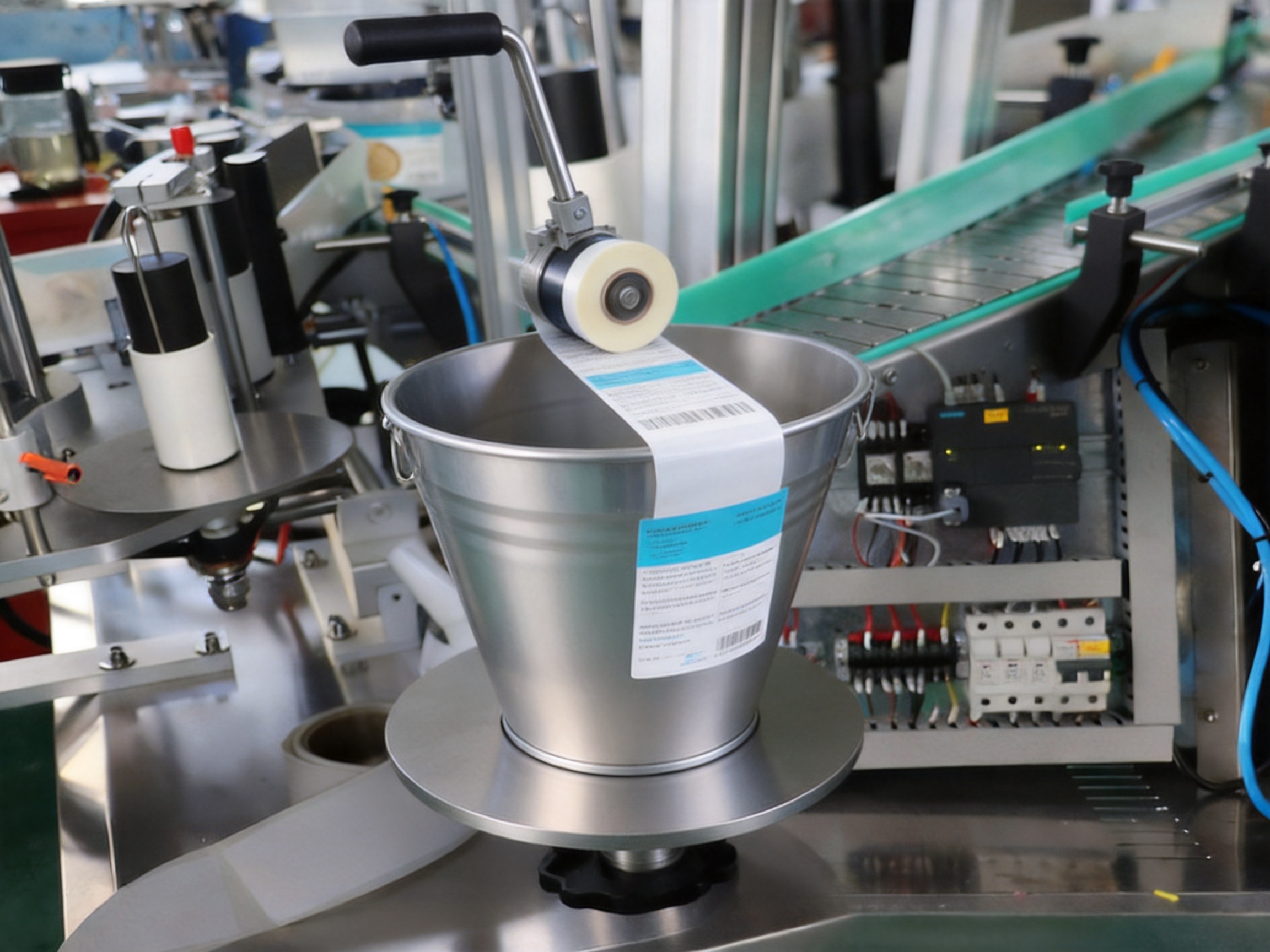
The touch-screen human-machine interface allows operators to set production parameters and adjust operating functions from a centralized control panel. A clear interface is important because labeling systems often require adjustments for product height, label position, dispensing length, rotation timing, pressing force, and conveyor speed.
Operators can use the interface to adjust the production speed according to the pail size, label dimensions, and upstream filling or closing speed. This helps coordinate the labeling machine with the rest of the packaging line. A slower speed may be appropriate for large pails, heavy labels, or difficult surfaces, while smaller and more stable containers may permit faster operation.
Production counting allows personnel to monitor completed units during a shift or batch. Automatic stop functions can be used when a production quantity has been reached or when a fault is detected. Power-saving standby operation can reduce unnecessary energy use during interruptions or pauses.
Production quantity reminders can assist with batch management, while parameter permission protection can limit unauthorized changes. This is useful in facilities where validated settings, product specifications, or quality procedures must be maintained. Different operators may have different access levels for daily operation, setup, maintenance, and technical adjustment.
A well-designed control system also supports faster changeovers. Once the appropriate parameters for a particular pail and label have been recorded, operators can use them as a reference during future production. This reduces repeated trial and error and helps preserve consistency between production runs.
Mechanical Design and Adjustment Capability
The structure of the machine combines a conveyor, product-support components, a rotary positioning mechanism, a label dispensing unit, a pressing mechanism, sensors, and a control system. Each component contributes to the final result, but the interaction between components is especially important for conical pails.
The conveyor must transfer the product smoothly without excessive vibration or uncontrolled movement. Product support must hold the pail securely while allowing the rotating mechanism to turn it. The handle-lifting system must provide enough movement to clear the label area without damaging the pail or obstructing the next stage.
The labeling head must be aligned with the intended label height and distance from the product. The pressing device must follow the surface closely enough to encourage adhesion while avoiding excessive force that could deform the pail or disturb the label. These relationships can be adjusted through the machine’s multi-directional mechanisms.
Forward and backward adjustment changes the distance between the labeling unit and the product. Left and right adjustment helps align the label with the centerline or selected edge. Upward and downward adjustment accommodates different label heights and pail dimensions. Angular adjustment is valuable when the label must contact a tapered or inclined area.
This adjustment range is a significant advantage over equipment designed with a narrow application window. A manufacturer handling multiple pail sizes can use the same basic machine platform for several products instead of purchasing an entirely separate system for each container shape. However, the practical range still depends on testing, and extremely sharp tapers or unusual handle geometries may require special tooling.
Manufacturing Strengths and Engineering Capabilities
The performance of a labeling machine depends not only on its design concept but also on how accurately and consistently the components are manufactured. Small errors in rollers, brackets, shafts, guides, or mounting surfaces can influence label position and machine stability. For this reason, an equipment supplier with in-house machining and assembly capabilities can offer important advantages.
Shanghai Ruixiao Packaging Technology Co., Ltd., operating under the RICIO labeling machinery organization, specializes in research, development, and manufacturing of labeling equipment. The company is headquartered in Shanghai, China, and has developed from an equipment assembly background into a source manufacturer with in-house precision machining capabilities.
The company’s manufacturing structure includes multiple CNC machining centers and an experienced technical team. CNC machining supports controlled production of core mechanical parts, including brackets, shafts, rollers, mounting plates, and other components that require repeatable dimensions. In-house machining can improve communication between design and production teams and help reduce dependence on unrelated external suppliers.
Managing the process from core component machining to complete machine assembly and commissioning allows the manufacturer to evaluate the entire equipment system rather than treating each component separately. This integrated approach can help identify alignment problems, interference between mechanisms, unsuitable clearances, and control timing issues before shipment.
The company follows an ISO 9001 international quality system. A quality management framework helps organize design review, material control, production procedures, inspection, assembly, testing, documentation, and after-sales communication. Certification itself does not replace application testing, but it provides a structured basis for process control and continuous improvement.
Engineering experience across multiple labeling categories also contributes to customization capability. The manufacturer provides solutions for syringe labeling, round and square bottle labeling, double-sided labeling, high-speed labeling, and real-time print-and-apply systems. Knowledge gained from these different applications can support the development of specialized handling and dispensing solutions for pails.
The company serves industries including food and beverage, pharmaceuticals and healthcare, daily chemicals and cosmetics, and chemical packaging. Its products are exported to more than 40 countries and regions. International application experience can be valuable because packaging standards, operating environments, container materials, and production expectations differ between markets.
For customers, the main benefit of this manufacturing background is the ability to discuss the entire application rather than purchasing a generic machine based only on a speed claim. Product samples, label samples, layout drawings, line speed, coding needs, and operator requirements can be considered together when developing the final configuration.
Why In-House Precision Machining Matters
In-house CNC machining can contribute to dimensional consistency across repeated parts. When a machine requires several guide components or rotating elements to work together, consistent dimensions make alignment and replacement easier. It can also support faster modifications when a customer requires a different product fixture, special support plate, or customized labeling position.
In-house technical control may also shorten the communication path between the customer, design engineer, machinist, assembly technician, and commissioning team. This is particularly useful for nonstandard pails, because application problems may involve both mechanical geometry and control timing. A coordinated technical team can investigate these issues more directly.
Assembly and Commissioning
Final assembly and commissioning are essential stages in labeling machine production. The equipment must be checked not only when empty but also with actual pails and labels. Commissioning should verify product transfer, handle clearance, rotary positioning, label release, pressing action, sensor response, and discharge stability.
Testing with customer samples is especially important for conical pails. The machine may need different settings for a hard plastic pail compared with a flexible metal container. Label adhesive, liner stiffness, label length, and application temperature can all influence the result. A manufacturer that performs practical sample testing can identify these factors before the machine is placed into full production.
Installation, Changeover, and Operation
Before installation, the user should confirm that the factory floor can support the machine dimensions, weight, power supply, and compressed-air requirements. The packaging size is approximately 2,000 by 800 by 1,300 millimeters, and the net machine weight is approximately 250 kilograms. Additional space should be allowed for operator access, label roll replacement, cleaning, adjustment, and maintenance.
The electrical supply is generally AC 220 V at 50/60 Hz, with variations available when required. Pneumatic functions require an air supply in the approximate range of 0.4 to 0.6 MPa. Air quality should be appropriate for the machine, with suitable filtration and moisture control where necessary.
During initial setup, the operator should confirm the pail diameter, product height, handle position, label height, label length, label roll direction, and desired circumferential location. Mechanical adjustment should be performed gradually. The product should be centered, supported, and allowed to rotate without excessive resistance.
After mechanical adjustment, the operator can set the operating parameters through the touch screen. Initial tests should be performed at a lower speed. The first labeled pails should be inspected for vertical alignment, circumferential position, edge adhesion, surface wrinkles, bubbles, and contact with the handle or lid.
Changeover between products should include cleaning the relevant contact surfaces and checking that the label roll, backing paper, sensor position, pressing mechanism, and product support settings match the new product. If the new pail has a different taper or handle design, the operator should not assume that the previous parameters will produce acceptable results.
Once the first samples meet the required standard, production speed can be increased gradually. The best operating speed is not always the maximum available speed. A stable speed that provides accurate positioning and smooth label adhesion may be more valuable than a higher nominal output with increased waste or rework.
Quality Control and Maintenance
Quality control should cover both the incoming materials and the finished labeled pail. Pails should be checked for consistent dimensions, clean surfaces, and stable handles. Labels should be inspected for correct size, adhesive condition, winding direction, liner quality, and printed information.
During operation, inspectors can monitor label position, orientation, adhesion, surface smoothness, and coding quality. A sample-based inspection plan may be sufficient for stable production, while products with strict regulatory or customer requirements may require more frequent checks or an automatic inspection and rejection system.
Daily maintenance should include cleaning dust, adhesive residue, and product contamination from the conveyor, pressing components, sensors, and label dispensing area. Sensors must remain clean and correctly aligned. Loose fasteners, unusual vibration, and changes in rotating resistance should be reported before they develop into larger faults.
Label rolls should be stored in suitable environmental conditions. Excessive humidity, heat, or contamination can affect adhesive performance and label feeding. The roll should be installed securely, and the backing material should follow the correct path through the machine.
Periodic maintenance may include checking belts, bearings, pneumatic components, electrical connections, guides, rollers, and safety devices. Lubrication should follow the manufacturer’s recommendations because excessive lubricant near labels or adhesive surfaces can cause contamination.
Preventive maintenance helps preserve labeling accuracy and reduces unexpected downtime. It also allows operators to identify wear in components that influence product rotation or label pressing. When a pail is no longer held concentrically, even a well-calibrated sensor system may produce inconsistent results.
Optional Functions for Expanded Automation
Thermal Coding and Inkjet Printing
A thermal coding printer or inkjet printer can add manufacturing dates, expiration dates, batch numbers, serial information, or traceability codes. Printing can be performed on the label, pail surface, or another designated area, depending on the product and coding system.
Integrated coding reduces the need for a separate manual marking operation. It can also help synchronize the printed information with the production count or selected product recipe. The choice between thermal transfer and inkjet printing depends on the surface, required resolution, ink or ribbon characteristics, and production environment.
Automatic Feeding
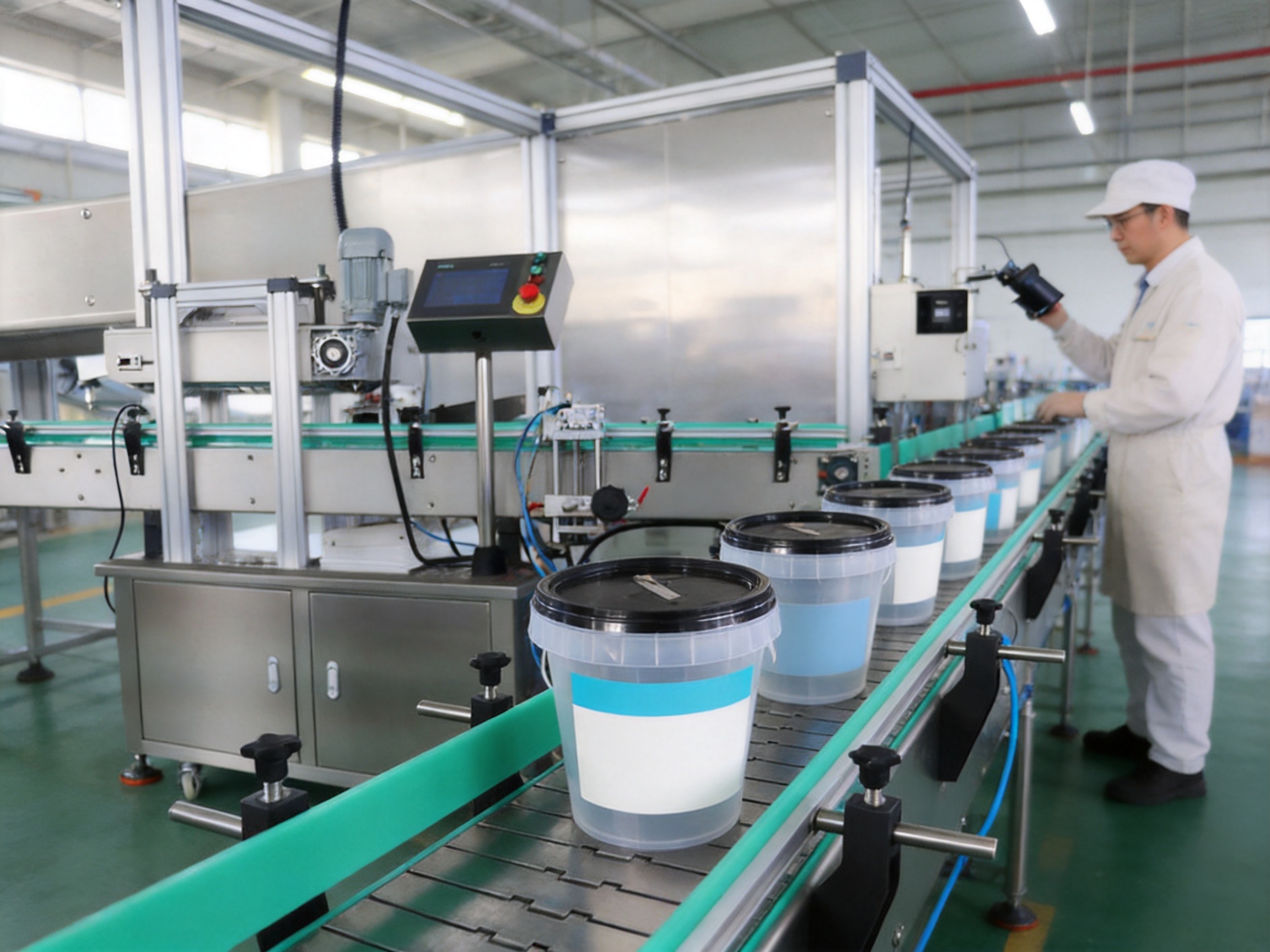
An automatic feeding device can supply pails to the labeling machine from an upstream packaging process. This option is useful when the filling, lid pressing, or sealing equipment operates continuously. Automatic feeding can reduce manual loading and help maintain a stable product interval.
Automatic Collection
An automatic collection device can receive labeled pails after application and arrange or transfer them to the next operation. This is helpful when products must be accumulated before palletizing, carton packing, inspection, or warehouse transfer.
Additional Labeling Units
Some applications require more than one label. An additional labeling unit can be used for front-and-back labels, side labels, warning labels, ingredient labels, or different labels applied at separate heights. The configuration should be selected according to the required spacing and circumferential relationship between labels.
Unlabeled-Product Rejection
An unlabeled-product rejection system can remove products when the label sensor or inspection system identifies a missing or incorrectly applied label. This helps prevent nonconforming products from reaching the next packaging stage. Rejection equipment is particularly useful when labels contain critical regulatory or traceability information.
How to Select the Correct Configuration
Customers should prepare detailed information before requesting a quotation or technical proposal. The most important information includes pail drawings or samples, diameter, height, taper angle, material, handle type, lid design, surface finish, label dimensions, label material, adhesive type, and required labeling position.
The production requirement should also be defined. This includes the target output per minute, working hours per day, batch size, upstream and downstream equipment, operator involvement, and expected future expansion. A machine that is suitable for a small batch operation may need different feeding and collection equipment for continuous high-volume production.
Label details are equally important. The manufacturer should review the label height, length, backing material, roll core diameter, maximum roll diameter, winding direction, gap between labels, and whether the label is flexible enough for the pail curvature. A long label on a sharply tapered pail may require a different pressing arrangement from a short label applied near the center of a gently curved surface.
Customers should specify whether they need one label, two labels, front-and-back application, a fixed circumferential position, edge labeling, or a combination of these functions. They should also indicate whether the label must align with a handle, lid feature, existing mark, or printed product information.
Sample testing is strongly recommended. A machine may appear compatible based on diameter and height alone, but actual performance can be affected by surface texture, pail flexibility, handle movement, adhesive behavior, and label stiffness. Testing provides a more dependable basis for confirming speed, accuracy, and final configuration.
Economic and Operational Value
The value of an automatic conical pail labeling machine is not limited to its initial purchase price. A complete evaluation should consider labor reduction, label material savings, reduced rework, improved appearance, production stability, changeover time, maintenance requirements, and the ability to connect with other packaging equipment.
When manual labeling is used, the cost of labor may increase as production volume grows. Manual processes may also generate hidden costs through inconsistent application, rejected products, relabeling, customer complaints, and slower order completion. Automation can reduce these factors when the machine is correctly matched to the product.
Label waste is another important consideration. No-product-no-label control, label detection, and stable dispensing can reduce unnecessary material consumption. Even small savings per pail can become significant over long production runs, especially when labels are large or made from specialized materials.
Stable labeling also improves production planning. When the labeling cycle is repeatable, downstream packing and palletizing operations can be scheduled more reliably. Operators can use production counting and quantity reminders to manage batches and coordinate material preparation.
The machine’s ability to support different pail sizes and label configurations may also reduce the need for multiple dedicated machines. This does not mean that one standard configuration will handle every possible container. However, a platform with adjustable support, rotary positioning, and multi-directional labeling adjustment can provide broader utility than a machine designed for only one product.
Safety and Responsible Operation
Operators should receive training before using the machine. Training should cover loading, label roll installation, touch-screen operation, adjustment points, emergency stops, cleaning, and fault handling. Operators should never reach into moving mechanisms while the machine is running.
The handle-lifting, rotary, pressing, and conveyor mechanisms should be inspected for safe movement. Guards and protective devices should remain in place. Before maintenance, cleaning, or adjustment inside moving areas, the machine should be stopped and isolated according to the facility’s safety procedures.
Products containing chemicals, solvents, or hazardous materials may require additional environmental and safety controls. The labeling machine should be installed in a location suitable for the product and label materials, with appropriate ventilation, spill management, electrical protection, and cleaning procedures.
Safe operation also supports equipment reliability. Preventing unauthorized adjustments, overloading, impact damage, and contamination can extend component life and reduce avoidable downtime.
Frequently Asked Questions
What types of containers can this machine label?
The machine is designed for round pails, conical pails, small to medium-sized drums, and other handled containers within the applicable size range. Standard applications cover products with diameters of approximately 150–400 millimeters and heights of approximately 200–500 millimeters. Special sizes should be confirmed through sample testing.
Can it label tapered pails?
Yes. The machine is specifically designed to address the changing diameter and curved surface of conical or tapered pails. Adjustable labeling-head positions, controlled rotary movement, and a pressing mechanism help the label follow the product surface.
How does the machine prevent the handle from interfering with the label?
A handle-lifting mechanism raises or supports the handle before the labeling operation. This creates clearance between the handle and the label application area. The exact adjustment depends on the handle design, pail height, and desired label position.
Can the machine apply two labels?
Yes. Depending on the application, it can support single-label, double-label, front-and-back, edge, or fixed-position labeling. Additional labeling units may be added when the application requires separate labels at different heights or positions.
What labeling speed can be achieved?
The stated speed range is approximately 10–25 pails per minute. The actual speed depends on pail dimensions, label size, label material, product stability, positioning requirements, operator loading, and optional equipment. The machine should be tested with actual samples to confirm the practical output.
What label sizes are supported?
The standard label height range is approximately 10–150 millimeters, and the label length range is approximately 15–300 millimeters. Customized specifications may be considered according to the user’s label and product requirements.
Does the machine require compressed air?
The standard technical information specifies an air pressure range of approximately 0.4–0.6 MPa. The exact requirement depends on the pneumatic components included in the final configuration and should be confirmed before installation.
Can a date or batch code be printed during labeling?
Yes. Optional thermal coding printers and inkjet printers can be integrated to add production dates, batch numbers, traceability codes, and other variable information.
Does the machine label every time it detects a gap in the product flow?
The photoelectric detection system supports no-product-no-label operation. When no pail is detected, the machine can prevent unnecessary label dispensing. This function helps reduce label waste during irregular feeding or temporary product gaps.
How accurate is the label placement?
The stated labeling accuracy is approximately plus or minus 1.5 millimeters under suitable conditions. The actual result depends on container roundness, product hardness, taper, surface condition, label material, adhesive, and correct machine adjustment.
Can the equipment be connected to a complete packaging line?
Yes. Optional automatic feeding, collection, coding, additional labeling, and unlabeled-product rejection systems can be used to build a more complete packaging solution. The interface with upstream and downstream equipment should be planned during the technical design stage.
Why is sample testing important?
Sample testing confirms whether the pail, label, handle, adhesive, taper, and desired labeling position are compatible with the machine. It also helps determine practical speed, pressing requirements, positioning accuracy, and the need for customized fixtures or controls.
What manufacturing capabilities support this machine?
The manufacturer operates CNC machining centers, maintains an experienced technical team, and manages processes from core component machining to machine assembly and commissioning. The company also works under an ISO 9001 quality system and has experience with several categories of labeling equipment.
Conclusion
The automatic conical pail labeling machine provides a specialized answer to the difficulties of labeling tapered, handled, round pails and small drums. By combining conveying, handle lifting, product detection, rotary positioning, label dispensing, and pressing, it creates a more controlled process than manual labeling or a basic cylindrical-container applicator.
Its main advantages include flexible adjustment, stable product positioning, reduced label waste, support for multiple label formats, improved appearance, and compatibility with additional coding and packaging functions. The operating range covers pails with approximate diameters of 150–400 millimeters, heights of 200–500 millimeters, label heights of 10–150 millimeters, and label lengths of 15–300 millimeters, subject to application confirmation.
Manufacturing capability is an important part of the equipment’s value. CNC machining, in-house technical coordination, complete assembly, commissioning, and an ISO 9001 quality system provide a structured foundation for producing and customizing labeling machinery. Experience with bottles, syringes, double-sided applications, high-speed systems, and print-and-apply equipment further supports the development of application-specific solutions.
For manufacturers that need consistent label placement, lower manual labor requirements, improved package presentation, and a pathway toward greater packaging automation, this machine offers a practical platform. The best results depend on correct configuration and testing with actual pails and labels. When product samples, production targets, label specifications, and future automation plans are reviewed together, the automatic conical pail labeling machine can become a reliable part of an efficient and scalable packaging line.
References
1. Shanghai Ruixiao Packaging Technology Co., Ltd. Product information for the automatic conical pail labeling machine, model RXL-RCD.
2. Shanghai Ruixiao Packaging Technology Co., Ltd. Technical specifications for pail, drum, bottle, syringe, and industrial labeling equipment.
3. ISO 9001. Quality management systems: requirements and principles for controlled manufacturing processes.
4. General pressure-sensitive labeling engineering practices for curved and tapered containers.
5. General packaging automation principles relating to product detection, rotary positioning, label dispensing, coding, inspection, and rejection.
Product: Automatic Conical Pail Labeling Machine

related products
related News
 +86 13681850339
 sales@raxpack.com
 Building 6, No. 477 Tiefeng Road, Baoshan District, Shanghai, China
- Tabletop Labeling Machine
- Round Bottle Labeling Machine
- Automatic Tube Labeling Machine
- Pouch Labeling Machine
- Rotary Labeling Machine
- Syringe Labeling Machine
- Top Labeling Machine
- Single Side Sticker Labeling Machine
- Double Side Labeling Machine
- Bucket Labeling Machine
- Bottom Labeling Machine
- Corner Label Applicator
- Waist Sealing Labeling Machine
- Square Bottle Labeling Machine
