 English
 русский
 Español
 عربى



Box Single Corner Self-Adhesive Labeling Machine: Precision Carton Corner Labeling for Automated Packaging
2026-10-22
Content
- 1 Introduction to Automated Corner Labeling
- 2 Product Overview
- 3 Why Corner Labeling Requires Specialized Equipment
- 4 Core Advantages of the Machine
- 5 Operating Principle
- 6 Technical Specifications
- 7 Performance Compared with Alternative Labeling Methods
- 8 Manufacturing Strengths and Engineering Capabilities
- 9 Applications Across Multiple Industries
- 10 Label and Carton Compatibility
- 11 Installation and Setup Considerations
- 12 Operation and Maintenance
- 13 Integration into Automated Packaging Lines
- 14 Quality, Accuracy, and Production Efficiency
- 15 Selection Guidance for Buyers
- 16 Frequently Asked Questions
- 16.1 What type of product is this machine designed to label?
- 16.2 Can the machine apply tamper-evident labels?
- 16.3 Does the machine stop when there is no carton?
- 16.4 What labeling speed can be expected?
- 16.5 What is the expected labeling accuracy?
- 16.6 Can the machine handle different carton sizes?
- 16.7 Can it print batch numbers and production dates?
- 16.8 Can it apply barcode labels or electronic regulatory codes?
- 16.9 Can the machine be connected to another production line?
- 16.10 What power supply does the machine use?
- 16.11 What should be tested before purchase?
- 16.12 What makes this machine different from a general labeling machine?
- 16.13 Who manufactures the machine?
- 17 Conclusion
- 18 References
- 19 Product: Box Single Corner Self-Adhesive Labeling Machine
Introduction to Automated Corner Labeling
Carton packaging has become increasingly important across pharmaceutical, food, beverage, electronics, cosmetics, healthcare, and daily chemical industries. A package must not only protect its contents but also communicate product information, support traceability, reinforce brand identity, and provide visible evidence of opening or tampering. For many cartons, a label applied across a corner or along a closing flap can perform several of these functions at the same time.
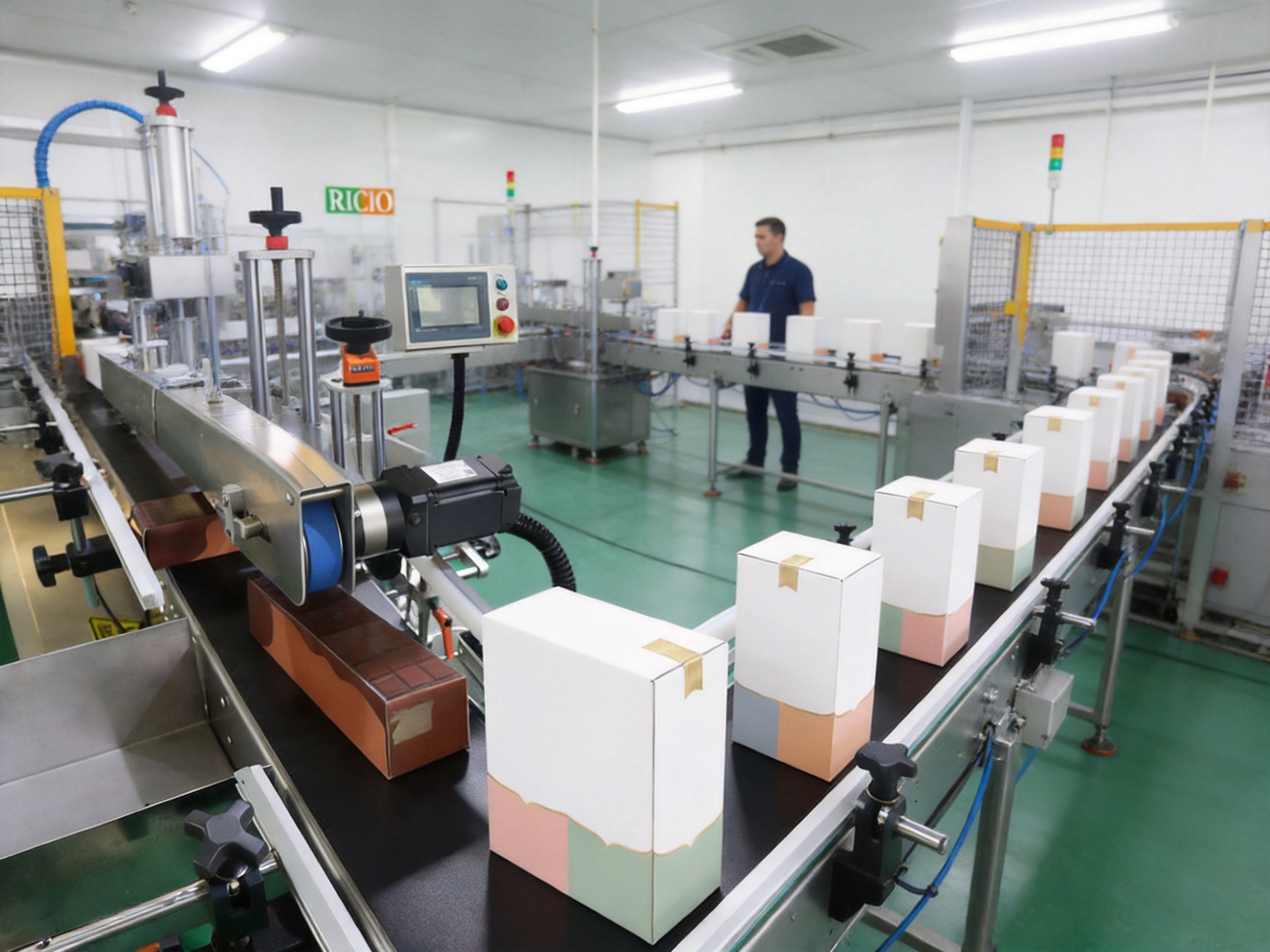
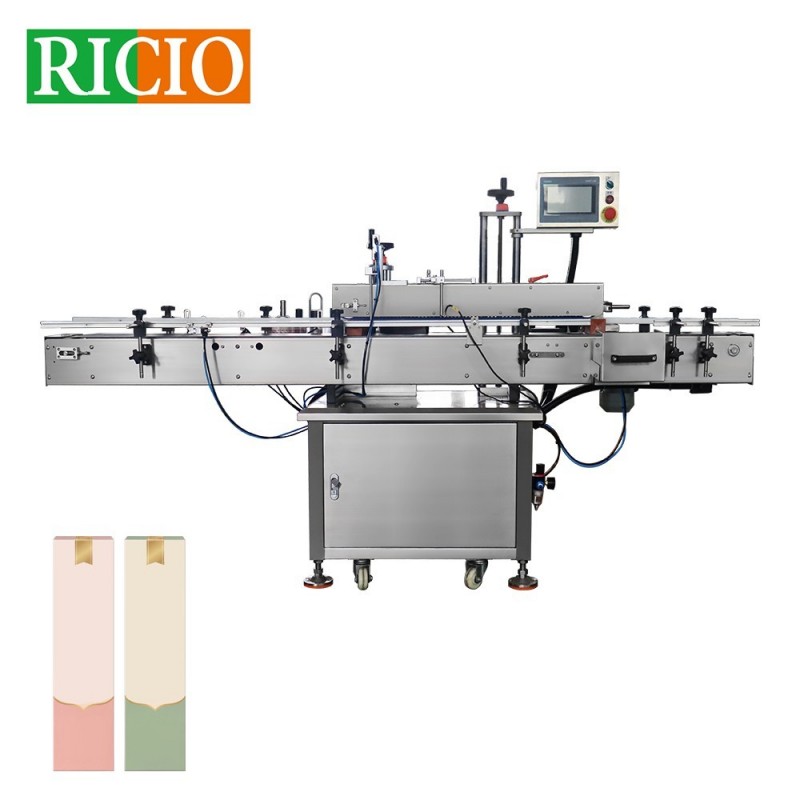
The Box Single Corner Self-Adhesive Labeling Machine is an automatic labeling system developed for this specific requirement. Designated as RXL-SSC, the machine applies self-adhesive labels to carton corners and single-side corner positions. It is designed to deliver consistent label placement while supporting coding, counting, product detection, and corner folding operations.
Unlike general-purpose labeling equipment that may require extensive modifications for corner applications, this machine combines carton conveying, label dispensing, corner application, pressing, and detection within one coordinated system. Its structure is compact, its operating logic is straightforward, and its adjustable configuration allows it to handle cartons with different dimensions, materials, colors, and packaging requirements.
The machine is suitable for manufacturers seeking a more reliable alternative to manual corner labeling and less specialized equipment. It can operate as an independent workstation or connect with upstream and downstream machinery in an automated production line. This flexibility makes it practical for both established factories and growing manufacturers that intend to expand their packaging automation in stages.
Box Single Corner Self-Adhesive Labeling Machine
Product Overview
The Box Single Corner Self-Adhesive Labeling Machine is engineered to apply one self-adhesive label to a specified carton corner or corner-sealing position. During operation, cartons are conveyed into the labeling area, detected by a photoelectric sensor, accurately positioned, and labeled by the dispensing mechanism. Rollers, brushes, and pressing components then help secure the label to the carton surface.
The application can be used for tamper-evident sealing, corner identification, regulatory marking, batch traceability, or other packaging functions. Because the label can bridge a carton edge or be applied to a designated corner area, it may provide a visible indication if the carton has been opened or disturbed after packaging.
The system includes automatic label feeding and product detection. When no carton is present, label feeding stops automatically. This function prevents unnecessary dispensing and helps reduce label waste. It also improves synchronization between the product flow and the labeling cycle, which is especially valuable in high-volume production environments.
Automatic photoelectric tracking monitors the position of incoming cartons and supports the correct timing of label application. If a carton is missing, the machine can avoid applying a label to an empty position. Intelligent control functions also help identify and correct label-feeding deviations, supporting consistent performance over extended operating periods.
The carton conveying system is designed to provide stable product movement through the labeling area. An upper roller pressing mechanism and side brushing mechanism assist in attaching the label firmly to the carton. These components are particularly important for corner labels because the label must conform to more than one surface or remain securely attached near a carton edge.
Primary Functions
The machine provides automatic carton conveying, product detection, label dispensing, corner application, pressing, and production counting. Depending on the production configuration, it can also support batch number printing and production date marking. These functions allow manufacturers to combine labeling and basic traceability operations in a single packaging process.
Its adjustable labeling speed enables users to adapt production output to carton dimensions, label length, operator requirements, and the capabilities of connected equipment. The stated speed range is approximately 4 to 80 pieces per minute, with actual throughput depending on product size and label specifications.
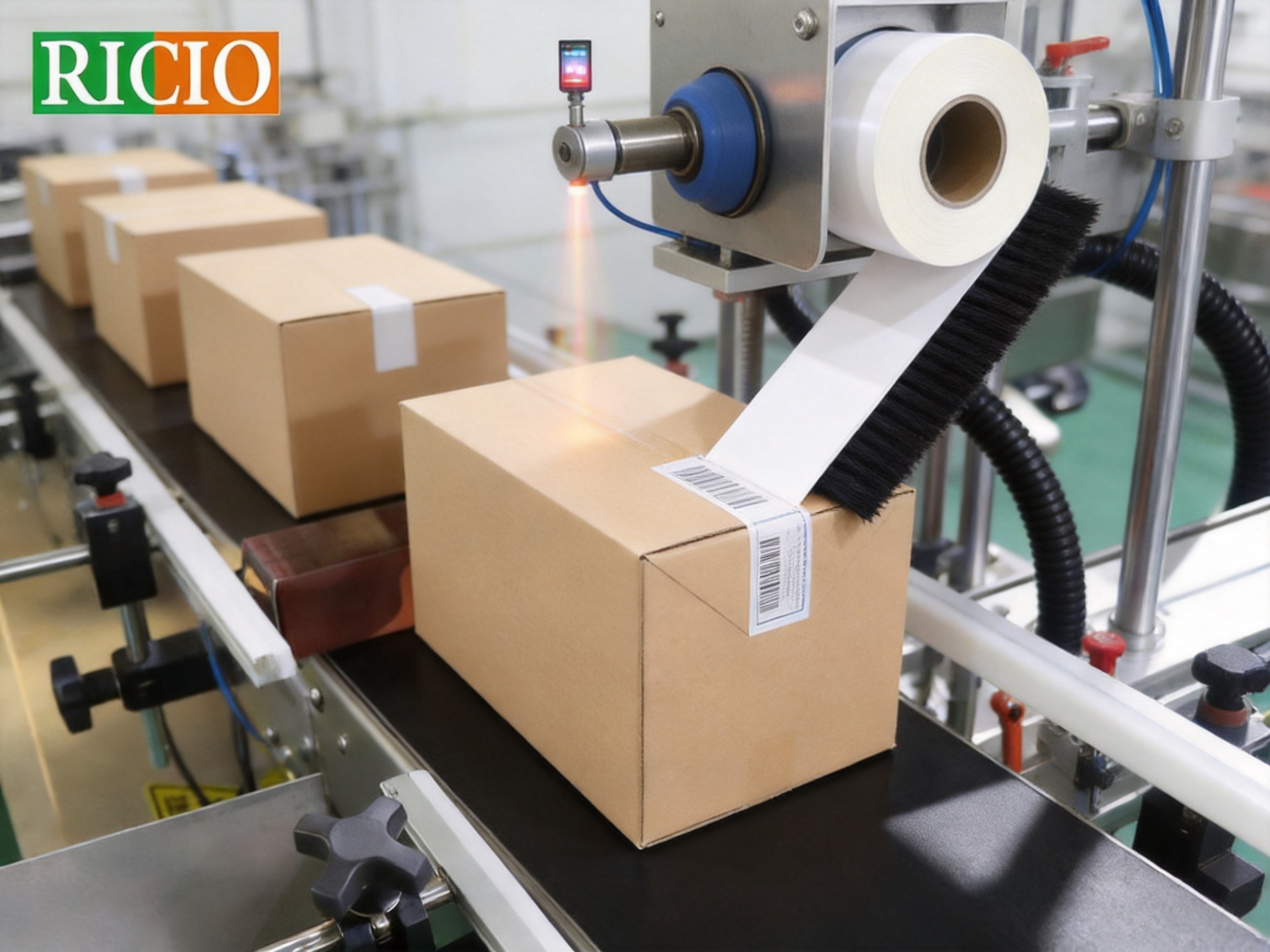
The system is compatible with self-adhesive labels, barcode labels, and electronic regulatory codes. This allows it to serve both basic identification applications and more advanced packaging processes that require machine-readable information.
Why Corner Labeling Requires Specialized Equipment
Applying a label to a flat carton panel is relatively simple compared with applying a label across or near a corner. A corner introduces changes in surface direction, differences in contact pressure, and a greater risk of edge lifting. If the label is not positioned correctly, it may wrinkle, detach, or fail to provide the intended tamper-evident effect.
Manual application can create additional inconsistencies. Operators may position labels at different heights, apply different pressure, or change the angle of the label from one carton to another. These variations can affect appearance, inspection results, sealing reliability, and the overall professional quality of the package.
General flat-surface labelers may not provide the roller and brush arrangement needed to press a label around a corner. They may also lack product-positioning controls suitable for cartons that vary in length, width, or height. A specialized corner labeling system addresses these challenges by coordinating product conveyance, label timing, pressing, and side contact.
The Box Single Corner Self-Adhesive Labeling Machine is designed around these practical requirements. Its upper roller pressing mechanism applies controlled contact to the label, while the side brushing mechanism supports adhesion along the carton side or edge. This coordinated structure helps minimize label lifting and improves repeatability.
Another important consideration is carton diversity. Packaging lines may process cartons made from coated paperboard, uncoated paperboard, laminated materials, or other packaging substrates. Cartons may also have different colors, surface finishes, and dimensions. A labeling machine must therefore offer adjustment capability rather than relying on one fixed product format.
Core Advantages of the Machine
Purpose-Built Corner Application
The most important advantage of the machine is its dedicated design for single-corner labeling and carton corner sealing. Its application structure is not merely a standard flat labeling unit with a basic attachment added. The conveying, pressing, and brushing functions are arranged to support the physical demands of corner application.
This specialization can provide more consistent results than manual labeling or equipment designed only for flat-panel applications. It also simplifies the process of developing a repeatable packaging procedure because the machine is configured around the location where the label must be applied.
Consistent Label Positioning
Stable product conveying and automatic photoelectric tracking help maintain the timing and position of each labeling cycle. Consistent positioning is important for carton appearance, barcode readability, tamper-evident performance, and downstream inspection.
The system can detect the product before label feeding begins. This product-present logic helps prevent labels from being released when a carton is absent. It also reduces the risk of labels being applied between cartons or wasted during interruptions in product flow.
Reliable Adhesion and Pressing
Corner labels must remain firmly attached despite changes in surface direction. The upper roller pressing mechanism provides a controlled pressing action, while the side brushing mechanism assists contact along the carton side. Together, these components help remove air gaps and improve label attachment.
Reliable pressing is particularly beneficial for cartons that will be transported, packed into shipping cases, or handled by automated equipment after labeling. A label that is only partially attached may lift during conveying or storage. By improving the contact between the adhesive and carton surface, the machine supports more durable application results.
Reduced Label Waste
Label waste can become a significant operating cost in large-scale production. Waste may result from missed products, incorrect timing, manual positioning errors, or unnecessary label feeding during line stoppages. The machine addresses these issues through product detection and automatic control of label dispensing.
When the sensor detects that no carton is present, the system stops feeding labels. This function does not eliminate all possible waste, since label performance also depends on material quality and correct machine adjustment, but it can substantially improve material efficiency compared with uncontrolled or manually synchronized application.
Integrated Coding and Counting Support
Many packaging operations require more than a label. They may also need a batch number, production date, lot information, or production count. The machine can support coding and marking functions as part of the packaging workflow, reducing the need for separate manual operations.
Production counting helps operators monitor output and compare actual production with scheduled quantities. When combined with batch and date marking, the system can support more organized production management and improve the traceability of finished cartons.
Adaptability to Different Cartons
The machine is designed for cartons with different specifications, colors, and materials. Its stated carton range includes a length of approximately 18 to 300 millimeters, a width range of approximately 18 to 200 millimeters, and another dimensional range listed as 18 to 150 millimeters for the applicable carton direction.
Because packaging formats differ between industries, adjustment capability is a major consideration when selecting a labeling machine. A machine that can be adapted to multiple carton sizes may reduce the need for separate equipment and help manufacturers manage product variety more efficiently.
Independent or Inline Operation
The Box Single Corner Self-Adhesive Labeling Machine can work independently or connect with other production equipment. In standalone operation, operators can feed cartons into the system and collect labeled products at the discharge end. In an automated line, the machine can be integrated with carton forming, filling, sealing, coding, inspection, or case-packing equipment.
This operating flexibility helps manufacturers choose an installation method according to their current production scale. A company may begin with a single-machine configuration and later connect the unit to a larger packaging line as output requirements increase.
Operating Principle
Carton Feeding and Position Detection
Cartons enter the machine through the conveying section. The conveyor maintains a controlled product path and guides each carton toward the labeling station. A photoelectric sensor detects the incoming carton and communicates its presence to the control system.
The sensor signal allows the machine to coordinate label release with carton position. If the expected product is not detected, the machine can suspend label feeding. This basic synchronization function is essential for avoiding missing labels, misplaced labels, and unnecessary consumption of label material.
Label Dispensing
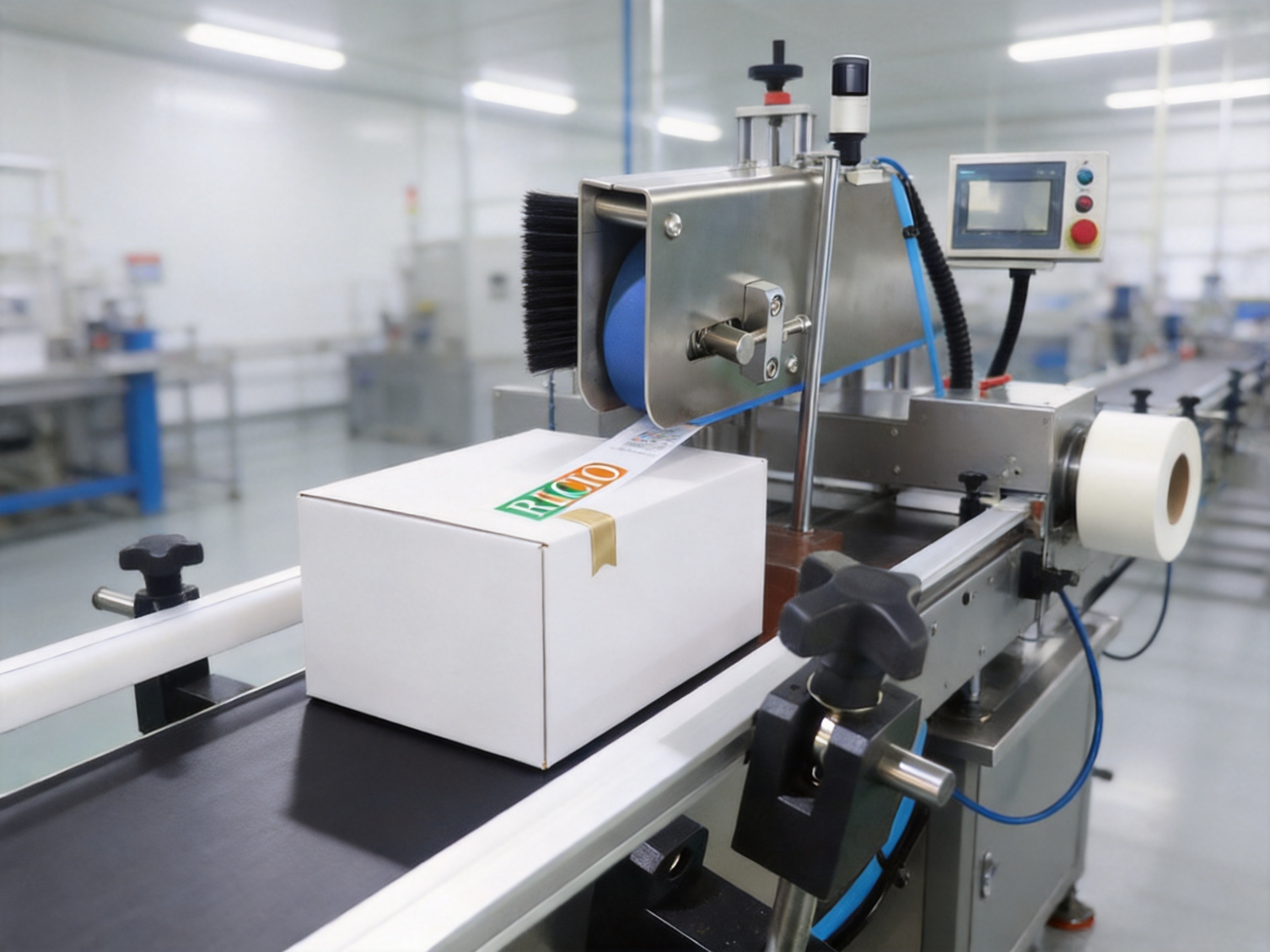
Self-adhesive labels are supplied from a roll mounted on the labeling mechanism. The maximum recommended label roll outer diameter is approximately 300 millimeters, while the label roll core inner diameter is approximately 76 millimeters. The label material must be suitable for automatic dispensing and have sufficient tensile strength.
The label web moves through the dispensing path, where the label is separated from its backing material at the required timing. The machine then presents the label to the carton corner. Correct adjustment of label tension, product speed, and dispensing position helps maintain accurate application.
Corner Application and Pressing
After the label reaches the application position, the carton continues through the pressing section. The upper roller applies pressure to the label, while the side brushing component supports contact on the adjacent surface. This combination helps the label follow the carton geometry and remain attached across the intended corner area.
The pressing process is especially important when the label functions as a tamper-evident seal. The label must be attached firmly enough that removal or opening of the carton produces a visible change. The exact tamper-evident result depends on the label construction, adhesive, carton surface, and packaging design, but consistent machine application is an essential part of the process.
Counting and Discharge
Once the label has been applied and pressed, the carton exits the labeling area. The control system can count completed units and provide operators with production information. The finished carton can then move to inspection, packing, palletizing, or another stage of the production line.
When the machine is integrated with upstream and downstream equipment, signals can be exchanged to coordinate product flow. This can help reduce congestion and improve overall line stability.
Technical Specifications
Item | Specification |
Applicable product | Cartons requiring single-corner or corner-sealing labels |
Carton dimensions | Length 18 to 300 millimeters; width 18 to 200 millimeters; applicable height or related dimension 18 to 150 millimeters |
Label length | 20 to 200 millimeters |
Labeling speed | Approximately 4 to 80 pieces per minute, depending on product size and label length |
Labeling accuracy | Approximately plus or minus 1 millimeter |
Maximum label roll outer diameter | Approximately 300 millimeters |
Label roll core inner diameter | Approximately 76 millimeters |
Minimum single-label spacing | At least 3 millimeters |
Label material requirement | Label thickness at least 8 micrometers; backing paper thickness at least 5 micrometers; sufficient tensile strength required |
Machine power | Approximately 1500 watts |
Power supply | AC 220 volts, 50 or 60 hertz, single phase; other configurations can be customized when required |
Machine dimensions | Approximately 1800 by 1000 by 1600 millimeters |
Net weight | Approximately 280 kilograms |
These specifications provide a general basis for evaluating machine suitability. Actual performance can vary according to carton rigidity, surface finish, label adhesive, label shape, environmental conditions, operator adjustment, and the configuration of connected equipment. Product samples and label samples should be tested before final installation.
Performance Compared with Alternative Labeling Methods
Compared with Manual Labeling
Manual labeling may appear economical for small production runs, but it can become inefficient as volume increases. Operators must repeatedly position each label, apply pressure, inspect the result, and maintain a consistent working rhythm. Fatigue and differences between operators can lead to variations in label position and adhesion.
The automatic machine improves repeatability by using controlled product movement, sensor-based timing, and dedicated pressing components. It can also count production and coordinate with other machinery. These functions reduce dependence on manual synchronization and allow operators to focus on material supply, inspection, and production supervision.
Compared with General Flat-Panel Labelers
Flat-panel labelers are suitable for many applications, but they may not provide the contact arrangement needed for a corner label. A corner application requires controlled pressure from more than one direction and may require the label to follow a change in surface angle.
The Box Single Corner Self-Adhesive Labeling Machine has an upper roller and side brushing structure intended for this type of application. This gives it a functional advantage in carton corner sealing compared with equipment designed only for a single flat surface.
Compared with Separate Labeling and Manual Pressing Operations
Some production lines apply a label with one device and rely on a separate manual operation to press or fold the label around the carton corner. This arrangement can create a bottleneck and may produce inconsistent adhesion.
By combining application and pressing in one coordinated machine, the RXL-SSC reduces the number of separate handling steps. The carton remains under controlled movement while the label is pressed into place. This can improve line organization and reduce the labor required for secondary finishing.
Compared with Non-Intelligent Label Feeding
Basic label dispensers may continue feeding labels even when cartons are absent. This can lead to label accumulation, web breaks, product contamination, and material waste. The automatic product detection function of this machine provides a more controlled approach.
Its detection and control functions help ensure that labels are dispensed only when a suitable carton is present. This is a practical advantage for production lines that experience variable spacing, brief interruptions, or occasional product gaps.
Manufacturing Strengths and Engineering Capabilities
The machine is manufactured by Shanghai Ruixiao Packaging Technology Co., Ltd., also known as RICIO. The company specializes in the research, development, and manufacturing of labeling machinery for multiple industries and product types.
The company developed from the acquisition of Shanghai Zhenbao Machinery Parts Factory. This background provides a foundation in machinery component production and precision mechanical processing. Rather than operating only as an equipment assembler, the company has developed in-house machining and manufacturing capabilities for key components.
In-House Precision Machining
RICIO operates multiple computer numerical control machining centers and maintains an experienced technical team. In-house machining gives the manufacturer greater control over component dimensions, mechanical interfaces, material selection, and production consistency.
For a corner labeling machine, mechanical accuracy is important because the position of rollers, guides, sensors, and dispensing components influences final label placement. Precision-machined parts can help maintain stable alignment and reduce the variations that may occur when critical components are sourced from multiple unrelated suppliers.
In-house production also supports engineering modifications. When a customer requires a special carton size, a different conveyor arrangement, or a customized electrical configuration, the manufacturer can evaluate adjustments more directly. This can shorten communication cycles between design, machining, assembly, and commissioning teams.
Complete Process from Components to Commissioning
The company manages the process from core component machining to complete machine assembly and commissioning. This integrated approach allows the technical team to evaluate the complete machine rather than treating each subsystem as an isolated product.
During assembly, the interaction between the conveyor, sensor, labeling head, pressing mechanism, control system, and frame can be checked as one system. During commissioning, the machine can be adjusted for product tracking, label feeding, pressing pressure, and operating speed.
This full-process capability is valuable for specialized equipment because performance depends on the relationship between individual parts. A high-quality label dispenser alone cannot compensate for unstable conveying, and a precise sensor cannot deliver accurate results if the mechanical structure is poorly aligned.
Quality System and Production Control
The company manages manufacturing and assembly in accordance with the ISO 9001 international quality system. A quality management system provides a structured framework for documentation, production control, inspection, process management, and corrective action.
For customers, this type of system can improve confidence that equipment manufacturing is based on repeatable procedures rather than informal assembly practices. It also supports more organized handling of technical specifications, testing records, component requirements, and after-sales service information.
Application-Oriented Engineering
Labeling machinery must be adapted to real production conditions. The company’s product range includes equipment for syringes, round bottles, square bottles, double-sided labeling, high-speed labeling, and real-time print-and-apply operations. This broad experience exposes the engineering team to different container shapes, materials, line speeds, label materials, and packaging regulations.
That application knowledge can benefit carton corner labeling projects. Although cartons differ from bottles or medical devices, the same engineering principles apply: product tracking, label tension, dispensing accuracy, machine stability, operator usability, and line integration must all work together.
The company exports equipment to more than 40 countries and regions. International project experience can help the manufacturer understand different power requirements, factory layouts, production practices, documentation needs, and customer expectations.
Applications Across Multiple Industries
Pharmaceutical Cartons
Pharmaceutical packaging often requires batch information, production dates, product identification, and tamper-evident features. A corner label can provide visible evidence of carton opening while also supporting traceability requirements.
The machine can be used for cartons containing medicines, healthcare products, medical supplies, and related items. Its counting and coding support can help organize production, while accurate label positioning can improve the consistency of packaging inspection.
Food Packaging Boxes
Food manufacturers use cartons for snacks, cereal products, confectionery, prepared foods, and other packaged goods. Corner labels may be used for promotional information, product identification, tamper evidence, or supplementary regulatory codes.
The machine’s adjustable speed and carton-size flexibility make it suitable for food packaging operations with several product formats. The automatic stop function also helps reduce label consumption during interruptions or gaps in the product flow.
Electronic Product Boxes
Mobile phone boxes, network card boxes, accessories, and other electronic product packages often require clean and accurate labeling. A poorly positioned label can reduce the visual quality of an otherwise carefully designed package.
The controlled conveying and pressing structure helps create a more uniform appearance. The system can also support barcode or electronic regulatory code labels when the packaging process requires machine-readable information.
Daily Chemical and Cosmetic Packaging
Cosmetics, personal care products, household products, and cleaning supplies may use cartons with different finishes, colors, and dimensions. A corner label can support product security, brand presentation, and batch traceability.
The machine is designed to work with cartons made from different materials and presented in different formats. Application tests remain important because coated or highly finished carton surfaces may require a specific adhesive and pressing condition.
Printing and Light Industrial Products
Printing products, stationery, card products, poker card boxes, and other light industrial goods may require carton corner labels for identification or security. The machine can help replace repetitive manual application with a more stable automated process.
The available application examples include poker card boxes, mobile phone boxes, mask boxes, carton tamper-evident labeling, and network card box labeling. These examples demonstrate that the equipment can serve both consumer packaging and specialized product packaging applications.
Label and Carton Compatibility
Label Construction
The machine is designed for self-adhesive labels. The supplied technical information indicates a label thickness of at least 8 micrometers and a backing paper thickness of at least 5 micrometers, together with sufficient tensile strength. These requirements help the label web move through the dispensing path without excessive stretching or tearing.
Label quality affects the performance of every automatic labeling machine. If the backing paper is too weak, the web may break. If the label adhesive is unsuitable for the carton surface, the label may lift after application. If the labels are not spaced correctly, the sensor and dispensing system may not separate them consistently.
Label Spacing
The stated minimum distance between individual labels is approximately 3 millimeters. Sufficient spacing helps the dispensing mechanism identify the gap between labels and separate each label from its backing paper.
Before production, users should confirm the label pitch, shape, adhesive type, backing material, and winding direction. These factors affect the way the roll is mounted and the timing required for stable dispensing.
Carton Surface and Rigidity
Cartons should have sufficient structural stability to travel through the conveyor without collapsing, twisting, or changing position. Excessively flexible cartons may require additional guiding or support components.
Surface finish also affects adhesion. Glossy, coated, dusty, damp, or irregular carton surfaces may require a suitable adhesive specification. The machine can apply the label accurately, but adhesive performance ultimately depends on the compatibility between the label and the carton material.
Installation and Setup Considerations
Installation begins with selecting a stable, level location that provides adequate access to the machine, label roll, control panel, and maintenance areas. The installation space should also allow operators to safely load cartons and remove finished products.
The electrical supply should match the required AC 220-volt, 50 or 60 hertz, single-phase configuration unless another arrangement has been specified. Customized power requirements should be confirmed before shipment and installation.
Mechanical setup includes adjusting the carton guides, conveyor position, labeling head, upper roller, side brush, and sensor locations. The objective is to keep the carton stable and ensure that the label reaches the designated corner position without excessive resistance.
Initial commissioning should use actual cartons and labels whenever possible. Test products allow the technical team to evaluate label position, corner folding, adhesive contact, machine speed, and the behavior of the packaging material. Several samples should be inspected at different operating speeds before normal production begins.
Operators should also confirm the machine response during product gaps, line stops, label roll replacement, and restart conditions. These practical tests help ensure that the equipment performs reliably under normal factory conditions rather than only during a short demonstration.
Operation and Maintenance
Daily Operation
Before starting production, operators should inspect the label roll, backing web path, carton guides, sensors, pressing rollers, and side brush. The label roll should be mounted in the correct direction and aligned with the dispensing path.
Operators should confirm that the cartons enter the machine in a consistent orientation. Product variation outside the configured range can affect label position and may cause unstable conveying or incorrect detection.
During operation, the control panel can be used to adjust production speed and monitor the labeling process. If labels begin to shift, wrinkle, or lift, the machine should be stopped and the cause investigated rather than allowing defective products to accumulate.
Cleaning
Carton fibers, dust, adhesive residue, and backing-paper particles can accumulate around the dispensing edge, rollers, and brush. Regular cleaning helps maintain stable label movement and consistent pressing performance.
Cleaning methods should be selected according to the materials used in the machine. Abrasive tools or unsuitable solvents may damage surfaces, rollers, sensors, or protective coatings. The machine should be isolated from power before cleaning areas near moving or electrical components.
Inspection of Wear Components
Pressing rollers, side brushes, belts, guides, and other contact components should be inspected periodically. Wear can change the pressure applied to the label or affect carton movement. Replacing worn components in a timely manner helps prevent larger problems and maintains application quality.
Photoelectric sensors should be kept clean and correctly aligned. A sensor that is obstructed, contaminated, or mechanically displaced may cause missed detection or incorrect label timing.
Label Roll Replacement
When a label roll is replaced, the operator should thread the new material according to the designated path and check the tension before restarting production. The first several cartons should be inspected carefully to verify label position and adhesion.
Maintaining consistent label material from one production batch to the next can also improve machine stability. Major changes in label thickness, backing paper, adhesive, or winding direction may require a new setup.
Integration into Automated Packaging Lines
The machine can be positioned after carton forming, filling, or sealing equipment, depending on the intended labeling location. It may also be installed before inspection, case packing, bundling, or palletizing equipment.
When integrated into a production line, important considerations include conveyor height, product transfer spacing, control signals, emergency-stop coordination, and the speed relationship between machines. The labeling unit should receive cartons at a stable and manageable interval.
Integration can improve efficiency because cartons do not need to be manually transported between separate operations. It also supports more consistent production records and reduces the number of manual handling points where products may be damaged or misoriented.
For manufacturers with changing production requirements, the machine’s ability to operate independently is equally important. A standalone installation can provide immediate automation without requiring the entire packaging line to be redesigned.
Quality, Accuracy, and Production Efficiency
The stated labeling accuracy is approximately plus or minus 1 millimeter. This level of accuracy can support many carton corner labeling applications, but actual results depend on carton stability, label tolerances, sensor adjustment, adhesive behavior, and the precision of the incoming product flow.
Production efficiency is not determined only by maximum speed. A stable machine operating at a suitable speed may provide better overall output than a faster system that frequently requires correction or produces rejected cartons. The adjustable range of approximately 4 to 80 pieces per minute allows users to balance speed with product handling and application quality.
Reduced waste also contributes to efficiency. Product detection prevents unnecessary label feeding, while automatic counting helps operators monitor output and identify production deviations. A consistent pressing mechanism can reduce rework caused by loose, lifted, or incorrectly applied labels.
For high-volume operations, these improvements can contribute to lower labor requirements, more predictable material consumption, and better utilization of floor space. For smaller operations, the same functions can reduce dependence on manual work and provide a practical path toward automation.
Selection Guidance for Buyers
Before purchasing a corner labeling machine, users should define the complete application. This includes carton length, width, height, material, surface finish, weight, corner location, label length, label width, adhesive type, required speed, and the desired relationship between labeling and coding.
Manufacturers should provide representative cartons and labels for testing. Sample testing can confirm whether the label follows the corner correctly, whether the adhesive bonds to the carton, whether the roller and brush pressure are suitable, and whether the machine reaches the required output.
Buyers should also consider future product formats. A machine that supports a wider range of carton sizes may offer better long-term value than equipment configured for only one product. Adjustment capability, changeover time, spare-parts availability, and technical support should be considered together with the initial purchase price.
Electrical requirements and factory conditions should be reviewed in advance. The customer should confirm available power, floor space, conveyor height, environmental conditions, operator access, and line communication requirements.
Finally, the buyer should evaluate the manufacturer’s engineering and service capabilities. A supplier with in-house machining, complete assembly, commissioning experience, and an established quality system may be better prepared to support customized applications and long-term equipment performance.
Frequently Asked Questions
What type of product is this machine designed to label?
It is designed primarily for carton boxes that require a self-adhesive label on a single corner or corner-sealing position. It can be used for pharmaceutical cartons, food boxes, electronic product boxes, daily chemical packaging, printing products, beverage packaging, and other suitable carton applications.
Can the machine apply tamper-evident labels?
Yes. The machine is designed for carton corner sealing and tamper-evident labeling applications. The final security performance depends on the label construction, adhesive, carton design, and the way the label is positioned, but the machine provides controlled placement and pressing for this purpose.
Does the machine stop when there is no carton?
The system uses automatic product detection and can stop label feeding when no product is detected. This helps avoid labeling empty positions and reduces unnecessary label waste.
What labeling speed can be expected?
The stated speed range is approximately 4 to 80 pieces per minute. Actual speed depends on carton dimensions, label length, product spacing, adhesive behavior, and the configuration of connected equipment.
What is the expected labeling accuracy?
The listed labeling accuracy is approximately plus or minus 1 millimeter. Actual accuracy should be confirmed through testing with the customer’s cartons and labels.
Can the machine handle different carton sizes?
Yes. The machine is designed for cartons with different specifications, colors, and materials. The listed carton ranges include a length of approximately 18 to 300 millimeters, a width of approximately 18 to 200 millimeters, and an applicable related dimension of approximately 18 to 150 millimeters.
Can it print batch numbers and production dates?
The machine can support batch number printing, production date marking, and production counting as part of the packaging process. The exact coding equipment and integration method should be confirmed according to the project requirements.
Can it apply barcode labels or electronic regulatory codes?
Yes. The system supports self-adhesive labels, barcode labels, and electronic regulatory codes, provided that the label material and dimensions are compatible with the machine.
Can the machine be connected to another production line?
Yes. It can operate independently or be integrated with other production equipment. Line integration should be planned around conveyor height, carton spacing, machine speed, communication signals, and emergency-stop requirements.
What power supply does the machine use?
The standard specification is AC 220 volts, 50 or 60 hertz, single phase. Other power configurations may be customized when required and should be confirmed before production.
What should be tested before purchase?
Users should test actual cartons and labels to verify application position, corner folding, adhesion, label tension, production speed, detection performance, and restart behavior. Testing is particularly important when cartons have unusual shapes, coatings, or surface finishes.
What makes this machine different from a general labeling machine?
It is specifically designed for single-corner carton labeling. Its upper roller pressing mechanism and side brushing mechanism support adhesion around the corner, while product detection and automatic label control help improve synchronization and reduce waste.
Who manufactures the machine?
The machine is manufactured by Shanghai Ruixiao Packaging Technology Co., Ltd., a Shanghai-based developer and manufacturer of labeling machinery. The company provides equipment for carton, bottle, syringe, high-speed, double-sided, and print-and-apply labeling applications.
Conclusion
The Box Single Corner Self-Adhesive Labeling Machine provides a specialized solution for carton corner sealing, tamper-evident labeling, and single-side corner applications. Its value comes from the combination of dedicated corner application hardware, stable conveying, automatic product detection, controlled label feeding, pressing rollers, side brushing, and intelligent operating functions.
Compared with manual labeling, the machine offers greater repeatability and improved production organization. Compared with general flat-surface labeling equipment, it provides a more suitable structure for applying and pressing labels near a carton corner. Compared with uncontrolled label dispensing systems, its product detection function can help reduce waste and prevent labeling without a product.
The machine also benefits from the manufacturing capabilities of Shanghai Ruixiao Packaging Technology Co., Ltd. The company’s in-house precision machining, technical team, complete assembly and commissioning process, ISO 9001 quality management approach, and experience with international labeling projects support the development of reliable and application-focused equipment.
For manufacturers handling pharmaceutical cartons, food boxes, electronic packaging, cosmetics, daily chemicals, printed products, or other suitable cartons, this machine can provide a practical route toward more consistent corner labeling. Proper sample testing, correct label selection, regular maintenance, and suitable line integration will help users achieve the best long-term results.
References
1. Product technical specification sheet for the Box Single Corner Self-Adhesive Labeling Machine, model RXL-SSC.
2. Manufacturer-provided application information for carton corner sealing and tamper-evident labeling.
3. Manufacturer-provided information on labeling machinery design, precision machining, assembly, commissioning, and quality management.
4. General principles of automatic self-adhesive label dispensing, product detection, carton conveying, and pressure application.
5. General packaging engineering practices for carton labeling, batch identification, production date marking, barcode application, and tamper-evident packaging.
Product: Box Single Corner Self-Adhesive Labeling Machine

related products
related News
 +86 13681850339
 sales@raxpack.com
 Building 6, No. 477 Tiefeng Road, Baoshan District, Shanghai, China
- Tabletop Labeling Machine
- Round Bottle Labeling Machine
- Automatic Tube Labeling Machine
- Pouch Labeling Machine
- Rotary Labeling Machine
- Syringe Labeling Machine
- Top Labeling Machine
- Single Side Sticker Labeling Machine
- Double Side Labeling Machine
- Bucket Labeling Machine
- Bottom Labeling Machine
- Corner Label Applicator
- Waist Sealing Labeling Machine
- Square Bottle Labeling Machine
