 English
 русский
 Español
 عربى



Automatic Paging Top and Bottom Pouch Labeling Machine: Precision Double-Sided Labeling for Flat Products
2026-11-17
Content
- 1 Integrated Paging and Labeling for Flat Products
- 2 Top, Bottom, or Double-Sided Label Application
- 3 Vacuum-Assisted Conveying for Lightweight and Flexible Items
- 4 Servo Label Feeding and Photoelectric Detection
- 5 Consistent Application with Pressing and Smoothing Mechanisms
- 6 PLC Control and Touch Screen Operation
- 7 Technical Specifications
- 8 Advantages Compared with Conventional Labeling Solutions
- 9 Applications Across Multiple Industries
- 10 Optional Modules for Coding, Reading, and Traceability
- 11 Manufacturing Strength and Engineering Capability
- 12 Materials, Structure, and Cleanability
- 13 Installation, Commissioning, and Changeover
- 14 How to Select the Correct Configuration
- 15 Operating Benefits for Production Managers
- 16 Quality and Reliability Considerations
- 17 Q&A
- 17.1 What products can the automatic paging top and bottom pouch labeling machine handle?
- 17.2 Can the machine label both sides of a product?
- 17.3 How does the paging system separate products?
- 17.4 Why is a vacuum conveyor useful for pouches and thin sheets?
- 17.5 What is the expected labeling speed?
- 17.6 What labeling accuracy can be expected?
- 17.7 Can the product size and conveyor width be customized?
- 17.8 Does the machine prevent labels from being applied when no product is present?
- 17.9 Can the machine print or read codes?
- 17.10 What materials are used for the machine structure?
- 17.11 What control system does the machine use?
- 17.12 What should be provided for application testing?
- 18 Conclusion
- 19 References
- 20 Product: Automatic Paging Top and Bottom Pouch Labeling Machine
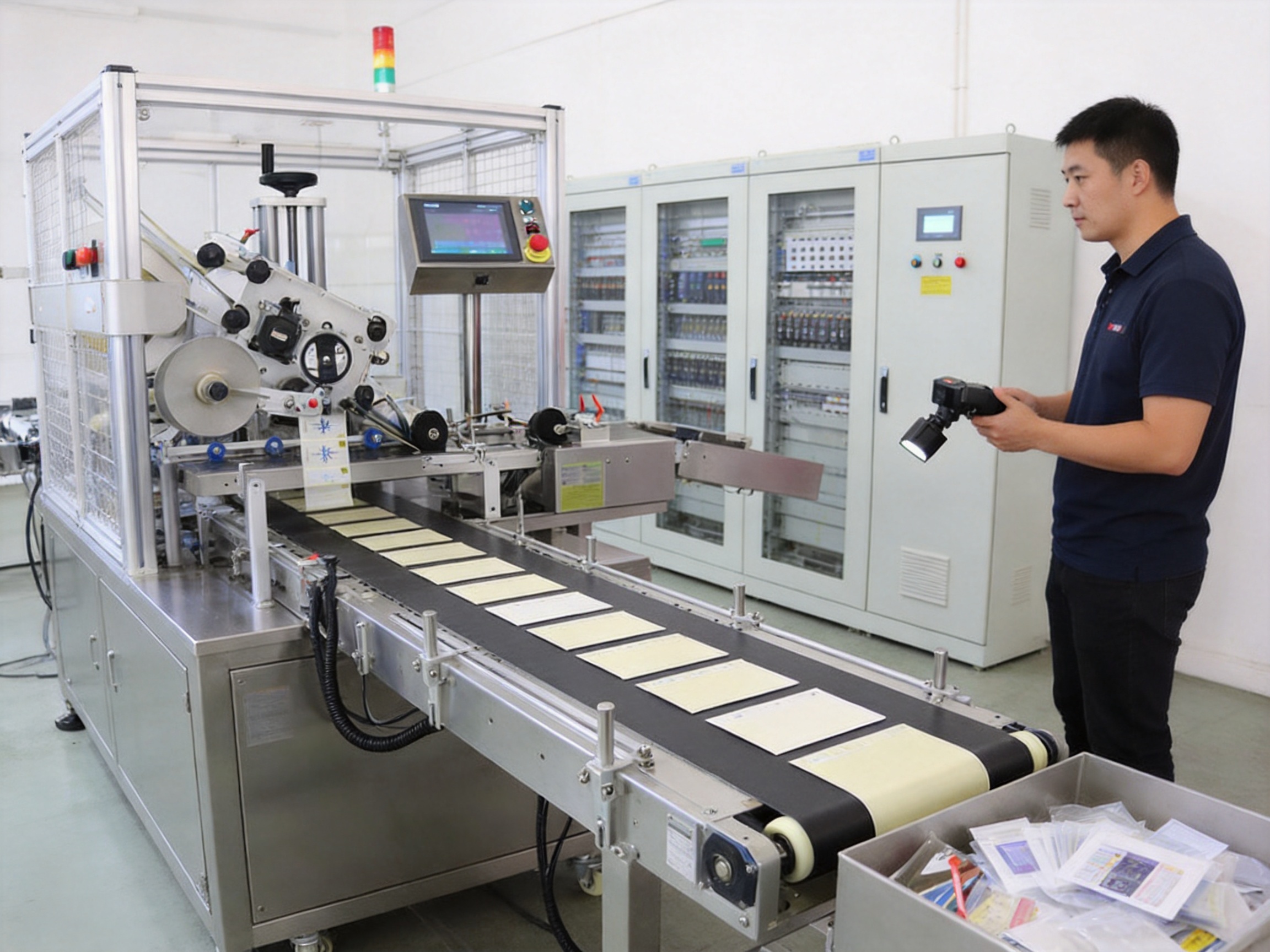
Modern packaging operations increasingly require flexible labeling systems that can handle different product formats, maintain high positioning accuracy, and connect smoothly with upstream and downstream equipment. Flat products such as pouches, plastic bags, cards, paper sheets, leaflets, labels, and thin cartons can be especially difficult to label because they are lightweight, flexible, and often supplied in stacks rather than as individually separated items. Manual separation and labeling can create inconsistent spacing, slow production, increase labor costs, and lead to product damage or label waste.
The automatic paging top and bottom pouch labeling machine is designed to address these challenges in one integrated system. It combines automatic product paging, controlled conveying, product detection, and top-and-bottom label application in a continuous process. Instead of relying on an operator to separate and position each product, the machine uses a friction-type paging mechanism to divide stacked products one by one. The separated products then travel through a controlled conveyor system, where labels can be applied to the upper surface, lower surface, or both surfaces according to the production requirement.
This configuration gives the machine a major advantage over conventional single-purpose labeling equipment. Many standard labelers are designed for round containers, square bottles, or already-separated products. They may require additional feeding equipment when handling flat products in stacks. By integrating the paging function with double-sided labeling, this machine reduces the number of separate processing stages and creates a more compact, coordinated, and efficient packaging workflow.
The system is suitable for industries that need reliable identification, traceability, branding, product information, or security labeling on flat products. Applications include food packaging, pharmaceutical packaging, daily chemical products, electronics, stationery, logistics, card production, plastic packaging, and document handling. It can apply barcode labels, QR code labels, anti-counterfeit labels, instruction labels, promotional labels, product information labels, and other pressure-sensitive labels.
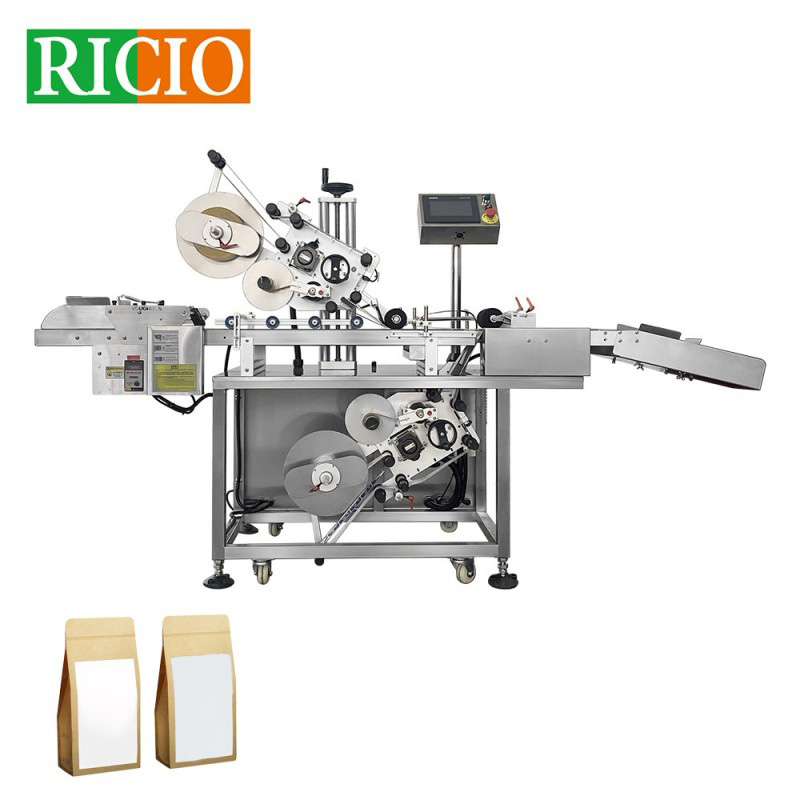
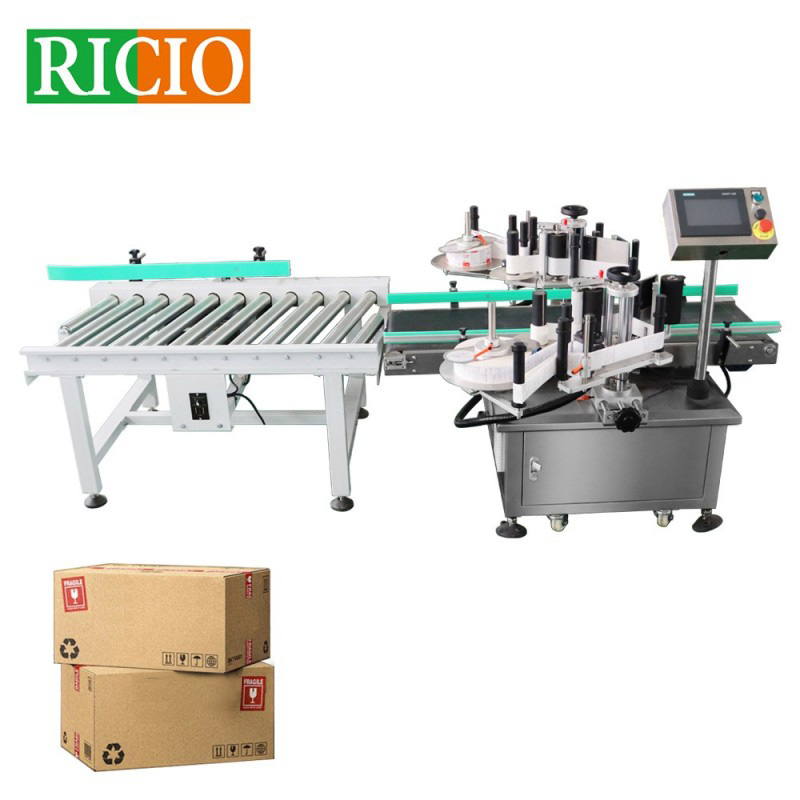
Automatic Paging Top and Bottom Pouch Labeling Machine
Integrated Paging and Labeling for Flat Products
One of the most important features of the machine is its integrated product paging system. Flat products are often delivered in stacks because this is convenient for loading and storage. However, a stack cannot be sent directly into a labeling position if labels must be applied individually. Products must first be separated, aligned, and transferred at a predictable interval.
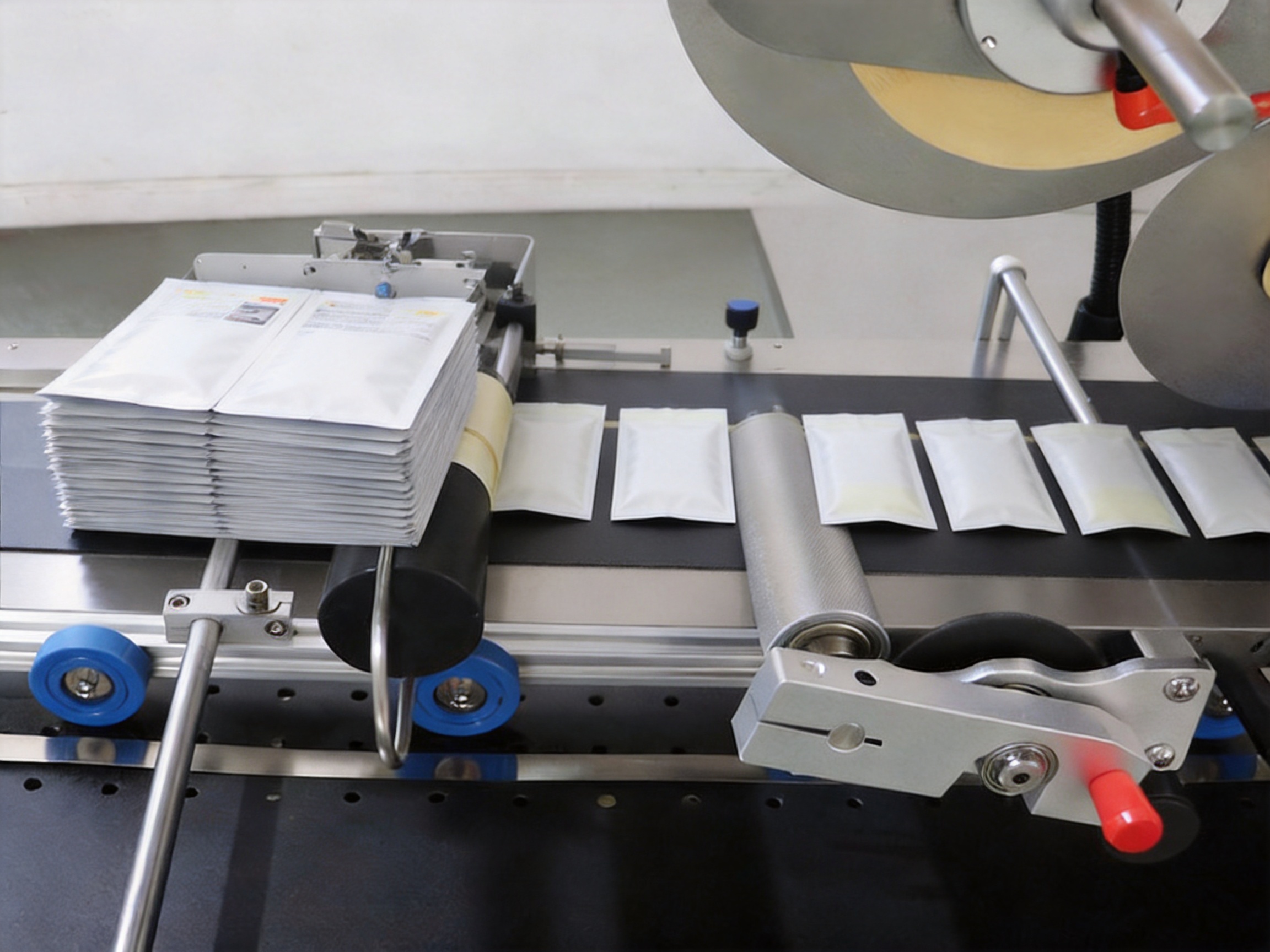
The machine uses a friction-based paging mechanism to separate products from a stack. The operator places the products into the paging section, where controlled friction and mechanical conveying gradually release them one at a time. The design is intended to reduce overlapping, double feeding, and irregular product spacing. Once separated, each product enters the conveyor section in a consistent orientation and timing pattern.
Automatic paging provides several operational benefits. It reduces the need for manual feeding, helps maintain a steady production rhythm, and enables the labeling heads to work according to a known product position. It also reduces the possibility of two products reaching the labeling area together, which could cause incorrect label placement or missed labels.
Compared with manual loading and labeling, automatic paging supports more consistent production quality. Operators can focus on replenishing product stacks, checking materials, and monitoring the process instead of repeatedly picking up and placing individual products. This is particularly valuable when products are thin, slippery, delicate, or difficult to handle at high frequency.
The paging function can be adjusted according to the physical characteristics of the product. Product stiffness, surface friction, thickness, dimensions, and stacking condition all influence how products should be separated. The machine’s adjustable structure allows the operating parameters and mechanical positions to be adapted for different product samples. For special product formats, the conveyor width and product-handling configuration can be customized.
Top, Bottom, or Double-Sided Label Application
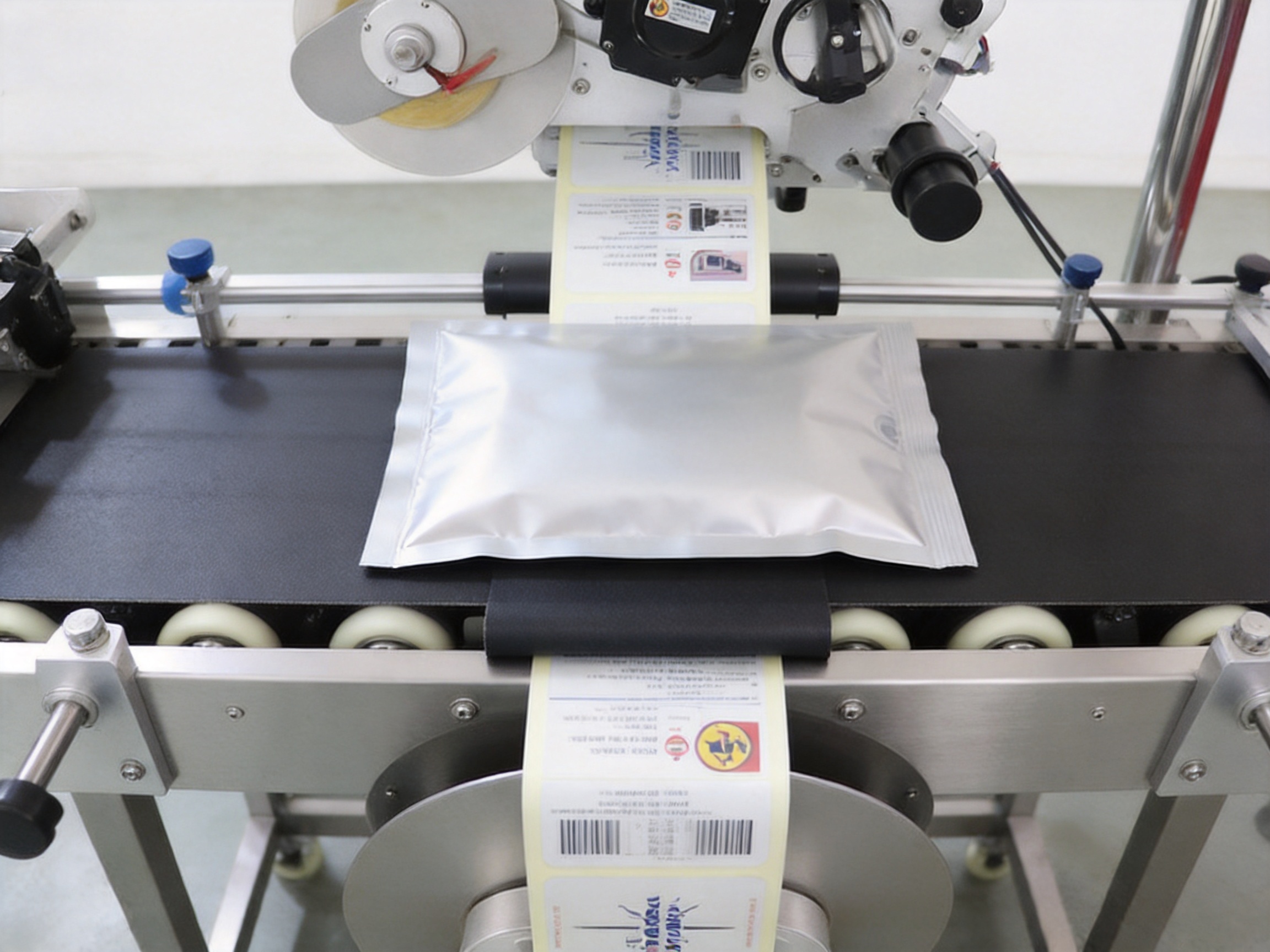
The machine is designed to support flexible label placement. Depending on the application, it can apply a label to the top surface, the bottom surface, or both sides of a flat product. This capability allows one machine to serve multiple labeling requirements instead of limiting production to a single label position.
Top labeling is commonly used for branding, product identification, promotional information, barcodes, QR codes, and manufacturing data. Bottom labeling can be used for concealed information, batch identification, security marks, instructions, or information that must remain separate from the primary front design. Double-sided labeling is useful when a product requires a front label and a back label, or when information must be visible from both sides.
Upper and lower labeling heads can be operated together or configured according to the product requirements. If only one surface needs labeling, the unused labeling head can be disabled or omitted from the operating process. If both sides require labels, the two labeling units can work in coordination with the product detection and conveying system.
This flexibility creates a practical advantage over equipment that is dedicated to only top labeling or only bottom labeling. It also reduces the need to move products between multiple machines. Every additional transfer can introduce alignment errors, handling labor, and production delays. Completing both labeling operations in one controlled line helps simplify the workflow and supports more stable output.
The machine can be configured for products such as pouches, PE bags, paper sheets, paper boxes, paper cards, plastic cards, membership cards, prepaid cards, instruction sheets, film sheets, label cards, leaflets, and other flat or flexible items. Product dimensions and conveyor width can be designed around customer-provided samples, allowing the equipment to match the actual production application rather than forcing the product to conform to a fixed standard.
Vacuum-Assisted Conveying for Lightweight and Flexible Items
Lightweight products can be difficult to transport accurately. Air movement, surface friction, product flexibility, and uneven edges may cause a pouch or sheet to shift while it is moving. If the product moves away from the intended position before label application, the label may be placed too close to an edge, become skewed, or miss the product entirely.
The automatic paging top and bottom pouch labeling machine uses a vacuum-assisted conveyor to help hold products firmly during movement. Vacuum support is especially useful for thin bags, plastic sheets, paper items, and flexible packaging materials. By stabilizing the product against the conveyor surface, the system reduces floating, sliding, curling, and lateral movement.
A stable product position improves the relationship between the product sensor, label dispenser, and labeling applicator. When the product remains flat and controlled, the label can be dispensed and pressed onto the intended location with greater consistency. Vacuum assistance also helps the product pass through the labeling area without being lifted by airflow or disturbed by the movement of the applicator.
This feature distinguishes the machine from basic belt conveyors that simply transport products without actively controlling them. A conventional conveyor may be adequate for rigid cartons or heavy containers, but it may not provide sufficient stability for very thin products. The vacuum conveyor is therefore an important part of the machine’s ability to handle a broad range of flat packaging materials.
The conveyor speed is adjustable from zero to 50 meters per minute. The appropriate speed depends on product dimensions, label size, product spacing, adhesive performance, and the required production rate. Operators can select a stable operating speed that balances throughput with labeling accuracy. The machine is rated for approximately 150 to 200 sheets per minute, with actual performance depending on the product and label specifications.
Servo Label Feeding and Photoelectric Detection
Accurate label dispensing requires coordination between product movement and label movement. If labels are fed too early or too late, they may be applied to the wrong position. If the label feed is inconsistent, gaps between labels may vary or labels may be wasted. The machine uses a servo-driven label feeding system to provide controlled and repeatable label dispensing.
The servo system allows the label feed to respond precisely to the machine’s operating parameters. Label length, product spacing, conveyor speed, and application position can be adjusted through the control interface. Servo control also supports smooth acceleration and deceleration, which can help reduce sudden movements that affect label alignment.
Photoelectric sensors detect product arrival and provide a trigger signal for the labeling process. When a product reaches the preset detection position, the control system calculates or initiates the correct label release timing. This synchronized action helps place each label at the target location on the top or bottom surface.
Photoelectric detection also supports no-product-no-labeling operation. If no product is present, the machine does not release a label unnecessarily. This function helps reduce label waste, particularly during start-up, temporary product interruptions, or irregular feeding conditions. It also prevents adhesive labels from being applied directly to the conveyor or machine components.
Label detection sensors can monitor whether a label is available and whether the label roll is feeding normally. If a label is missing, a roll is empty, or an abnormal feed condition occurs, the control system can issue an alarm. These safeguards improve operational awareness and help operators respond quickly before a large quantity of product is affected.
Consistent Application with Pressing and Smoothing Mechanisms
Applying a label is not simply a matter of placing adhesive material on a product. The label must make full contact with the surface and remain securely attached. Flexible pouches and thin sheets can contain wrinkles, folds, air pockets, or uneven areas that interfere with adhesion. The machine uses pressing and label-applying mechanisms to support smooth contact between the label and product surface.
As the product passes through the application area, the labeling mechanism places the label and presses it onto the surface. The pressing action helps remove air between the label and the product, improving adhesion and reducing the possibility of bubbles. It also helps minimize lifted edges, wrinkles, and partial attachment.
Correct mechanical adjustment is important because products differ in thickness and flexibility. A pressure level that is suitable for a rigid card may be too strong for a soft pouch, while insufficient pressure may result in incomplete adhesion. The adjustable structure enables operators or technicians to adapt the application conditions to the product material and label construction.
Label position can also be adjusted through the machine settings and mechanical components. Operators can set the desired offset from the product edge, control the label release timing, and adjust the placement position according to product size. These settings help support repeatable production when changing between different products or label formats.
Compared with manual application, automated pressing provides more consistent force and travel. Human operators may place labels at different angles or apply different amounts of pressure from one product to another. Mechanical application reduces this variation and improves the visual consistency of the finished package.
PLC Control and Touch Screen Operation
The machine is controlled by a PLC system and operated through a touch screen interface. This arrangement provides centralized control over paging, conveying, product detection, label feeding, labeling timing, alarms, counting, and other machine functions.
Operators can enter or adjust parameters for product dimensions, label position, conveyor speed, labeling speed, and other production conditions. A clear touch screen interface makes it easier to manage routine adjustments without requiring extensive manual intervention. Saved settings can support faster changeover between products with different sizes or label positions.
The control system includes production counting functions, allowing operators to monitor completed units during a production run. Counting information can support production planning, shift reporting, material control, and quality verification. The system can also provide fault alarms to identify conditions such as label shortages, product feeding problems, sensor faults, or abnormal operation.
Parameter protection helps prevent unauthorized or accidental changes to critical machine settings. This is valuable in production environments where several operators use the same equipment. By restricting access to protected parameters, the company can help maintain consistent operating conditions and reduce the risk of unintended adjustments.
Energy-saving standby is another useful function. When the machine is temporarily inactive, selected functions can enter a lower-energy state. This can help reduce unnecessary power consumption during short production interruptions, material replenishment, or shift changes.
Automatic correction functions can assist with maintaining label position during operation. While the exact correction method depends on the configuration and product characteristics, the goal is to identify deviations and support stable positioning. These functions complement proper machine setup and do not eliminate the need for accurate product samples and suitable label materials, but they can improve day-to-day operating reliability.
Technical Specifications
The following specifications describe the standard configuration of the automatic paging top and bottom pouch labeling machine. Actual performance and dimensions may vary according to product samples, label material, label size, and selected options.
| Specification | Standard Value or Description |
|---|---|
| Power supply | AC 220 V, 50/60 Hz, single-phase |
| Power consumption | 1,200 W |
| Labeling speed | Approximately 150–200 sheets per minute, depending on product and label conditions |
| Labeling accuracy | Approximately ±1 mm, subject to product characteristics and operating conditions |
| Conveyor speed | 0–50 meters per minute, adjustable |
| Product size range | Customizable according to customer requirements |
| Label height | 10–150 mm |
| Label length | 15–300 mm; special sizes can be customized |
| Label roll inner diameter | Minimum 76 mm |
| Label roll outer diameter | Maximum 300 mm |
| Net weight | Approximately 200 kg |
| Packaging dimensions | Approximately 2,200 × 750 × 1,500 mm |
| Conveyor width | Customizable according to customer-provided samples |
The stated accuracy of approximately ±1 mm should be understood as an application reference rather than an absolute result for every product. Flexible materials, irregular surfaces, product deformation, label construction, adhesive performance, and the quality of product separation can influence the final result. Proper testing with actual samples is essential before confirming a production specification.
Advantages Compared with Conventional Labeling Solutions
Integrated Product Separation
A major advantage is the combination of product paging and labeling in one machine. Conventional systems may require an operator to feed products individually or may need a separate sheet feeder before labeling. Integrating the paging section reduces manual handling and simplifies the overall line layout.
Double-Sided Capability
The ability to label the top, bottom, or both sides gives the machine broader application flexibility than single-sided equipment. A company can use one platform for multiple product requirements instead of purchasing separate machines for front and back labeling.
Improved Handling of Thin Products
The vacuum-assisted conveyor is designed to stabilize lightweight and flexible products. This provides a practical advantage over ordinary conveyors that may allow thin products to slide, float, or fold. Better product control supports improved label placement and reduces rejects.
Reduced Label Waste
No-product-no-labeling, sensor-based triggering, and label detection help prevent unnecessary label release. Reduced waste lowers material costs and can be especially important when using customized, high-value, serialized, or security labels.
Flexible Changeover
Adjustable parameters and a touch screen control system make it easier to switch between products and label formats. Changeover still requires appropriate mechanical adjustment and testing, but the process is more organized than manually recalibrating separate equipment.
Compact Integration
Because paging, conveying, detection, and labeling are integrated, the machine can occupy less space than a sequence of independent units. Its compact structure allows installation in existing packaging areas and can make it easier to connect the equipment to other production or inspection systems.
Optional Coding and Inspection Functions
The machine can be equipped with optional modules such as hot coding equipment, inkjet printers, transparent label sensors, barcode readers, and QR code readers. These options expand the system from a basic label applicator into a more complete identification and traceability station.
Applications Across Multiple Industries
In the food industry, the machine can label flexible pouches, product information sheets, promotional cards, ingredient documents, and flat packaging components. Top labels can support branding and product presentation, while bottom labels can carry batch information, traceability details, or supplementary instructions.
Pharmaceutical and healthcare packaging often requires accurate information, readable codes, and controlled label placement. The machine can process instruction sheets, pharmaceutical pouches, medical packaging materials, cards, and other flat products. When combined with barcode or QR code reading, it can support verification and traceability workflows.
Daily chemical and cosmetic manufacturers may use the system for sample pouches, sachets, product cards, promotional inserts, and flexible packaging. The ability to apply labels to both surfaces is useful when products need front-facing branding and reverse-side usage or regulatory information.
In electronics and stationery production, the machine can label cards, manuals, plastic sheets, product information inserts, and small flat packages. These products can vary significantly in size and material, making adjustable product handling and flexible conveyor configuration important.
Logistics operations can use the machine to apply routing labels, identification labels, barcode labels, or QR code labels to flat mailers, documents, cards, and pouches. Automated paging can help process stacks of similar items at a consistent rate and reduce repetitive manual work.
Card printing and plastic card applications may include membership cards, prepaid cards, security cards, financial cards, and promotional cards. These products require accurate positioning because labels that are skewed or placed too close to an edge can affect appearance, scanning, or downstream handling.
Plastic packaging manufacturers can use the equipment for PE bags, film sheets, pouches, and other flexible products. Vacuum conveying helps stabilize materials that would otherwise be difficult to transport through a conventional labeling system.
Optional Modules for Coding, Reading, and Traceability
Many modern packaging lines require more than physical label application. They may need to print production dates, batch numbers, lot codes, serial numbers, or variable information. Optional hot coding equipment and inkjet printers can be integrated into the line to add this information during or around the labeling process.
A hot coding machine can be used for suitable films, labels, and packaging materials where heat-transfer coding is appropriate. Inkjet printing can provide flexible variable-data printing for text, numbers, barcodes, or other marks. The appropriate printing method depends on the surface, ink compatibility, resolution requirement, drying time, and production environment.
A transparent label sensor can support applications where standard label detection is difficult. Transparent materials may transmit or reflect light differently from ordinary opaque labels, so specialized sensing can improve detection reliability when using clear labels.
Barcode readers and QR code readers can be added for identification and verification. A reader may confirm that the correct code is present, check the readability of a label, or connect the labeling process with a production database. These functions can help reduce the risk of applying the wrong label to a product or releasing incorrectly identified goods.
When combined with PLC control, coding, scanning, and labeling modules can create a coordinated workflow. Product detection can trigger label application, printing can add variable information, and code reading can verify the result. This configuration is valuable for industries that require product traceability, anti-counterfeit control, or batch-level documentation.
Manufacturing Strength and Engineering Capability
The performance of a labeling machine depends not only on its visible frame and control panel but also on the quality of its internal components, mechanical tolerances, electrical integration, and commissioning process. The manufacturer behind this equipment specializes in the research, development, and production of labeling machinery for different packaging applications.
Its manufacturing background includes in-house precision machining capabilities developed through the acquisition of an established machinery parts factory. This foundation enables the company to manage important mechanical production activities internally rather than relying entirely on outside suppliers. In-house control over selected components can help improve dimensional consistency, shorten communication cycles, and support faster engineering modifications.
Multiple CNC machining centers are used to produce precision mechanical parts. CNC machining allows components to be manufactured according to controlled digital programs, helping maintain repeatable dimensions and reliable fit between mechanical assemblies. For labeling equipment, these details are important because sensor brackets, guide components, roller supports, label-dispenser structures, and adjustment mechanisms must work together accurately.
Precision machining also supports customized production. Different customers may require different conveyor widths, product guides, labeling positions, or material-handling structures. A manufacturer with internal machining resources can respond more efficiently to these requirements and develop application-specific parts without redesigning the entire machine around standard components.
The manufacturing process covers core component machining, mechanical assembly, electrical installation, software integration, machine testing, and commissioning. Managing these stages as a connected process helps ensure that the mechanical and control systems are evaluated together. A labeler may have accurate mechanical parts but still perform poorly if the sensors, servo system, conveyor, and control software are not synchronized correctly. Integrated engineering reduces this risk.
The equipment is manufactured in accordance with an ISO 9001 quality management system. A quality management framework supports documented processes, inspection procedures, corrective actions, and continuous improvement. Although certification alone does not guarantee the result of every application, a structured quality system provides a formal basis for controlling manufacturing and service activities.
Materials, Structure, and Cleanability
The machine housing uses SUS304 stainless steel and T6 aluminum alloy. SUS304 stainless steel is widely used in packaging machinery because it offers corrosion resistance, strength, and a surface that is relatively easy to clean. It is suitable for many food, pharmaceutical, chemical, and general industrial environments.
T6 aluminum alloy provides a useful combination of strength and reduced weight. It can be used in structural sections, brackets, frames, and adjustment assemblies where rigidity and manageable equipment weight are both important. The combination of stainless steel and aluminum allows the machine to balance durability, cleanability, and practical installation requirements.
A cleanable machine structure is important when labels, adhesive materials, paper dust, film particles, or product residues may accumulate during daily operation. Smooth surfaces and accessible components make routine cleaning easier. Regular cleaning can help protect sensors, rollers, conveyor surfaces, and label application parts from contamination that could affect performance.
The compact design also supports installation in existing facilities. With a net weight of approximately 200 kilograms and packaging dimensions of approximately 2,200 by 750 by 1,500 millimeters, the machine can be planned into a range of production layouts. Final space requirements should account for operator access, material loading, label roll replacement, maintenance, electrical connections, and safe movement around the equipment.
Installation, Commissioning, and Changeover
Successful installation begins with a clear understanding of the product and label specifications. Before delivery or commissioning, the customer should provide representative samples of the products, label rolls, and any packaging materials that will be processed. Sample testing helps determine the correct paging settings, conveyor width, sensor position, vacuum level, label head arrangement, and pressing configuration.
During commissioning, technicians can establish the product path from the paging area through the conveyor and labeling stations. The product should be checked for stable separation, consistent spacing, correct orientation, and reliable detection. The label position should then be adjusted on each surface that requires labeling.
Changeover between products may involve adjusting the paging guides, conveyor guides, labeling head positions, sensor locations, label feed parameters, pressing mechanisms, and touch screen settings. The machine is designed to make these changes practical and organized. However, operators should always confirm the first products after changeover before starting full-speed production.
Label replacement should be performed according to the defined threading route and sensor arrangement. Correct label roll installation is important for smooth feeding and accurate detection. Operators should verify the label roll inner diameter, outer diameter, backing material, adhesive condition, and label spacing before operation.
Routine maintenance includes cleaning the conveyor and label application surfaces, checking rollers and belts, inspecting sensors, confirming fastener tightness, and reviewing electrical connections. Preventive maintenance reduces unexpected downtime and helps preserve labeling accuracy over the life of the equipment.
How to Select the Correct Configuration
The first consideration is the product material. Rigid cards, paper sheets, film sheets, PE bags, and soft pouches may require different paging friction, vacuum support, pressing force, and guide settings. A product that bends easily may need more careful surface control than a rigid card.
The second consideration is the product size. Product length, width, thickness, and edge condition influence the conveyor design and the available labeling area. Since the product size range and conveyor width can be customized, customers should provide precise dimensions and representative samples during the technical discussion.
The third consideration is label size and position. The standard label height range is 10 to 150 millimeters, and the standard label length range is 15 to 300 millimeters. Special label dimensions may be possible, but the label must be evaluated for backing material, gap, adhesive, roll diameter, and application speed.
The fourth consideration is the required production rate. The machine can reach approximately 150 to 200 sheets per minute under suitable conditions, but actual speed depends on product size, label size, separation reliability, and the distance needed between products. A lower speed may be appropriate when labels are large, products are flexible, or positioning requirements are strict.
The fifth consideration is whether coding, scanning, or inspection is needed. If the product requires a date code, batch number, barcode verification, QR code reading, or variable information, these requirements should be planned before finalizing the machine configuration.
Finally, the customer should define whether the machine will operate independently or as part of a larger production line. Interface requirements, upstream feeding, downstream collection, conveyor height, electrical standards, and communication signals should be considered during the engineering stage.
Operating Benefits for Production Managers
For production managers, the value of the machine extends beyond label placement. Automatic paging can reduce dependence on repetitive manual labor. Stable conveying and sensor-controlled labeling can improve production predictability. Counting and alarm functions can provide better visibility into output and machine status.
Reduced manual handling can also support more consistent product quality. When operators no longer need to separate and label every individual item, variation caused by fatigue, speed differences, or inconsistent placement can be reduced. This is particularly beneficial in long production runs or applications involving many small products.
The machine can also help reduce production waste. No-product-no-labeling minimizes labels released during product interruptions, while accurate label feeding reduces unnecessary overlap and misplacement. Better product control can decrease the number of products rejected because of skewed, wrinkled, or partially attached labels.
Flexible configuration supports product diversification. A manufacturer that sells several pouch sizes, card formats, or flat packaging designs can use the same basic machine platform for multiple products. This can improve equipment utilization and reduce the need to purchase a separate labeler for every product variation.
Integration with coding and reading modules may further improve production control. Information can be printed, labels can be applied, and codes can be checked in a coordinated sequence. This helps support modern requirements for traceability, anti-counterfeit protection, and accurate product identification.
Quality and Reliability Considerations
Reliable labeling is the result of coordinated design rather than one isolated component. The paging mechanism must separate products consistently, the conveyor must maintain their position, the sensors must detect them accurately, and the servo system must feed labels at the correct moment. The pressing mechanism must then complete adhesion without damaging the product.
The manufacturer’s emphasis on precision machining and integrated assembly supports this coordinated approach. Components manufactured with controlled dimensions can reduce unwanted movement and make adjustment more repeatable. Controlled assembly and commissioning help verify that the mechanical, electrical, and software systems operate together.
Quality also depends on application-specific testing. A labeler that performs well with rigid cards may require different settings for soft PE bags. Product samples should therefore be tested under realistic conditions, including the actual label material, adhesive, product stack, operating speed, and environmental conditions.
Environmental factors such as temperature, humidity, dust, static electricity, and adhesive behavior can affect flexible product handling. Technical evaluation should consider the production environment so that sensor selection, vacuum control, conveyor surface, and label application settings can be selected appropriately.
Q&A
What products can the automatic paging top and bottom pouch labeling machine handle?
The machine is designed for flat and flexible products such as pouches, PE bags, paper sheets, paper boxes, cards, plastic cards, membership cards, prepaid cards, instruction sheets, film sheets, label cards, leaflets, and similar items. Product size, thickness, stiffness, and surface condition should be evaluated through sample testing.
Can the machine label both sides of a product?
Yes. The machine can be configured to apply labels to the top surface, bottom surface, or both surfaces. Upper and lower labeling heads can be used together or independently according to the application.
How does the paging system separate products?
The machine uses a friction-type paging mechanism. Products are placed in the paging section, where controlled friction separates them from the stack and transfers them individually to the conveyor.
Why is a vacuum conveyor useful for pouches and thin sheets?
A vacuum conveyor helps hold lightweight products against the conveyor surface. This reduces sliding, floating, folding, and shifting during transport, which supports more stable label positioning.
What is the expected labeling speed?
The reference labeling speed is approximately 150 to 200 sheets per minute. Actual speed depends on product dimensions, label dimensions, product material, label adhesive, spacing requirements, and the required accuracy.
What labeling accuracy can be expected?
The reference accuracy is approximately plus or minus 1 millimeter. Actual results may vary according to product flexibility, surface condition, product separation, label material, machine settings, and operating environment.
Can the product size and conveyor width be customized?
Yes. Product size ranges and conveyor width can be customized according to customer requirements and product samples. Custom engineering should be discussed before final machine production.
Does the machine prevent labels from being applied when no product is present?
Yes. The control system supports no-product-no-labeling operation. Product detection triggers the label application process, helping reduce label waste during gaps or feeding interruptions.
Can the machine print or read codes?
Optional modules can include hot coding equipment, inkjet printers, transparent label sensors, barcode readers, and QR code readers. These modules can support printing, identification, verification, and traceability.
What materials are used for the machine structure?
The housing is made from SUS304 stainless steel and T6 aluminum alloy. These materials provide corrosion resistance, structural durability, manageable weight, and practical cleanability.
What control system does the machine use?
The machine uses PLC control with a touch screen interface. Operators can adjust production parameters, monitor alarms, manage counting functions, and protect key settings.
What should be provided for application testing?
Customers should provide representative products, label rolls, and details about the desired label position, production speed, and coding or reading requirements. Testing with actual materials gives the most reliable basis for final configuration.
Conclusion
The automatic paging top and bottom pouch labeling machine provides an integrated solution for flat and flexible products that are difficult to separate and label manually. By combining automatic paging, vacuum-assisted conveying, photoelectric detection, servo label feeding, and top-and-bottom application, it supports a more controlled and efficient packaging process.
Its ability to apply labels to the top, bottom, or both sides gives it an advantage over single-purpose labeling equipment. Adjustable product handling, customizable conveyor width, flexible label positioning, and optional coding or reading modules allow the machine to serve a wide range of applications. Functions such as no-product-no-labeling, label detection, automatic correction, production counting, alarm management, standby operation, and parameter protection further support practical factory use.
The equipment is also supported by a manufacturing approach that includes in-house precision machining, CNC production capabilities, integrated assembly, electrical and software commissioning, and ISO 9001-based quality management. These strengths help the manufacturer respond to customized requirements and maintain better control over important mechanical and engineering processes.
For companies processing pouches, cards, paper products, plastic sheets, packaging bags, or other flat items, the machine offers a way to reduce manual handling, improve label consistency, lower material waste, and simplify line integration. With proper sample testing and configuration, it can become a reliable part of an automated packaging, coding, identification, or traceability operation.
References
1. Product technical specification sheet for the automatic paging top and bottom pouch labeling machine.
2. Internal application information for flat-product paging, conveying, and double-sided label application.
3. ISO 9001 quality management principles for manufacturing and process control.
4. General engineering guidance for pressure-sensitive label application and product handling.
5. Packaging automation practices for barcode, QR code, coding, and product traceability systems.
6. Technical information concerning CNC machining, stainless-steel equipment construction, and aluminum alloy machine frames.
Product: Automatic Paging Top and Bottom Pouch Labeling Machine

related products
related News
 +86 13681850339
 sales@raxpack.com
 Building 6, No. 477 Tiefeng Road, Baoshan District, Shanghai, China
- Tabletop Labeling Machine
- Round Bottle Labeling Machine
- Automatic Tube Labeling Machine
- Pouch Labeling Machine
- Rotary Labeling Machine
- Syringe Labeling Machine
- Top Labeling Machine
- Single Side Sticker Labeling Machine
- Double Side Labeling Machine
- Bucket Labeling Machine
- Bottom Labeling Machine
- Corner Label Applicator
- Waist Sealing Labeling Machine
- Square Bottle Labeling Machine
