 English
 русский
 Español
 عربى



Automatic High-Speed Vertical Round Bottle Labeling Machine: Precision, Flexibility, and Efficient Packaging Automation
2026-10-12
Content
- 1 1. The Role of High-Speed Round Bottle Labeling in Modern Packaging
- 2 2. Product Overview
- 3 3. Main Technical Specifications
- 4 4. High-Speed Servo Label Feeding
- 5 5. Automatic Detection and Product Separation
- 6 6. Flexible Labeling for Different Round Containers
- 7 7. Advantages Compared with Conventional Labeling Equipment
- 8 8. Stable Mechanical Design for Continuous Operation
- 9 9. Manufacturing Strengths and Engineering Capabilities
- 10 10. Quality Control from Machining to Commissioning
- 11 11. Applications across Major Industries
- 12 12. Optional Modules and Complete Line Integration
- 13 13. Operating Procedure
- 14 14. Maintenance and Long-Term Reliability
- 15 15. Factors That Influence Labeling Accuracy
- 16 16. Why Choose a Source Manufacturer?
- 17 17. Installation and Project Planning
- 18 18. Q&A
- 18.1 Q1: What types of products can this machine label?
- 18.2 Q2: Can it apply a full-wrap label?
- 18.3 Q3: What is the maximum labeling speed?
- 18.4 Q4: What labeling accuracy can be expected?
- 18.5 Q5: Can the machine process different bottle sizes?
- 18.6 Q6: Can the equipment print batch numbers and dates?
- 18.7 Q7: Does the machine require compressed air?
- 18.8 Q8: Can the conveyor width be customized?
- 18.9 Q9: What label materials can be used?
- 18.10 Q10: Can the machine be connected to a complete packaging line?
- 18.11 Q11: How does the touch screen improve operation?
- 18.12 Q12: Why is sample testing important?
- 18.13 Q13: What manufacturing advantages does the supplier provide?
- 18.14 Q14: Is the machine suitable for export projects?
- 19 19. Purchasing Checklist
- 20 20. Conclusion
- 21 References
- 22 Product: Automatic High Speed Vertical Round Bottle Labeling Machine
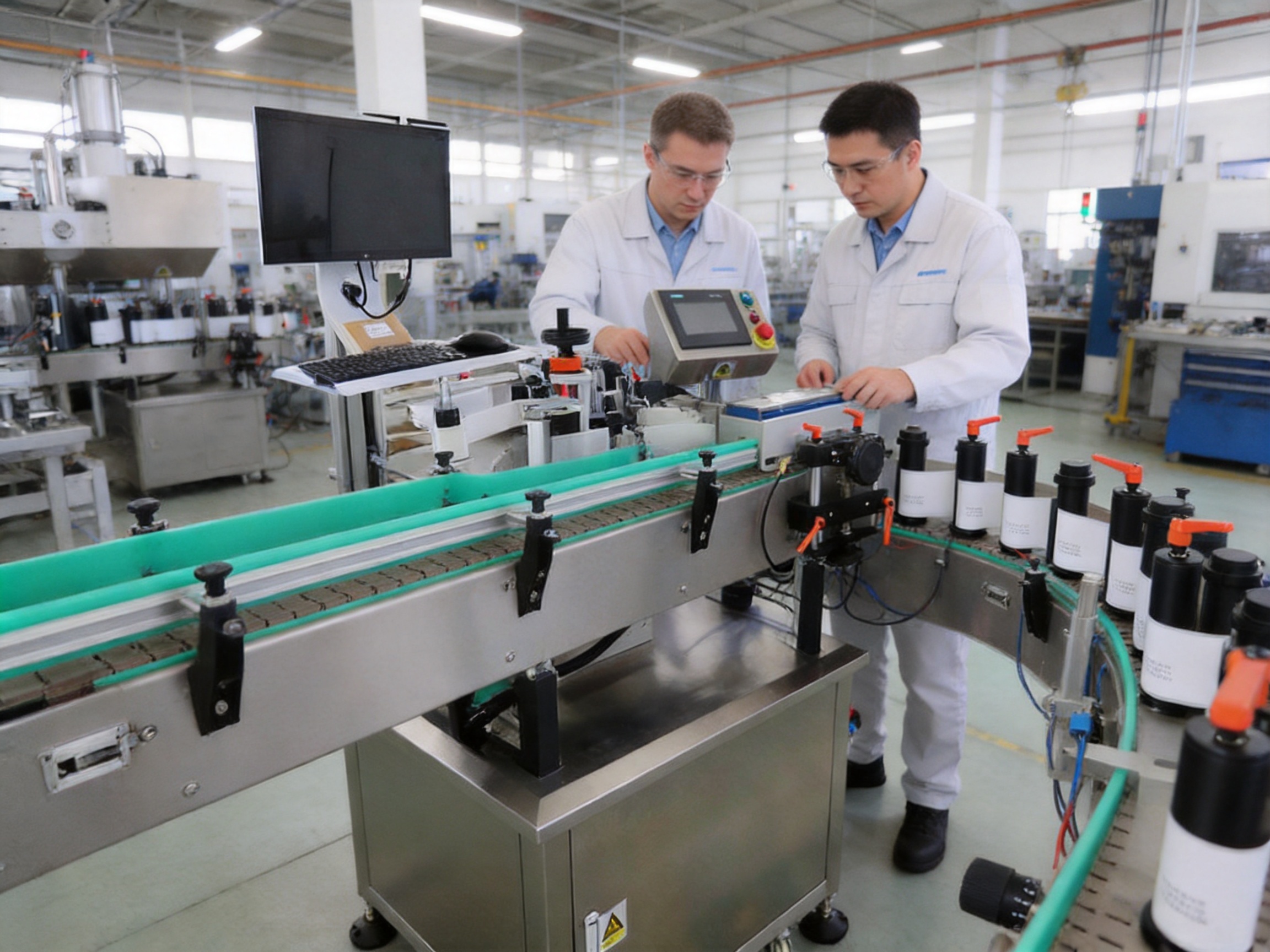
Modern packaging lines must achieve more than high production speed. They must also deliver accurate label placement, stable operation, consistent product presentation, low material waste, and straightforward changeover between different container formats. These requirements are especially important when manufacturers process small cylindrical bottles, vials, oral liquid containers, cosmetic packages, seasoning bottles, and other round products in demanding industries.
The automatic high-speed vertical round bottle labeling machine is designed to address these requirements through a coordinated system for bottle conveying, separation, detection, label feeding, application, and production monitoring. It provides an integrated solution for full-wrap labeling, partial-wrap labeling, and other applications involving round containers. By combining a high-accuracy servo label feeding system, automatic photoelectric detection, adjustable product handling components, and an intuitive touch-screen control interface, the machine supports reliable labeling across a broad range of production conditions.
Manufactured by Shanghai Ruixiao Packaging Technology Co., Ltd., the RICIO labeling machine is developed for companies seeking a dependable industrial label machine rather than a basic standalone applicator. Its structure is suitable for continuous operation, while its adjustable configuration allows manufacturers to adapt the equipment to different bottle diameters, label dimensions, production speeds, and packaging requirements.
This article explains the machine’s operating principles, technical characteristics, industrial applications, competitive advantages, customization possibilities, manufacturing strengths, maintenance requirements, and purchasing considerations.
1. The Role of High-Speed Round Bottle Labeling in Modern Packaging
Round bottles are widely used because they are easy to handle, fill, transport, and display. However, their curved surfaces create special challenges for labeling. A label must be fed at the correct speed, positioned accurately, pressed firmly against the container, and wrapped or applied without wrinkles, bubbles, skewing, or loose edges.
Manual labeling and low-capacity semi-automatic equipment can be suitable for small workshops, but they often create inconsistencies when production volumes increase. Operators may place labels at different heights, apply different wrap tensions, or fail to maintain the required spacing between products. These variations can reduce product appearance, increase rejection rates, and make batch management more difficult.
An automatic vertical round bottle labeling machine minimizes these problems by coordinating the complete labeling sequence. Bottles enter the conveying system, are separated at a controlled distance, detected by sensors, and transferred through the labeling station. The label is released from its backing material at a precisely controlled time, applied to the bottle, and pressed or wrapped around the container according to the selected configuration.
The result is a repeatable process that can operate for long periods with limited manual intervention. This is particularly valuable for pharmaceutical, food, beverage, cosmetics, daily chemical, and chemical packaging operations, where production consistency and traceability are essential.
2. Product Overview
The automatic high-speed vertical round bottle labeling machine is designed for fast and accurate labeling of small and medium-sized cylindrical containers. Its vertical conveying arrangement provides stable product transportation while allowing the labeling head to operate continuously along the production path.
The equipment can be configured for different label applications, including full-wrap labeling, partial-wrap labeling, and selected-position labeling. Depending on bottle shape, label dimensions, adhesive material, and production objectives, the machine can be adjusted to apply labels around the circumference or onto a defined area of the round surface.
A typical operating cycle begins when bottles are placed on the infeed conveyor or supplied by an upstream machine. The conveying system transports the products toward the separation section. A detection sensor identifies the leading edge or position of each bottle, while a separation mechanism creates a suitable interval between products. This spacing helps prevent double labeling and ensures that every bottle reaches the label application position in a predictable manner.
When the bottle reaches the labeling station, the servo-controlled label feeding system advances the label to the dispensing point. The label is then transferred to the bottle surface. A wrapping or pressing mechanism completes the application, depending on the required labeling pattern. The labeled product continues toward the discharge section and may be sent to a downstream inspection, packing, collection, or coding process.
The machine is equipped with a touch-screen control system through which operators can adjust production speed, label position, counting parameters, and other operating settings. Fault indication, parameter protection, and energy-saving standby functions support safer and more efficient daily production.
3. Main Technical Specifications
The following specifications describe the standard configuration. Actual performance may vary according to bottle diameter, bottle material, label length, label material, label adhesive, production layout, and selected options.
| Specification | Standard Value |
| Voltage | AC 220 V, 50/60 Hz, single-phase |
| Power consumption | 2.5 kW |
| Air source | 5 kg |
| Labeling speed | 100–400 bottles per minute, adjustable according to product and label conditions |
| Reference speed for 330 ml bottles | Approximately 150 bottles per minute |
| Labeling accuracy | Approximately ±1 mm, depending on product, label size, and labeling pattern |
| Printing speed | Up to 600 times per minute when equipped with a compatible coding system |
| Labeling qualification rate | At least 99.99 percent under appropriate operating conditions |
| Air pressure strength | 5–7 kg/cm² |
| Feeding and discharging direction | From left to right |
| Net weight | Approximately 350 kg |
| Gross weight | Approximately 450 kg |
| Bottle diameter range | Approximately 10–100 mm |
| Bottle height range | Approximately 20–300 mm |
| Label height range | Approximately 10–110 mm |
| Label length range | Approximately 10–250 mm; customized dimensions may be available |
| Label roll inner diameter | Approximately 76 mm |
| Label roll outer diameter | Approximately 300 mm |
| Label gap | Approximately 3 mm |
| Packaging dimensions | Approximately 2400 × 1200 × 1400 mm |
| Conveyor belt width | Customized according to the diameter and characteristics of the client’s bottles |
These values should be confirmed during technical consultation and sample testing. The actual operating speed should always be selected according to the stability of the bottle, the length and material of the label, the adhesive performance, and the required labeling accuracy.
4. High-Speed Servo Label Feeding
One of the most important factors in automatic labeling performance is the accuracy and stability of label feeding. If the label is released too early, too late, too quickly, or too slowly, the result may be an incorrect label position, uneven spacing, wrinkles, or excessive waste.
The machine uses a high-accuracy servo label feeding system to control label movement. Servo technology enables precise control of acceleration, deceleration, stopping, and label release. This is especially useful when processing small labels, long labels, high-speed applications, or products that require a narrow positioning tolerance.
Compared with simpler mechanical feeding arrangements, servo-driven label feeding can provide more flexible parameter adjustment. Operators can adapt the label feed length and timing through the control system rather than making extensive mechanical changes. This reduces setup time and supports faster product changeover.
Stable label feeding also improves the use of expensive label materials. Better control helps reduce missed labels, double labels, label gaps, and unnecessary rejection. For manufacturers operating at high volumes, even a small reduction in material loss can create meaningful savings over the course of a production year.
5. Automatic Detection and Product Separation
Accurate labeling depends on accurate product positioning. The machine therefore uses photoelectric detection to identify bottles as they enter the labeling area. The sensors help coordinate product arrival with label release and provide feedback to the control system.
The detection system ensures that labels are applied only when a product is present. This prevents the machine from feeding labels onto an empty conveyor section, reducing waste and helping maintain the correct relationship between products and labels.
Product separation is also important in high-speed operation. If bottles touch one another or enter the labeling zone too closely, the labeling head may not have enough time to complete the application. The separation mechanism creates a controlled interval between products so that each bottle can be processed individually.
For products with different shapes, surfaces, or levels of stability, the conveying and separation components can be adjusted. These adjustments may include changes to guide rails, product spacing, conveyor speed, sensor position, and label head height. Correct setup is essential for achieving the best performance from the equipment.
6. Flexible Labeling for Different Round Containers
The machine is intended for a broad range of cylindrical packages. The stated bottle diameter range is approximately 10 to 100 mm, while bottle height may range from approximately 20 to 300 mm. These dimensions allow the equipment to serve applications involving small bottles, medium-sized containers, and selected taller packages.
Typical products include medicine bottles, oral liquid bottles, beverage containers, seasoning bottles, cosmetic bottles, shampoo and personal-care packages, laboratory containers, and chemical product bottles. The container may be made from glass, plastic, metal, or another suitable material, provided that its surface and geometry are compatible with the labeling process.
Full-wrap labeling is often used when a label should cover most or all of the bottle circumference. Partial-wrap labeling may be selected when the label needs to cover only a defined section. The machine can also be adjusted for different vertical positions, allowing labels to be placed near the shoulder, center, or lower section of a bottle.
Since the performance of any labeling machine depends on the interaction between the equipment, product, label, and adhesive, sample testing is recommended before final configuration. Testing allows the manufacturer to confirm bottle stability, label adhesion, label overlap, application speed, and the most suitable pressing or wrapping arrangement.
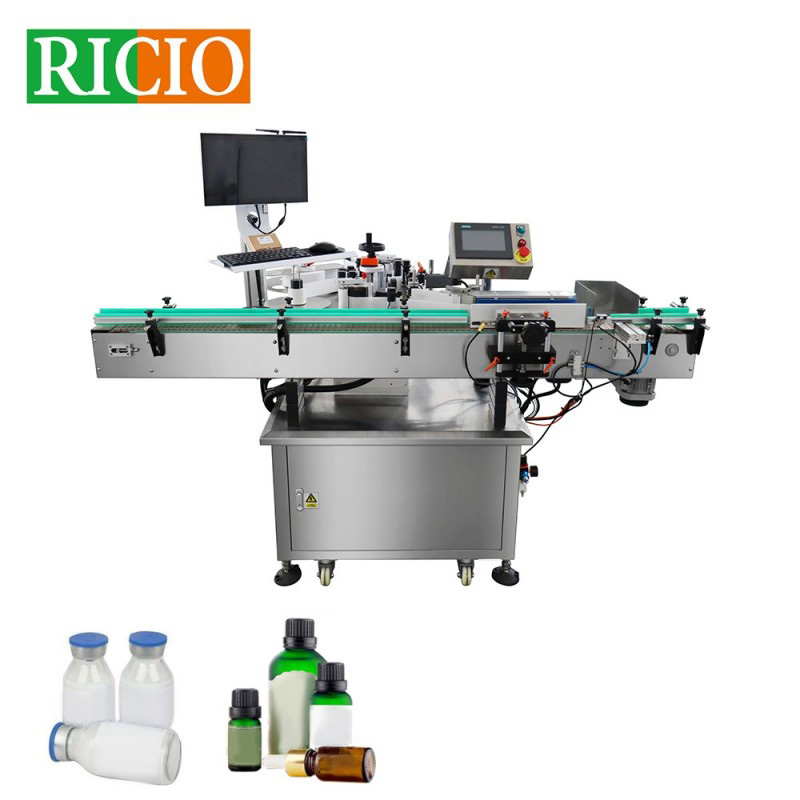
Automatic High Speed Vertical Round Bottle Labeling Machine
7. Advantages Compared with Conventional Labeling Equipment
7.1 Higher Production Efficiency
The machine is designed for continuous automated production rather than intermittent manual application. Its stated labeling speed is approximately 100 to 400 bottles per minute, depending on product and label conditions. For a 330 ml bottle, the reference speed is approximately 150 bottles per minute.
This capacity can significantly exceed manual labeling and many entry-level semi-automatic solutions. Higher speed allows manufacturers to match the output of filling, capping, inspection, and packing systems more effectively. It can also reduce labor requirements and prevent the labeling station from becoming a bottleneck in the production line.
7.2 Improved Positioning Consistency
Manual application can produce variation in label height, orientation, and overlap. The machine controls the process through sensors, servo label feeding, and adjustable mechanical components. Under suitable conditions, it can achieve an accuracy of approximately ±1 mm.
Consistent positioning is important for brand presentation, barcode scanning, regulatory information, and downstream inspection. A label that is placed at a stable height and orientation also creates a more professional appearance on retail shelves.
7.3 Reduced Label Waste
Automatic detection helps ensure that labels are fed only when bottles are present. Accurate label release and stable conveying further reduce missed applications, overlapping labels, and misaligned products. These functions help decrease material waste and the number of products requiring rework.
Lower waste is particularly valuable for specialty labels, foil labels, serialized labels, and products with strict batch control. The economic benefit becomes more visible as production volume increases.
7.4 Faster Changeover
Manufacturers may need to process several bottle sizes or label formats on the same production line. Adjustable guide rails, labeling head positions, sensor locations, and control parameters support faster changeover than fixed-purpose equipment.
Changeover still requires careful adjustment and verification, but the machine’s flexible structure reduces the need to purchase separate equipment for every bottle format. This makes it suitable for contract packers, diversified manufacturers, and companies producing multiple stock-keeping units.
7.5 Integrated Coding Possibilities
An optional high-speed hot stamping coder can be integrated with the labeling process. This configuration may print production dates, expiry dates, batch numbers, weight, price, or other required information while the label is being applied.
Combining labeling and coding in one operation can reduce additional handling and simplify the production line. It can also help improve traceability by ensuring that the correct code is applied in coordination with the relevant label and product batch.
7.6 Easier Operation and Monitoring
The touch-screen control system provides a centralized interface for operating and monitoring the machine. Operators can adjust speed, label position, production count, and other parameters through a user-oriented control panel.
Fault indication helps operators identify abnormal conditions more quickly. Parameter protection reduces the risk of accidental changes, while production counting supports basic output management. An energy-saving standby function can reduce unnecessary consumption during short production interruptions.
8. Stable Mechanical Design for Continuous Operation
A high-speed labeling machine must remain stable while the conveyor, label roll, sensors, motors, and application components operate continuously. Mechanical vibration can affect label placement, especially when the label is narrow or the application tolerance is strict.
The vertical conveying structure is designed to maintain a controlled product path. Guide components help keep bottles aligned, while the labeling head is positioned in relation to the product surface. The conveyor width can be customized according to the client’s bottle diameter, allowing the handling system to be matched more closely to the actual product.
The equipment has a net weight of approximately 350 kg, with a gross shipping weight of approximately 450 kg. This substantial machine structure supports stability during operation and transportation. Proper installation on a level floor, correct alignment, and suitable anchoring or leveling are still necessary to achieve the intended performance.
Mechanical stability is complemented by control-system coordination. The conveyor, label feeding system, detection sensors, and optional coding equipment must operate according to a synchronized sequence. This coordination is especially important at high speed, where small timing errors can quickly produce repeated labeling defects.
9. Manufacturing Strengths and Engineering Capabilities
The performance of a labeling machine depends not only on its external design but also on the manufacturing processes used to produce its frame, shafts, brackets, guide components, rollers, and precision assemblies. Shanghai Ruixiao Packaging Technology Co., Ltd. develops and manufactures labeling equipment with in-house precision machining capabilities.
The company’s manufacturing background is based on the acquisition of Shanghai Zhenbao Machinery Parts Factory. This development enabled the organization to progress from equipment assembly toward broader source-manufacturer capabilities. Its production resources include multiple CNC machining centers and an experienced technical team.
In-house CNC machining provides greater control over the dimensions and consistency of key components. Precision-machined parts can be produced according to controlled drawings and technical requirements, reducing dependence on unknown external component tolerances. This is valuable for assemblies where alignment, concentricity, surface quality, or repeatability affects labeling accuracy.
The company manages the process from core component machining to complete machine assembly and commissioning. This integrated workflow allows design, machining, assembly, electrical integration, and testing teams to communicate more directly. When a machine requires customization, the engineering team can evaluate the impact on mechanical structure, conveyor width, sensor locations, label head position, and control parameters.
Manufacturing and quality processes are managed in accordance with the ISO 9001 international quality system. A quality-management framework helps establish repeatable procedures for documentation, inspection, production control, assembly, testing, and corrective action. For international customers, this provides a more structured basis for evaluating the supplier’s manufacturing reliability.
The company serves customers in more than 40 countries and regions. Its product range includes syringe labelers, round bottle labelers, square bottle labelers, double-sided labeling machines, high-speed labelers, and real-time print-and-apply systems. This broad product experience is useful when a customer requires multiple machines or a complete labeling solution for different product formats.
10. Quality Control from Machining to Commissioning
Quality control for an automatic labeling machine should cover the complete production chain. Precision machining is only one part of the process. The finished machine must also be assembled correctly, electrically tested, calibrated, and operated under representative conditions.
During component production, dimensions and surface conditions should be checked according to drawings and process requirements. Components such as rollers, shafts, guide supports, and mounting plates must be sufficiently accurate to maintain alignment during operation.
During assembly, technicians must confirm the relationship between the conveyor, product guides, label dispenser, application roller, sensors, and control cabinet. Incorrect alignment can cause bottles to move off-center or labels to contact the product at the wrong angle.
Electrical commissioning includes checking motor operation, sensor response, emergency-stop functions, control-panel commands, parameter storage, and communication with optional equipment. The label feeding sequence must be synchronized with bottle detection and conveyor movement.
Final testing should use customer samples whenever possible. Testing with actual bottles and labels allows the technical team to evaluate the real application rather than relying only on general machine parameters. It can reveal issues related to bottle flexibility, surface curvature, label stiffness, adhesive behavior, or printing position.
This type of testing is particularly important for products with unusual shapes or demanding accuracy requirements. It also helps establish recommended settings for speed, sensor position, label feed length, pressing force, and bottle guide adjustment.
11. Applications across Major Industries
11.1 Pharmaceutical and Healthcare Packaging
Pharmaceutical packaging commonly uses small round bottles, oral liquid containers, vials, and other cylindrical packages. Labels may contain product names, dosage information, batch numbers, expiry dates, barcodes, and regulatory details.
Consistent label positioning supports readability and inspection. When combined with a coding system, the machine can help integrate identification information into the production process. Pharmaceutical manufacturers should select materials and configurations appropriate for their clean-production conditions and product requirements.
11.2 Food and Beverage Packaging
Food and beverage products often use round bottles for sauces, drinks, seasonings, oils, and specialty products. The machine can support attractive full-wrap or partial-wrap labels while maintaining a stable production rate.
Food packaging lines may process different bottle sizes during the same shift. The adjustable design can help reduce changeover time, although each product should be tested to confirm that the bottle remains stable at the selected speed.
11.3 Cosmetics and Personal Care
Cosmetic packaging places strong emphasis on appearance. Small misalignment, wrinkling, or uneven overlap can affect the perceived quality of the product. Stable label feeding and controlled bottle handling help improve the visual consistency of cosmetic bottles, personal-care containers, and toiletry packages.
The machine can be used for containers made from plastic, glass, or other suitable materials, subject to label adhesion and surface testing.
11.4 Daily Chemical Products
Daily chemical products include cleaners, detergents, care products, and household formulations. These products may use a variety of round bottle sizes and label materials. The flexible bottle and label ranges allow the equipment to be adapted to different packaging programs.
11.5 Chemical Products
Chemical packaging may require durable labels, strong adhesion, and clear identification. Depending on the application, labels may need to resist moisture, abrasion, oil, or chemical exposure. The machine can apply paper, plastic, foil, and other suitable label materials, but material compatibility should be verified before production.
12. Optional Modules and Complete Line Integration
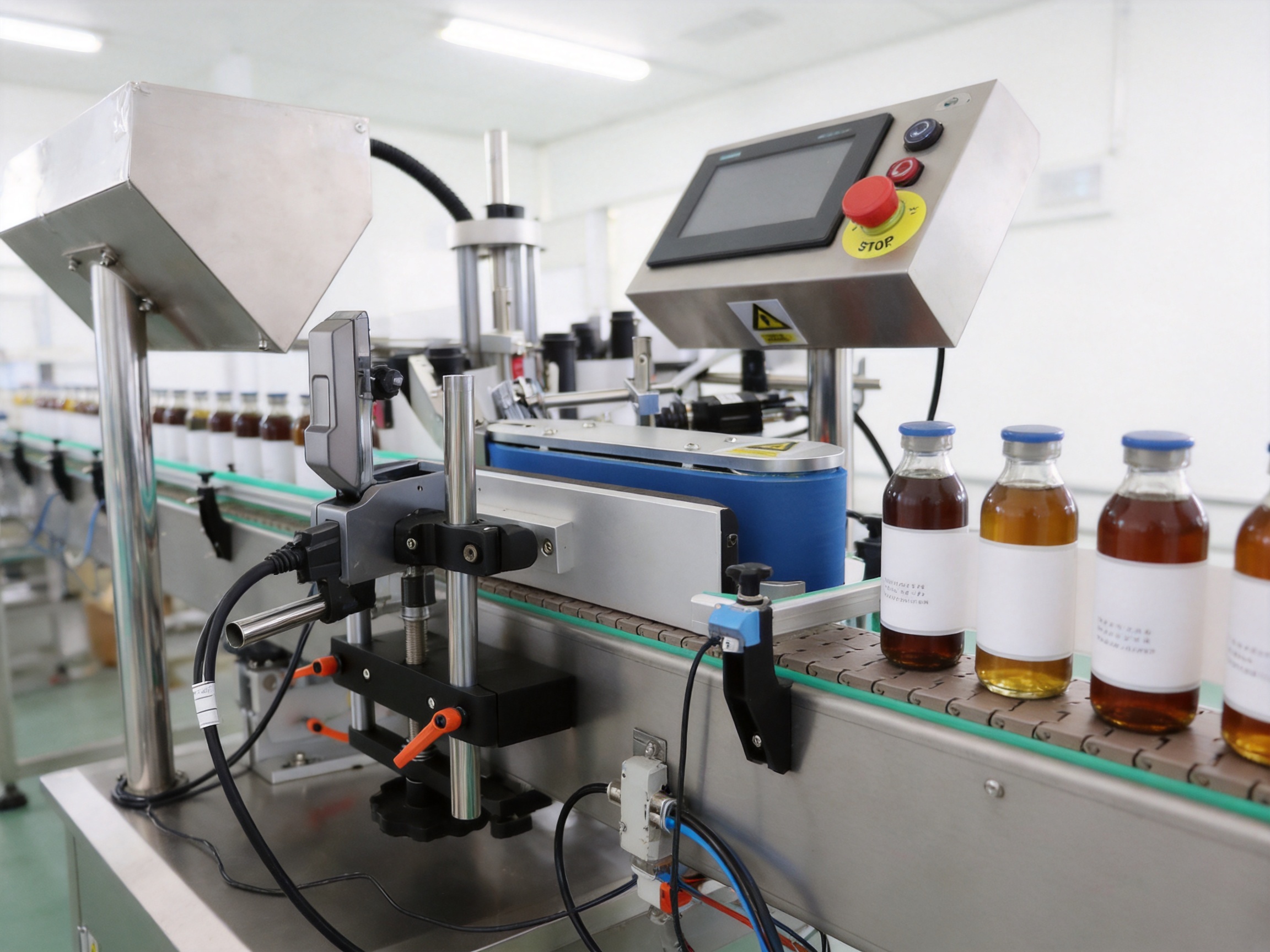
The automatic high-speed vertical round bottle labeling machine can serve as a standalone unit or as part of a broader packaging line. Optional modules can be selected according to the customer’s feeding, collecting, inspection, and coding requirements.
12.1 Automatic Feeding
An automatic feeding system can supply products to the labeling machine without continuous manual placement. This is useful when the upstream process produces bottles in bulk or when the line must operate for long periods with limited operator intervention.
12.2 Bottle Unscrambling Turntable
A bottle unscrambling turntable can help organize randomly placed bottles and guide them toward the conveyor. This may be useful for small bottles that are supplied in bulk and need to be arranged into a controlled flow before labeling.
12.3 Automatic Collection
An automatic collecting system can receive labeled products after application and organize them for inspection, packing, or transfer to another machine. Collection equipment helps reduce manual handling and maintain a continuous production flow.
12.4 Additional Labeling Heads
Additional labeling heads may be considered when a product requires more than one label. For example, a package may need a main body label and a secondary identification label. The correct number and arrangement of labeling heads depends on the product geometry and required label positions.
12.5 Integrated Printing and Coding
A compatible hot stamping coder can print dates, batch numbers, prices, weights, and other information during the labeling operation. The printing system may achieve up to 600 printing actions per minute, depending on the selected equipment and application conditions.
Integrating coding and labeling can save floor space, reduce repeated handling, and support more efficient traceability. The coding location and print quality should be tested with the actual label surface and production speed.
13. Operating Procedure
Before starting production, the operator should confirm that the correct label roll, product format, and machine recipe have been selected. The label roll must be installed in the correct direction, and the label web should pass through the guide path without excessive tension or slack.
The conveyor guides should be adjusted so that bottles remain stable and centered. The labeling head should be set to the correct height and horizontal position. Detection sensors must be aligned with the product path and checked for reliable response.
After the machine is powered on, the operator can enter the required settings through the touch screen. Important parameters may include conveyor speed, label feed length, label delay, product spacing, production count, and coding information.
A small number of trial bottles should be processed before full production begins. The operator should inspect label height, alignment, overlap, adhesion, wrinkles, and printed information. If necessary, adjustments can be made to sensor position, label timing, conveyor speed, or mechanical guides.
Once the trial result is approved, production can begin. During operation, the operator should monitor label roll tension, bottle flow, product spacing, sensor response, and any alarm messages. Periodic inspection helps identify small problems before they develop into repeated defects.
14. Maintenance and Long-Term Reliability
Regular maintenance helps preserve labeling accuracy and extend the service life of the equipment. The maintenance schedule should be based on operating hours, production environment, label material, and manufacturer recommendations.
The conveyor and guide components should be kept clean and free from adhesive residue, dust, and product debris. Contamination can affect bottle movement and cause labels to contact the product unevenly.
Label rollers, dispensing edges, and pressing components should be inspected for wear. Adhesive buildup can change the label path or interfere with smooth application. Cleaning should be performed using methods and materials that are compatible with the machine components.
Sensors should be checked regularly to ensure that they detect bottles and label gaps consistently. Loose mounting, dust, vibration, or accidental adjustment may reduce detection accuracy.
Electrical cabinets and control components should be maintained according to appropriate industrial safety procedures. Power should be isolated before authorized personnel perform internal inspection or service. Pneumatic components, where used, should also be checked for correct pressure and leakage.
Operators should record recurring alarms, product changes, label defects, and maintenance activities. This information can help identify trends and support preventive maintenance planning.
15. Factors That Influence Labeling Accuracy
The stated accuracy of approximately ±1 mm should be understood as a reference value under suitable conditions. Actual accuracy depends on several factors.
Bottle geometry is important. A round bottle with a consistent diameter is generally easier to label than a container with a tapered, flexible, or irregular surface. Bottle rigidity also affects how the product moves through the guides and application station.
Label characteristics influence feeding and adhesion. Label length, backing stiffness, adhesive type, material thickness, and label gap all affect the performance of the dispensing process. Foil, plastic, and paper labels may require different settings.
Production speed must be matched to the application requirements. Increasing speed may reduce the time available for pressing and wrapping. If the product is unstable or the label is long, a lower speed may be necessary to maintain the desired appearance.
Environmental conditions can also influence performance. Excessive dust, humidity, temperature changes, or static electricity may affect label handling and adhesive behavior. The machine should be installed in an environment appropriate for the product and label materials.
Correct setup is equally important. Guide rails, sensors, label head position, roll tension, and timing parameters must be adjusted carefully. Training operators and documenting approved settings can help maintain consistent results between shifts.
16. Why Choose a Source Manufacturer?
Working directly with a source manufacturer can provide advantages over purchasing through a supplier that only resells standard equipment. Direct engineering communication allows the customer to discuss bottle samples, label drawings, production targets, line direction, coding requirements, and future expansion plans with the technical team.
A source manufacturer with machining capabilities can evaluate modifications more efficiently. For example, a custom conveyor width, guide structure, bracket, mounting position, or labeling head arrangement may require changes to both mechanical and electrical systems. In-house technical resources can help ensure that these changes are coordinated rather than treated as isolated additions.
Direct manufacturing also supports more transparent communication about lead time, testing, spare parts, operator training, and after-sales service. Customers can request sample trials and receive recommendations based on actual product behavior.
Shanghai Ruixiao Packaging Technology Co., Ltd. combines product development, precision machining, machine assembly, commissioning, and international sales support. Its experience in multiple labeling applications enables it to provide equipment for round bottles as well as syringes, square containers, double-sided products, and print-and-apply requirements.
17. Installation and Project Planning
Before installation, the customer should prepare a level floor, suitable electrical power, compressed air where required, sufficient working space, and an appropriate product flow layout. The machine’s approximate packaging dimensions are 2400 × 1200 × 1400 mm, but additional space should be reserved for operation, maintenance, label roll replacement, and safety access.
The left-to-right feeding and discharging direction should be considered when planning the line. If the machine must operate in another direction, this requirement should be communicated during the design stage.
Customers should provide representative bottle samples, label samples, product drawings, expected speed, required label positions, and any coding information before final configuration. These details help the manufacturer determine the suitable labeling head, conveyor width, application method, and optional modules.
Acceptance testing should confirm the agreed production speed, labeling accuracy, product compatibility, coding performance, and operating functions. It is advisable to define acceptance criteria clearly before manufacturing begins.
18. Q&A
Q1: What types of products can this machine label?
The machine is designed primarily for round or cylindrical bottles and containers. Typical products include medicine bottles, oral liquid bottles, beverage containers, seasoning bottles, cosmetic bottles, personal-care packages, and selected chemical containers. Product samples should be tested before final confirmation.
Q2: Can it apply a full-wrap label?
Yes. The machine can be configured for full-wrap labeling of suitable cylindrical containers. It can also support partial-wrap and other round-bottle labeling patterns, depending on the application design.
Q3: What is the maximum labeling speed?
The stated range is approximately 100 to 400 bottles per minute. Actual speed depends on bottle diameter, bottle stability, label length, label material, adhesive performance, and the required labeling accuracy. For a 330 ml bottle, the reference speed is approximately 150 bottles per minute.
Q4: What labeling accuracy can be expected?
The reference accuracy is approximately ±1 mm under suitable operating conditions. Actual results depend on the bottle, label, machine settings, product spacing, and labeling pattern.
Q5: Can the machine process different bottle sizes?
Yes. The approximate bottle diameter range is 10 to 100 mm, and the approximate bottle height range is 20 to 300 mm. Adjustable guides, sensor positions, and labeling head settings support changeover between different products.
Q6: Can the equipment print batch numbers and dates?
Yes. An optional high-speed hot stamping coder can be integrated to print production dates, expiry dates, batch numbers, weight, price, and other information. The exact coding system should be selected according to the label material and printing requirements.
Q7: Does the machine require compressed air?
The listed air source is approximately 5 kg, with an air pressure strength range of approximately 5 to 7 kg/cm². The customer should confirm the required air supply capacity and quality during project planning.
Q8: Can the conveyor width be customized?
Yes. The conveyor belt width can be specially customized according to the diameter and characteristics of the customer’s sample bottles. Customization should be discussed before production.
Q9: What label materials can be used?
The machine can be used with suitable paper, plastic, foil, and other label materials. Because label stiffness, backing, adhesive, and surface finish affect performance, testing with the actual label roll is recommended.
Q10: Can the machine be connected to a complete packaging line?
Yes. Optional automatic feeding, bottle unscrambling, automatic collection, additional labeling heads, coding equipment, and other modules can be integrated according to the line design.
Q11: How does the touch screen improve operation?
The touch screen allows operators to adjust speed, label position, production count, and other parameters. It also supports fault indication, parameter protection, and energy-saving standby functions, helping simplify daily operation and monitoring.
Q12: Why is sample testing important?
Sample testing confirms whether the bottle remains stable, whether the label adheres correctly, whether the selected speed is suitable, and whether the desired label position can be achieved. It is especially important for tapered, flexible, unusually small, or surface-sensitive containers.
Q13: What manufacturing advantages does the supplier provide?
The supplier has in-house precision machining capabilities, multiple CNC machining centers, an experienced technical team, and an integrated process covering component machining, machine assembly, and commissioning. Its quality processes are managed according to the ISO 9001 international quality system.
Q14: Is the machine suitable for export projects?
The manufacturer exports labeling equipment to more than 40 countries and regions. International projects should confirm electrical standards, language requirements, shipping conditions, installation support, spare parts, and operator training in advance.
19. Purchasing Checklist
Before purchasing the machine, customers should prepare accurate information about the product and labeling requirements. The most important information includes bottle diameter, bottle height, bottle material, bottle rigidity, label dimensions, label material, label gap, adhesive type, label roll dimensions, desired production speed, and label position.
The customer should also explain whether the product requires full-wrap labeling, partial-wrap labeling, front-and-back positioning, a fixed orientation, or multiple labels. If printing is required, the customer should provide the required content, printing location, character size, and print contrast.
Production-line information is also important. The machine layout should consider infeed and discharge direction, available floor space, upstream and downstream equipment, collection requirements, and future expansion. If the customer plans to add inspection, coding, or automatic packing later, the machine should be designed with suitable integration points.
Finally, the customer should clarify the expected working schedule and service requirements. High-volume operations may benefit from spare label sensors, rollers, belts, electrical components, and other recommended parts being included in the project plan.
20. Conclusion
The automatic high-speed vertical round bottle labeling machine is an efficient solution for manufacturers that require fast, accurate, and consistent labeling of cylindrical containers. Its combination of vertical conveying, automatic product separation, photoelectric detection, servo-controlled label feeding, adjustable application components, and touch-screen operation provides a practical foundation for modern packaging automation.
Its advantages over conventional manual or semi-automatic systems include higher output, improved label positioning, reduced waste, faster changeover, easier monitoring, and the possibility of integrated coding. Optional feeding, unscrambling, collecting, additional labeling, and printing modules allow the machine to be adapted to different production objectives.
The equipment is supported by the manufacturing strengths of Shanghai Ruixiao Packaging Technology Co., Ltd. The company’s CNC machining capabilities, technical team, integrated assembly and commissioning process, and ISO 9001 quality-management approach contribute to more controlled equipment production. Its experience serving customers in more than 40 countries and regions also supports international packaging projects.
For the best result, every project should be evaluated using actual bottles and labels. Proper sample testing, line planning, installation, operator training, and preventive maintenance are essential to achieving the machine’s intended performance. When correctly configured, the automatic high-speed vertical round bottle labeling machine can help pharmaceutical, food, beverage, cosmetics, daily chemical, and chemical manufacturers improve productivity while delivering a cleaner and more consistent package appearance.
References
1. Product technical information for the automatic high-speed vertical round bottle labeling machine, model RXL-AH.
2. Manufacturer-provided operating and configuration specifications for round bottle labeling applications.
3. ISO 9001 quality management system principles for manufacturing and process control.
4. General engineering practices for automatic label dispensing, photoelectric detection, servo motion control, and conveyor-based packaging systems.
5. Manufacturer information regarding CNC machining, machine assembly, commissioning, customization, and international packaging-equipment applications.
Product: Automatic High Speed Vertical Round Bottle Labeling Machine

related products
-
Automatic High Speed Vertical Round Bottle Labeling Machine
-
Automatic Round Bottle Side and Top Labeling Machine
-
Automatic Round Bottle Tabletop Labeling Machine
-
Automatic Round Bottle Labeling Machine
-
Automatic Round Bottle Positioning Labeling Machine
-
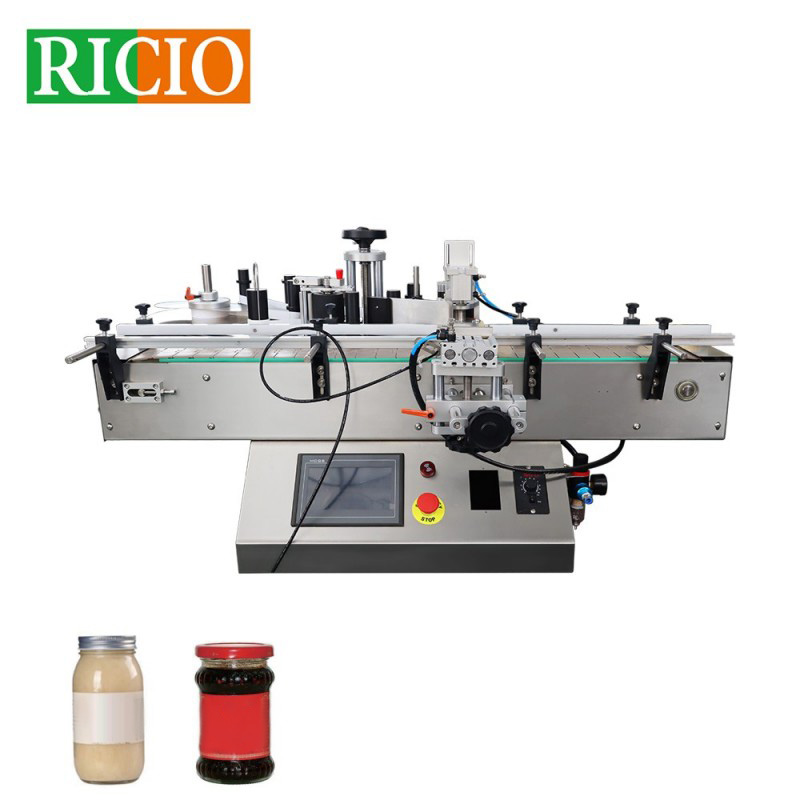
Automatic Round Bottle Positioning Tabletop Labeling Machine
related News
 +86 13681850339
 sales@raxpack.com
 Building 6, No. 477 Tiefeng Road, Baoshan District, Shanghai, China
- Tabletop Labeling Machine
- Round Bottle Labeling Machine
- Automatic Tube Labeling Machine
- Pouch Labeling Machine
- Rotary Labeling Machine
- Syringe Labeling Machine
- Top Labeling Machine
- Single Side Sticker Labeling Machine
- Double Side Labeling Machine
- Bucket Labeling Machine
- Bottom Labeling Machine
- Corner Label Applicator
- Waist Sealing Labeling Machine
- Square Bottle Labeling Machine
