 English
 русский
 Español
 عربى



Automatic Top and Bottom Labeling Machine: Precision, Flexibility, and Reliable Packaging Automation
2026-10-14
Content
- 1 Why Top and Bottom Labeling Requires Specialized Equipment
- 2 Core Operating Principle
- 3 Product Applications
- 4 Major Advantages Over Conventional Labeling Methods
- 5 Technical Configuration and Performance
- 6 PLC Control and Touch Screen Operation
- 7 Mechanical Design for Stable Label Application
- 8 Optional Printing and Code Verification Functions
- 9 Manufacturing Strengths of the Equipment Supplier
- 10 How the Machine Compares with Alternative Solutions
- 11 Installation and Production Planning
- 12 Maintenance and Long-Term Reliability
- 13 Improving Return on Investment
- 14 Recommended Selection Criteria
- 15 Frequently Asked Questions
- 15.1 What products can the automatic top and bottom labeling machine handle?
- 15.2 Can the machine apply different labels to the top and bottom surfaces?
- 15.3 What is the labeling speed?
- 15.4 How accurate is the labeling process?
- 15.5 What label sizes can the machine support?
- 15.6 Can transparent labels be used?
- 15.7 Can the machine print dates and batch numbers?
- 15.8 Can it read barcodes or QR codes?
- 15.9 Can the machine be integrated into an existing production line?
- 15.10 Is the conveyor width adjustable?
- 15.11 What is the product height range?
- 15.12 How does the machine reduce wrinkles and edge lifting?
- 15.13 What type of control system does it use?
- 15.14 What information should be supplied for a customized quotation?
- 16 Conclusion
- 17 References
- 18 Product: Automatic Top and Bottom Labeling Machine
Modern packaging operations increasingly require accurate, repeatable, and high-speed labeling on multiple product surfaces. A label may need to identify a product, display regulatory information, provide a barcode, communicate a batch number, or support traceability throughout the supply chain. When labels must be applied to both the upper and lower surfaces of a flat or square product, manual application becomes slow, inconsistent, and difficult to control. The automatic top and bottom labeling machine provides a practical solution by completing both labeling operations in one continuous conveying process.
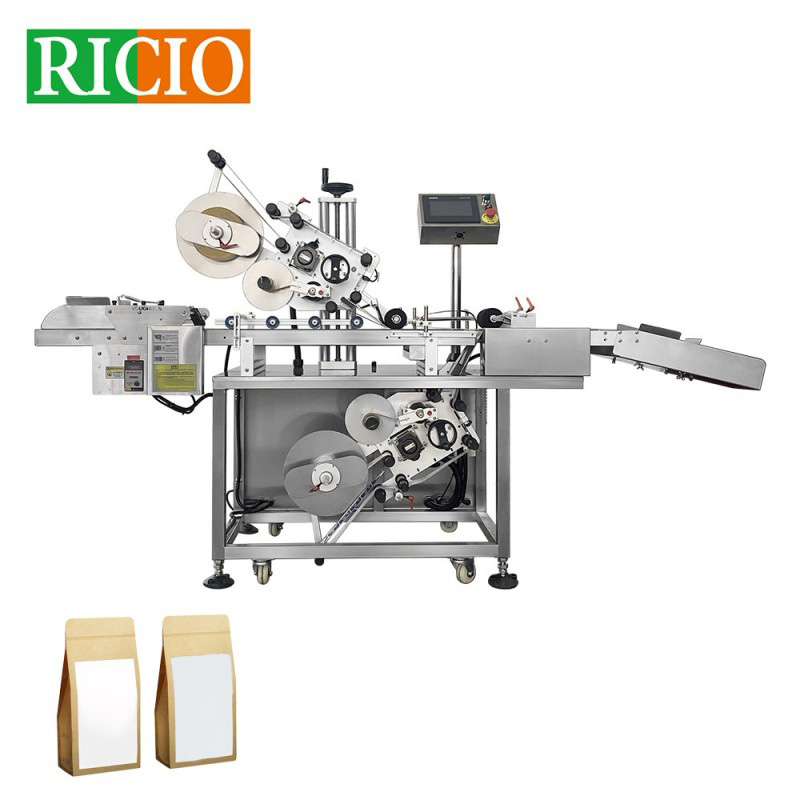
Designed for flat packages, boxed products, cards, pouches, bags, plastic boxes, and other products with suitable upper and lower surfaces, the RXL-PTB combines product detection, label dispensing, synchronized conveying, pressing, control, and optional coding functions in one integrated system. It can be used as a stand-alone machine or connected with upstream and downstream packaging equipment to form a continuous automated production line.
The machine is classified as a double side labeling machine because it applies labels to two opposing surfaces during the same production cycle. Unlike systems that require products to be turned over manually or transferred to a second machine, this configuration reduces handling, saves floor space, and helps maintain consistent label positioning. It is especially useful for applications requiring a front label and a back label, a product label and an instruction label, or a barcode label and a traceability label.
With adjustable production parameters, stable label dispensing, a PLC-based control system, and optional printing or code-reading functions, the machine addresses the requirements of manufacturers seeking higher productivity without sacrificing label quality. Its design also reflects the manufacturing capabilities of Shanghai Ruixiao Packaging Technology Co., Ltd., a Shanghai-based labeling machinery manufacturer with in-house precision machining, complete equipment assembly, and international packaging automation experience.
Why Top and Bottom Labeling Requires Specialized Equipment
Applying a label to the upper surface of a product is relatively straightforward when the product is stable and correctly positioned. Applying a second label to the lower surface introduces additional technical requirements. The machine must maintain product orientation, control the product gap, coordinate two label dispensers, and ensure that the upper and lower labels are released at the correct time.
If the product moves unevenly, the upper and lower labels may be offset from one another. If the label web tension is unstable, labels may wrinkle, stretch, or detach incorrectly. If the product is not supported throughout the conveying process, the bottom label may be damaged or fail to adhere uniformly. A specialized top and bottom labeling machine solves these problems through coordinated mechanical and electronic systems.
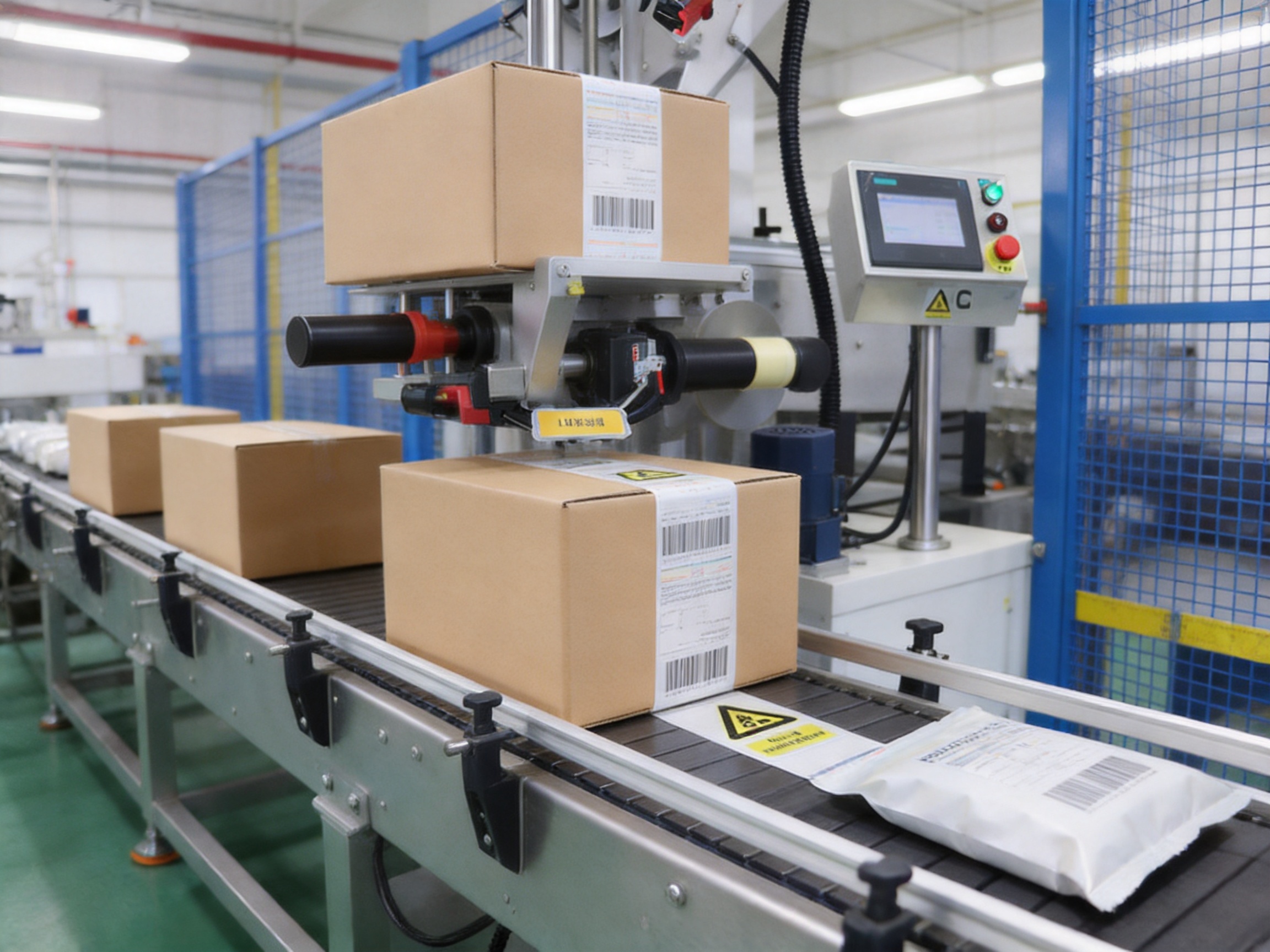
The RXL-PTB is designed around a continuous conveying process. Products enter the labeling zone, pass through the detection system, and are positioned for simultaneous or coordinated label application. Upper and lower labeling assemblies dispense labels onto the corresponding surfaces. After application, pressing rollers help smooth the labels and improve adhesion before the product leaves the machine.
This method reduces the need for manual repositioning and minimizes variation between products. It is particularly valuable where label alignment affects brand presentation, barcode readability, regulatory compliance, or downstream inspection. By controlling the complete application sequence, the machine helps create a repeatable labeling process rather than relying on operator timing and hand placement.
Core Operating Principle
The operating process begins when products are fed onto the conveyor. Depending on the application, products may arrive from a manual loading station, a carton former, a filling and sealing machine, a bagging machine, or another packaging system. The conveyor transports each item toward the labeling area while maintaining an appropriate product gap.
A product detection sensor identifies the leading edge or another reference point. The PLC receives this signal and calculates when each label should be released. The upper and lower labeling mechanisms then operate according to the configured parameters. These parameters may include conveyor speed, product dimensions, label length, label delay, label dispensing speed, and the required distance between products.
As the product passes through the application zone, one label is applied to the top surface and another is applied to the bottom surface. The exact sequence can be adjusted to match the product and label material. Pressing rollers or related pressing components then apply controlled contact pressure. This helps remove air pockets, flatten minor wrinkles, and secure the label edges.
After the product exits the labeling area, it can proceed to visual inspection, code verification, packing, case forming, or other downstream operations. Optional devices such as thermal coding printers, inkjet printers, barcode readers, and QR code readers can be integrated into the system to support identification and traceability.
The control interface allows operators to save and adjust production settings. A user may configure the machine for different product sizes or label specifications without making extensive mechanical changes. This flexibility is important for manufacturers that produce multiple stock-keeping units on the same line.
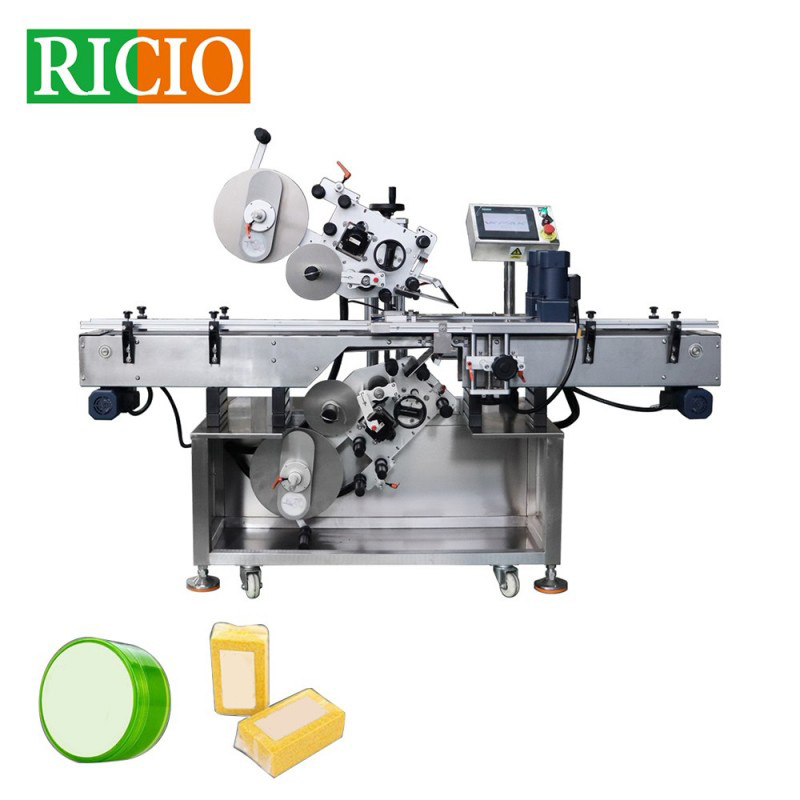
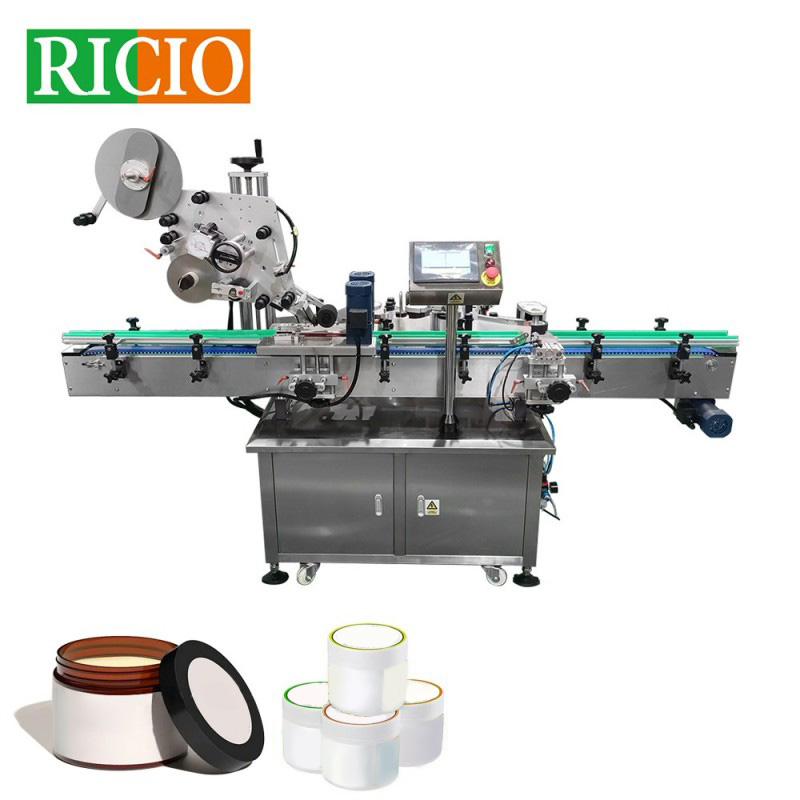
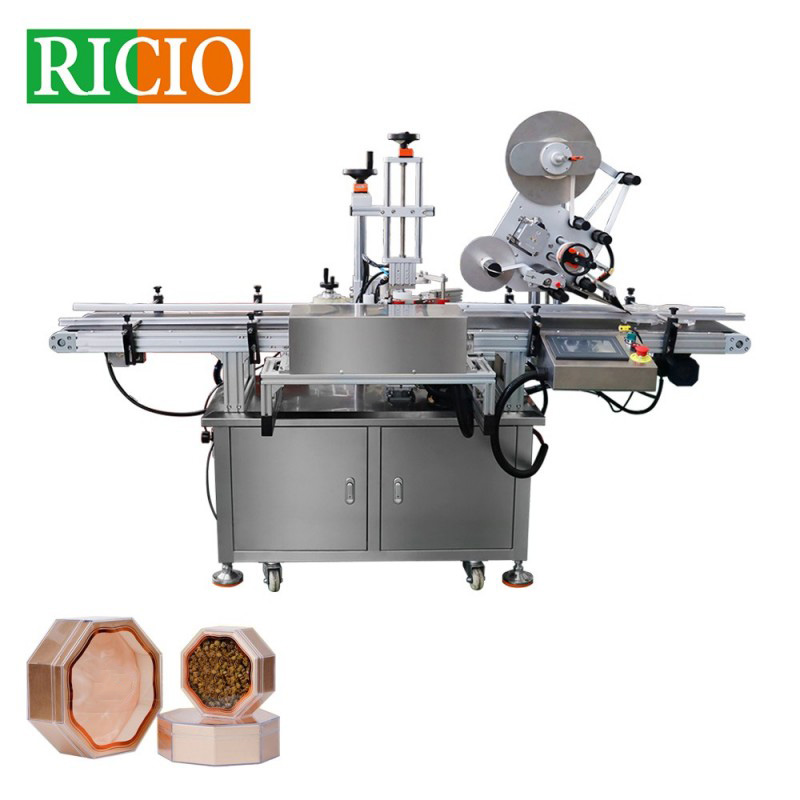
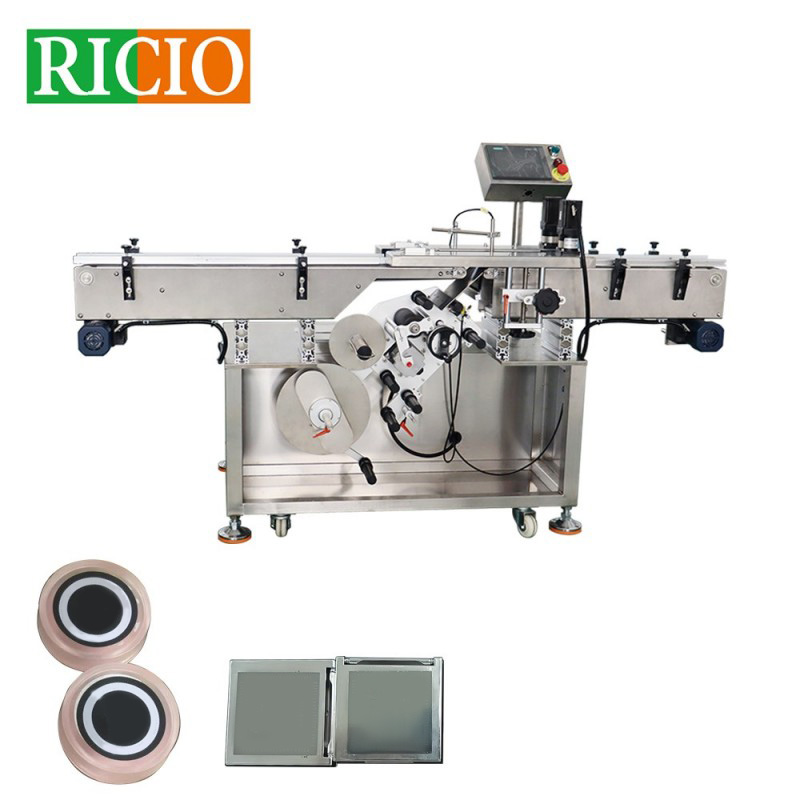
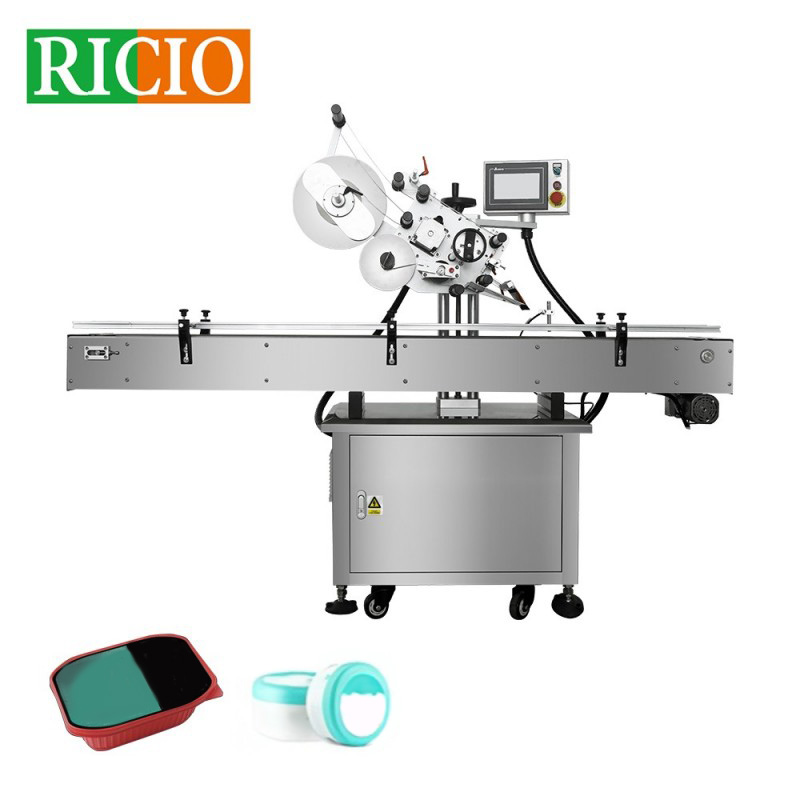
Automatic Top and Bottom Labeling Machine
Product Applications
The automatic top and bottom labeling machine is suitable for products with sufficiently flat, stable, and accessible surfaces. Typical applications include cartons, square packages, flat pouches, bags, cards, paper products, plastic boxes, blister packs, and packaged consumer goods.
In the food and beverage sector, the machine can apply identification labels, nutrition labels, promotional labels, expiry information, or traceability labels to packaged foods and flat containers. Grain and oil products, snack packs, prepared foods, and retail packages may benefit from automated two-sided labeling when the upper and lower surfaces are accessible during conveying.
In pharmaceutical and healthcare packaging, accurate label placement is important for product identification, batch management, dosage information, and inspection. The system can support labels containing barcodes, QR codes, instructions, or other controlled information. When connected with a coding or reading system, it can help manufacturers associate the physical package with production data.
Daily chemical and cosmetic products, including flat cartons, pouches, refill packages, and accessory boxes, can also be processed. Accurate top and bottom labeling helps maintain a consistent retail appearance while reducing the labor associated with manual label placement.
The machine is also appropriate for electronics, stationery, plastic packaging, chemical products, and industrial components that require identification on two surfaces. For example, a box may require a product label on its upper face and a logistics or barcode label on its lower face. A flat bag may need a consumer-facing label and a traceability label. A card or paper product may need front and reverse-side identification.
Major Advantages Over Conventional Labeling Methods
One-Pass Two-Surface Labeling
The most important advantage is the ability to apply labels to the top and bottom surfaces in one continuous process. A conventional single-side machine may require the product to pass through two separate machines or be manually turned over between operations. That approach increases handling time, creates additional alignment risk, and requires more production floor space.
By combining the two application functions in one machine, the RXL-PTB reduces process complexity. Products remain within a controlled conveying path, which supports better positioning and more consistent timing. The result is a more efficient process for products that require two labels.
Reduced Manual Labor
Manual labeling can be affected by fatigue, inconsistent pressure, changing hand position, and variations in product placement. These factors may lead to crooked labels, wrinkles, incomplete adhesion, or missing labels. Automated product detection and controlled dispensing reduce dependence on operator judgment.
Operators can focus on material loading, quality monitoring, and production management rather than repeatedly applying labels by hand. This can improve labor utilization and make output more predictable, especially during long production runs.
Improved Labeling Consistency
Label position is controlled by the relationship between the detection sensor, conveyor movement, and dispensing mechanism. Once the machine has been correctly set up, each product can receive labels at a consistent location. The stated labeling accuracy can reach approximately ±1 millimeter, depending on product characteristics and application conditions.
Actual accuracy is influenced by product stability, surface flatness, label material, conveyor condition, product spacing, and the quality of feeding. Nevertheless, a controlled automated process generally provides much greater repeatability than manual application.
Lower Risk of Wrinkles and Edge Lifting
Pressing rollers help the labels adhere firmly to the product surface. They smooth the label after initial placement and reduce the risk of air pockets, wrinkles, and partially attached edges. This is especially important for products that will be transported, stacked, or exposed to vibration after labeling.
A well-pressed label also improves package appearance. For consumer products, a smooth and accurately positioned label supports a more professional presentation. For industrial and pharmaceutical products, secure adhesion can help maintain readable product information throughout handling and distribution.
Flexible Production Speeds
The machine can operate at approximately 30 to 100 pieces per minute, depending on product size, label dimensions, feeding method, conveyor speed, and the requirements of linked equipment. Adjustable speed allows manufacturers to balance throughput and accuracy instead of being restricted to one fixed operating rate.
For a small batch, operators may choose a moderate speed that allows convenient inspection and changeover. For a stable, high-volume application, the conveyor and labeling parameters can be adjusted toward the upper end of the operating range, provided that product feeding and label supply are capable of supporting the selected rate.
Support for Different Label Sizes
The machine supports label heights from approximately 10 to 150 millimeters and label lengths from approximately 15 to 300 millimeters. These ranges cover many common product, instruction, barcode, and logistics label formats. Customized specifications can be considered when the product or label falls outside the standard configuration.
The label roll can have an inner diameter of approximately 76 millimeters and a maximum outer diameter of approximately 300 millimeters. A larger label roll can reduce the frequency of roll changes, while the supported dimensions provide flexibility for different production requirements.
Easy Integration
The compact structure allows the equipment to function as an independent labeling station or as part of a larger packaging line. It can be positioned after filling, sealing, cartoning, bagging, or inspection equipment, depending on the product flow.
Integration may include conveyor synchronization, product counting, coding, vision inspection, rejection systems, or downstream packing equipment. The ability to connect with existing equipment helps manufacturers improve an established line without replacing every machine.
Technical Configuration and Performance
The following table summarizes the main standard specifications. Actual configuration may be adjusted according to product samples, label design, production speed, and line requirements.
| Parameter | Standard Specification |
|---|---|
| Equipment type | Automatic top and bottom labeling machine |
| Model reference | RXL-PTB |
| Power supply | AC 220 V, 50/60 Hz; other configurations may be considered |
| Power consumption | Approximately 1500 W |
| Labeling speed | Approximately 30–100 pieces per minute |
| Labeling accuracy | Approximately ±1 mm, depending on product characteristics |
| Label supply speed | Approximately 3–30 meters per minute |
| Net weight | Approximately 200 kg |
| Packaging dimensions | Approximately 2100 × 1100 × 1500 mm |
| Label height | Approximately 10–150 mm |
| Label length | Approximately 15–300 mm |
| Label roll inner diameter | Minimum approximately 76 mm |
| Label roll outer diameter | Maximum approximately 300 mm |
| Product height range | Approximately 20–300 mm |
| Conveyor width | Customizable according to product samples |
These specifications should be treated as a reference for preliminary planning. Product shape, material, surface condition, label adhesive, label backing, and production line layout all affect the final machine configuration. Sample testing is recommended before finalizing an order.
PLC Control and Touch Screen Operation
The control system is based on a programmable logic controller and touch screen interface. This combination provides a structured method for managing sensors, motors, label dispensers, alarms, and production settings. The PLC coordinates the machine sequence, while the touch screen presents the operating information in a format that can be adjusted by authorized personnel.
Operators can typically set conveyor speed, label delay, product spacing, label length, and other relevant parameters. The system may also support production counting, fault indication, operation status recording, and label management. These functions help production teams understand current machine status and respond quickly when an abnormal condition occurs.
For manufacturers handling multiple products, stored parameter settings can simplify changeover. Instead of recalculating every value from the beginning, operators can select a suitable product program and make small adjustments after verification. This helps reduce setup time and encourages standardized operating practices.
A clear control interface is also useful for maintenance. When the system identifies a sensor, motor, or label supply problem, the fault indication can guide the operator toward the affected area. Faster identification reduces downtime and helps maintenance personnel determine whether the issue requires cleaning, adjustment, replacement, or technical support.
Mechanical Design for Stable Label Application
Accurate labeling depends not only on software but also on the mechanical quality of the conveyor, rollers, guide rails, label supply assemblies, and mounting structure. If a product shifts while moving through the labeling zone, even a well-calibrated sensor cannot guarantee perfect label placement.
The machine uses driving rollers and a controlled label dispensing system to support consistent label output. Wear-resistant components help reduce slipping and premature wear during continuous operation. Stable roller contact is particularly important when the machine is working with products of different weights or surfaces.
Adjustable guides can help center products and maintain a repeatable path. For flat packages and boxes, guide positioning supports consistent alignment with the top and bottom applicators. Where products vary in width, the conveyor and guide system can be customized or adjusted to match the required product range.
The pressing rollers are also important. Their role is not simply to push the label down; they must provide enough contact to promote adhesion without damaging the product, label, or package. Correct pressure depends on package material, label adhesive, label position, and product rigidity. Proper commissioning includes adjustment of roller contact and product transport conditions.
A practical machine design should also provide access for label roll replacement, cleaning, inspection, and routine maintenance. Reduced access time can make a meaningful difference in a high-use production environment. The compact layout of this labeling system is intended to provide useful functionality without requiring an unnecessarily large installation area.
Optional Printing and Code Verification Functions
Many modern packaging lines require more than label application. Production dates, expiry dates, batch numbers, serial numbers, QR codes, and other traceability data may need to be printed or verified during the same process.
A thermal coding printer can be added for applications requiring variable information on suitable label or packaging surfaces. An inkjet printer may be selected when direct marking on a product or package is preferred. The appropriate printing technology depends on the substrate, print resolution, ink requirements, production speed, and regulatory needs.
Transparent label sensors are another useful option. Standard label detection methods may need adjustment when labels have transparent areas or unusual backing materials. A suitable sensor configuration helps the machine distinguish between labels and gaps so that dispensing remains accurate.
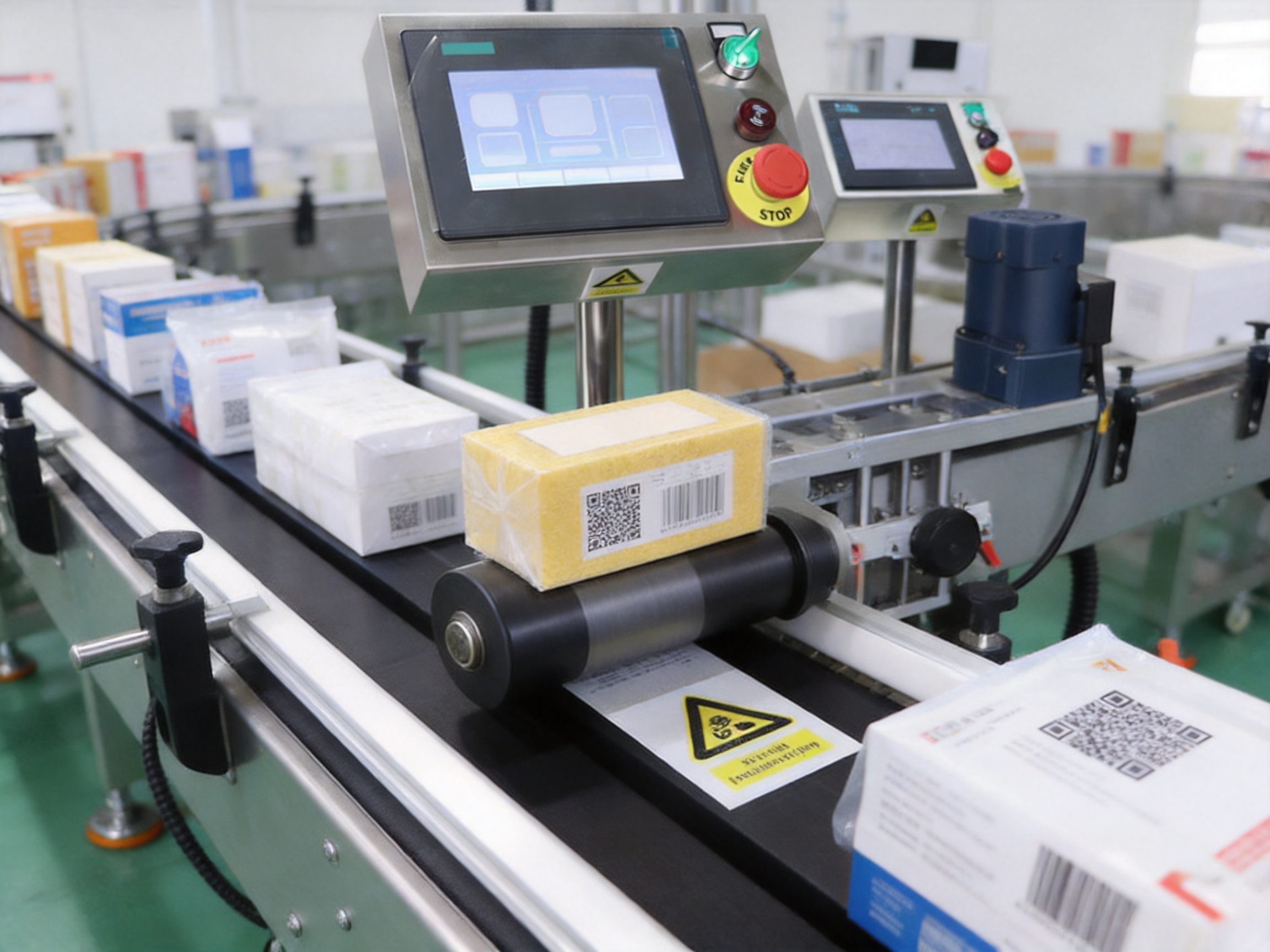
Barcode and QR code readers can support product verification and traceability. A reader may confirm that the correct code is present, check whether a label belongs to the intended product, or connect package information with a manufacturing database. When combined with a rejection device, code verification can help prevent incorrectly labeled products from moving to the next production stage.
These options reduce the need for secondary operations. Instead of labeling products first and manually printing or checking them later, manufacturers can bring multiple information-management functions into a controlled automated process. This improves efficiency and can reduce the risk of data or package mix-ups.
Manufacturing Strengths of the Equipment Supplier
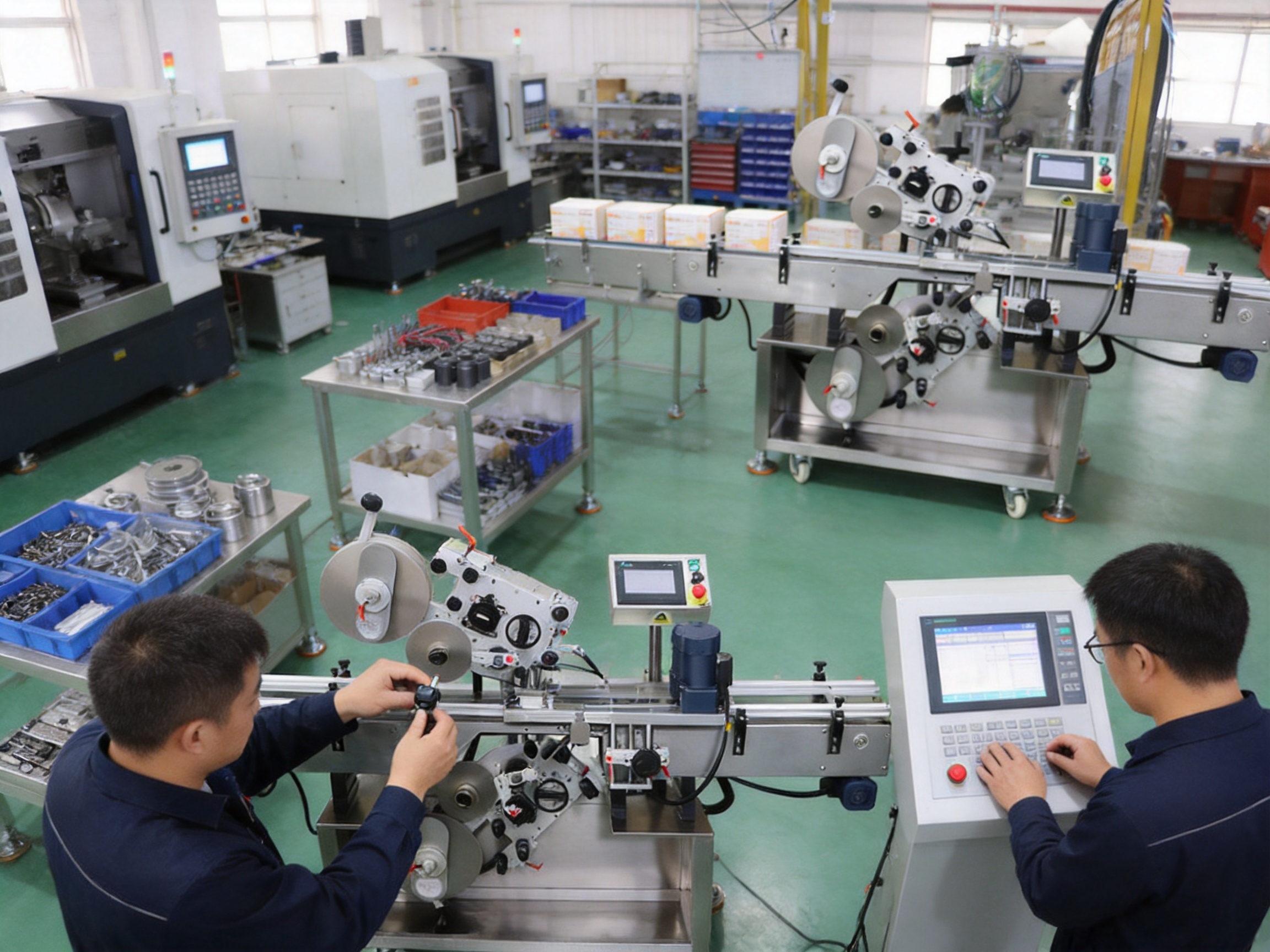
The performance of a labeling machine depends greatly on the capabilities of the company that designs, machines, assembles, tests, and supports it. Shanghai Ruixiao Packaging Technology Co., Ltd. develops and manufactures labeling machinery in Shanghai, China, serving customers in food, beverage, pharmaceutical, healthcare, daily chemical, cosmetics, electronics, and chemical packaging.
The company developed from the acquisition of Shanghai Zhenbao Machinery Parts Factory. This background is important because it combines equipment-building experience with a foundation in precision mechanical parts manufacturing. Rather than relying entirely on external component suppliers, the company has developed in-house machining capabilities that support closer control over key parts and assemblies.
Its manufacturing resources include multiple CNC machining centers and an experienced technical team. CNC machining allows components to be produced according to controlled digital dimensions and repeatable production procedures. This is valuable for machine parts such as brackets, rollers, supports, shafts, guide components, and other elements that influence alignment and movement.
In-house machining can also improve communication between design and production teams. When a component requires modification for a customer sample, engineers and machinists can work together more directly. This can shorten the feedback cycle and make customized designs more practical.
From Component Machining to Complete Assembly
The company manages a broad portion of the equipment process, from core component machining to complete machine assembly and commissioning. This integrated approach provides greater visibility into how individual parts work together as a system.
For a top and bottom labeling machine, the interaction between the conveyor, sensors, label dispensers, pressing rollers, guides, and control system is critical. A small dimensional difference in one mounting component can affect label alignment or product movement. Coordinated manufacturing and assembly help reduce this type of mismatch.
Complete commissioning is also important. A labeling machine should not be judged only by whether its motors run or whether labels can be dispensed. It must be evaluated with representative products and labels. The system needs to be checked for detection accuracy, label timing, product stability, pressing performance, speed control, and recovery from common operating interruptions.
Commissioning with actual customer samples helps identify practical issues before shipment. These may include difficult label materials, product surface variations, changes in product height, insufficient product spacing, or special code-printing requirements. Early testing allows the machine to be adjusted for real production conditions rather than only theoretical dimensions.
Quality Management and Process Control
The company manages its manufacturing and assembly activities according to the ISO 9001 international quality system. A quality management system provides a framework for documenting processes, controlling production activities, managing inspections, and improving consistency.
For packaging equipment, quality control should cover mechanical parts, electrical components, wiring, software configuration, safety systems, and final machine performance. Documentation and process controls make it easier to trace problems and establish corrective actions when necessary.
Quality management does not eliminate the need for product-specific testing. Every labeling application has unique variables. However, a structured quality system creates a stronger foundation for repeatable manufacturing and more reliable customer support.
International Experience
The company exports labeling equipment to more than 40 countries and regions. International project experience can provide useful insight into different packaging standards, production environments, electrical requirements, operator expectations, and industry applications.
Export experience also requires attention to packaging protection, documentation, installation guidance, spare parts, and communication across different time zones and languages. A manufacturer familiar with international deliveries is better positioned to plan equipment for overseas installation and long-distance transportation.
For buyers comparing labeling machine suppliers, manufacturing depth is an important consideration. A low initial price may not represent the best total value if the supplier lacks engineering support, customization capability, spare parts availability, or commissioning experience. A manufacturer with in-house technical resources can often provide more practical assistance throughout the equipment life cycle.
How the Machine Compares with Alternative Solutions
Manual Labeling
Manual labeling has a low initial equipment cost and may be acceptable for very small batches or product testing. However, it is labor-intensive and difficult to standardize. Applying two labels to opposite surfaces requires repeated product handling, which increases the possibility of incorrect orientation, missing labels, and inconsistent placement.
The automatic machine requires a larger initial investment but can provide higher output, more consistent application, and lower dependence on manual labor. For continuous or growing production, the reduction in handling and rework can provide significant operational value.
Two Separate Single-Side Labelers
Two independent single-side machines may be used to apply labels to the top and bottom surfaces. This solution can work, but it usually requires more floor space, more conveyors, additional transfer points, and greater coordination between machines. Products may need to be turned over or transferred between separate lines.
The integrated top and bottom machine reduces the number of process steps. Its coordinated applicators use one conveying system and one control environment, which can simplify operation and reduce the opportunity for product displacement between labeling stages.
Manual Product Turning
Some lines apply one label, manually turn the product, and then apply a second label. This approach creates an additional labor step and may damage labels that have not fully adhered. It also makes high-speed production difficult because product handling becomes a bottleneck.
The RXL-PTB is designed to avoid this repeated turning operation. Products remain in a defined conveying path while the upper and lower surfaces are labeled during the same pass.
Highly Specialized High-Speed Systems
Some high-speed labeling systems are engineered for one product format and a narrow range of label specifications. They may achieve exceptional output in a dedicated application but offer less flexibility when the manufacturer changes products or packaging formats.
The RXL-PTB offers a balance between productivity and adaptability. Its adjustable speed and customizable conveyor width make it suitable for manufacturers that need reliable output across several product sizes. It is not intended to replace every specialized ultra-high-speed system, but it can provide a more versatile solution for varied production requirements.
Installation and Production Planning
Before installation, manufacturers should review product dimensions, product material, surface flatness, label location, label adhesive, label roll dimensions, desired speed, and available floor space. These details determine whether the standard machine configuration is suitable or whether modifications are necessary.
Product samples and actual label samples should be supplied for testing whenever possible. Sample evaluation can confirm whether products remain stable during conveying, whether the labels release correctly, and whether the pressing rollers provide sufficient adhesion. It can also identify whether transparent labels, reflective surfaces, or unusual backing materials require special sensors.
The production line layout should include sufficient space for product loading, label roll replacement, operator access, maintenance, and downstream transfer. Although the machine is compact compared with multiple separate stations, it still requires safe access around moving parts and electrical panels.
Electrical supply should be confirmed before delivery. The standard power supply is AC 220 V at 50/60 Hz, while alternative configurations may be considered when required by the installation location. Integration with linked machines should include signal communication, conveyor speed coordination, emergency stop logic, and product accumulation control.
Operators should receive training in product changeover, label roll installation, sensor adjustment, cleaning, fault response, and basic preventive maintenance. Correct training helps preserve labeling accuracy and reduces avoidable downtime.
Maintenance and Long-Term Reliability
Routine maintenance is necessary for stable performance. Label dust, adhesive residue, paper fragments, and product debris can accumulate around sensors, rollers, and dispensing edges. Regular cleaning helps maintain accurate detection and smooth label release.
Rollers should be inspected for wear, contamination, and loss of traction. A worn or contaminated roller may allow products or label webs to slip. Guide rails should be checked to ensure they remain secure and correctly positioned after repeated changeovers.
Label tension and roll alignment should also be monitored. Poorly installed rolls can cause uneven web movement, label wrinkles, or dispensing errors. Operators should follow a consistent threading procedure and confirm that the label web passes correctly through each guide and sensor.
Electrical connections, sensor cables, emergency stop devices, and control cabinet components should be inspected according to the maintenance schedule. Preventive checks can identify loose connections or damaged cables before they cause an unexpected stoppage.
Software settings should be backed up or documented where appropriate. If multiple product programs are used, clear naming and parameter records can reduce the risk of selecting an incorrect setup. Maintenance teams should record recurring faults and corrective actions so that process improvements can be made over time.
Improving Return on Investment
The financial value of an automatic labeling machine should be evaluated across the complete production process rather than only by comparing purchase prices. Relevant factors include labor savings, reduced rework, improved throughput, lower material waste, reduced product handling, and the ability to integrate coding and inspection functions.
For operations that currently use several manual labeling stations, one automatic top and bottom machine may consolidate tasks and reduce the number of operators required. It can also make production planning easier because output is controlled by machine settings rather than individual working speed.
Improved label accuracy may reduce rejected products and customer complaints. A consistent label position is especially important when packages are displayed together on a retail shelf or when barcodes must be scanned by automated equipment.
Integration with coding and verification equipment can provide additional savings. Combining labeling, printing, and code reading in a single line reduces secondary handling and may eliminate separate manual inspection steps. The value will depend on production volume and the cost of current manual processes, but these benefits should be included in a full investment analysis.
Manufacturers should also consider future product development. A machine with adjustable parameters and customizable conveyor dimensions may continue to support new product sizes and label formats. This flexibility can extend the useful life of the equipment and reduce the need for early replacement.
Recommended Selection Criteria
When selecting a top and bottom labeling machine, buyers should begin with the product rather than the machine model. The most important questions concern the product’s dimensions, weight, surface material, rigidity, shape, and stability during conveying.
The label should also be evaluated. Important factors include label height, label length, adhesive type, backing material, transparency, surface finish, roll diameter, and printing requirements. Labels that are very thin, transparent, highly reflective, or unusually flexible may require special testing or sensors.
Production requirements should include target pieces per minute, operating hours per day, batch size, changeover frequency, and the need for future expansion. A machine that is suitable for a short daily run may not be appropriate for continuous multi-shift production without additional configuration.
Line integration is another major consideration. Buyers should identify the upstream feeding method, downstream packing method, available communication signals, and required rejection or inspection functions. If coding or scanning is needed, the equipment layout should reserve sufficient space and define how information will be exchanged.
Finally, the supplier should be evaluated for manufacturing capability, customization experience, testing procedures, documentation, spare parts, technical support, and after-sales service. A well-built machine is valuable, but long-term support is equally important for maintaining production performance.
Frequently Asked Questions
What products can the automatic top and bottom labeling machine handle?
The machine is intended for flat or sufficiently stable products with accessible upper and lower surfaces. Typical examples include flat packages, cartons, square packages, pouches, bags, cards, plastic boxes, paper products, and other products that can travel steadily on a conveyor. The final suitability should be confirmed through sample testing.
Can the machine apply different labels to the top and bottom surfaces?
Yes. The upper and lower labeling mechanisms can be configured for different label requirements, subject to the product design and machine configuration. For example, the top may receive a product or promotional label while the bottom receives an instruction, logistics, barcode, or traceability label.
What is the labeling speed?
The standard operating range is approximately 30 to 100 pieces per minute. Actual speed depends on product dimensions, label size, product spacing, feeding method, label material, operator loading speed, and the speed of connected equipment.
How accurate is the labeling process?
The reference labeling accuracy is approximately ±1 millimeter when product conditions and machine settings are suitable. Actual results depend on product stability, surface condition, label properties, conveyor movement, sensor performance, and the consistency of product feeding.
What label sizes can the machine support?
The reference label height range is approximately 10 to 150 millimeters, while the label length range is approximately 15 to 300 millimeters. Customized specifications may be considered for special label dimensions or product requirements.
Can transparent labels be used?
Transparent label applications may require a dedicated transparent label sensor or a different detection arrangement. An optional transparent label sensor is available according to production needs. Testing with the actual label material is recommended before final configuration.
Can the machine print dates and batch numbers?
Yes. Optional thermal coding printers and inkjet printers can be integrated to print production dates, expiry dates, batch numbers, supervision codes, and other variable information. The selected printer depends on the surface, print content, speed, and required resolution.
Can it read barcodes or QR codes?
Optional barcode and QR code readers can be added. These devices may be used to verify the correct label, confirm code readability, or support traceability. A compatible rejection system can also be considered when incorrect or unreadable products must be removed automatically.
Can the machine be integrated into an existing production line?
Yes. The machine can operate independently or be connected to upstream and downstream packaging equipment. Integration planning should consider conveyor height, product transfer, line speed, electrical signals, emergency stop functions, and available floor space.
Is the conveyor width adjustable?
The conveyor width can be customized according to the customer’s product samples and packaging requirements. Product dimensions should be provided during the design stage so that the conveying and guiding system can be configured correctly.
What is the product height range?
The standard product height range is approximately 20 to 300 millimeters. Customized arrangements may be considered when products fall outside this range or have unusual geometries.
How does the machine reduce wrinkles and edge lifting?
After labels are dispensed onto the upper and lower product surfaces, pressing rollers apply contact pressure to smooth and secure them. Correct pressure, label selection, surface preparation, and product stability are all important for achieving reliable adhesion.
What type of control system does it use?
The machine uses a PLC control system with a touch screen interface. Operators can adjust relevant parameters, monitor machine status, manage production settings, count products, and respond to fault indications through the control interface.
What information should be supplied for a customized quotation?
Useful information includes product drawings or samples, product dimensions, product material, label drawings, label dimensions, label roll specifications, desired production speed, power requirements, packaging line details, and any printing or code-reading requirements. Physical samples are recommended for accurate evaluation.
Conclusion
The automatic top and bottom labeling machine provides an efficient solution for products that require accurate labeling on two opposing surfaces. By combining product detection, coordinated upper and lower label dispensing, pressing rollers, PLC control, and optional printing or code-reading functions, it reduces manual handling and supports consistent production.
Its ability to label products in one continuous conveying process gives it a clear advantage over manual labeling, product turning, and two-stage single-side systems. Adjustable speed, customizable conveyor width, broad label size support, and integration capability make it suitable for a wide range of flat packaging applications.
The machine’s value is further supported by the supplier’s manufacturing infrastructure. Shanghai Ruixiao Packaging Technology Co., Ltd. combines packaging equipment development with in-house CNC machining, experienced engineering, complete machine assembly, commissioning, and ISO 9001-based quality management. This manufacturing approach supports accurate components, practical customization, and stronger control over the complete equipment process.
For manufacturers in food, beverage, pharmaceutical, healthcare, daily chemical, cosmetics, electronics, stationery, chemical, and general packaging industries, the RXL-PTB can provide a dependable path toward higher labeling efficiency. Proper sample testing, installation planning, operator training, and preventive maintenance will help ensure that the machine delivers stable long-term performance.
References
1. Shanghai Ruixiao Packaging Technology Co., Ltd., product specifications and technical information for the automatic top and bottom labeling machine.
2. ISO 9001, Quality Management Systems—Requirements.
3. General principles of industrial labeling equipment design, conveying, product detection, and pressure-assisted label application.
4. Packaging automation practices for food, pharmaceutical, healthcare, daily chemical, and industrial products.
5. General technical guidance for barcode verification, QR code reading, variable information printing, and packaging traceability.
6. Standard preventive maintenance practices for conveyor systems, label dispensing units, sensors, rollers, and PLC-controlled machinery.
Product: Automatic Top and Bottom Labeling Machine

 +86 13681850339
 sales@raxpack.com
 Building 6, No. 477 Tiefeng Road, Baoshan District, Shanghai, China
- Tabletop Labeling Machine
- Round Bottle Labeling Machine
- Automatic Tube Labeling Machine
- Pouch Labeling Machine
- Rotary Labeling Machine
- Syringe Labeling Machine
- Top Labeling Machine
- Single Side Sticker Labeling Machine
- Double Side Labeling Machine
- Bucket Labeling Machine
- Bottom Labeling Machine
- Corner Label Applicator
- Waist Sealing Labeling Machine
- Square Bottle Labeling Machine
