 English
 русский
 Español
 عربى



Automatic Round Bottle Positioning Labeling Machine for Precise Cylindrical Packaging
2026-11-09
Content
- 1 Why Positioning Matters in Round Bottle Labeling
- 2 Product Overview
- 3 Main Technical Specifications
- 4 How the Machine Works
- 5 Advantages Over Conventional Labeling Methods
- 6 Label and Product Compatibility
- 7 Manufacturing Strengths and Engineering Capabilities
- 8 Why the Manufacturing Process Matters to Buyers
- 9 Application Areas
- 10 Installation and Commissioning Considerations
- 11 Changeover and Maintenance
- 12 Quality and Productivity Benefits
- 13 Comparison with Alternative Solutions
- 14 How to Select the Correct Configuration
- 15 Safety and Operator Training
- 16 Customer Support and Project Service
- 17 Frequently Asked Questions
- 17.1 What products can the automatic positioning labeling machine handle?
- 17.2 What is the expected labeling speed?
- 17.3 What labeling precision can be expected?
- 17.4 Can the machine align a label with a bottle feature?
- 17.5 Can the conveyor width be changed?
- 17.6 Will a different bottle diameter require new tooling?
- 17.7 What label roll dimensions are supported?
- 17.8 What utilities are required?
- 17.9 Is the machine suitable for small production lines?
- 17.10 How should the machine be maintained?
- 17.11 Why is sample testing important?
- 18 Conclusion
- 19 References
- 20 Product: Automatic Round Bottle Positioning Labeling Machine
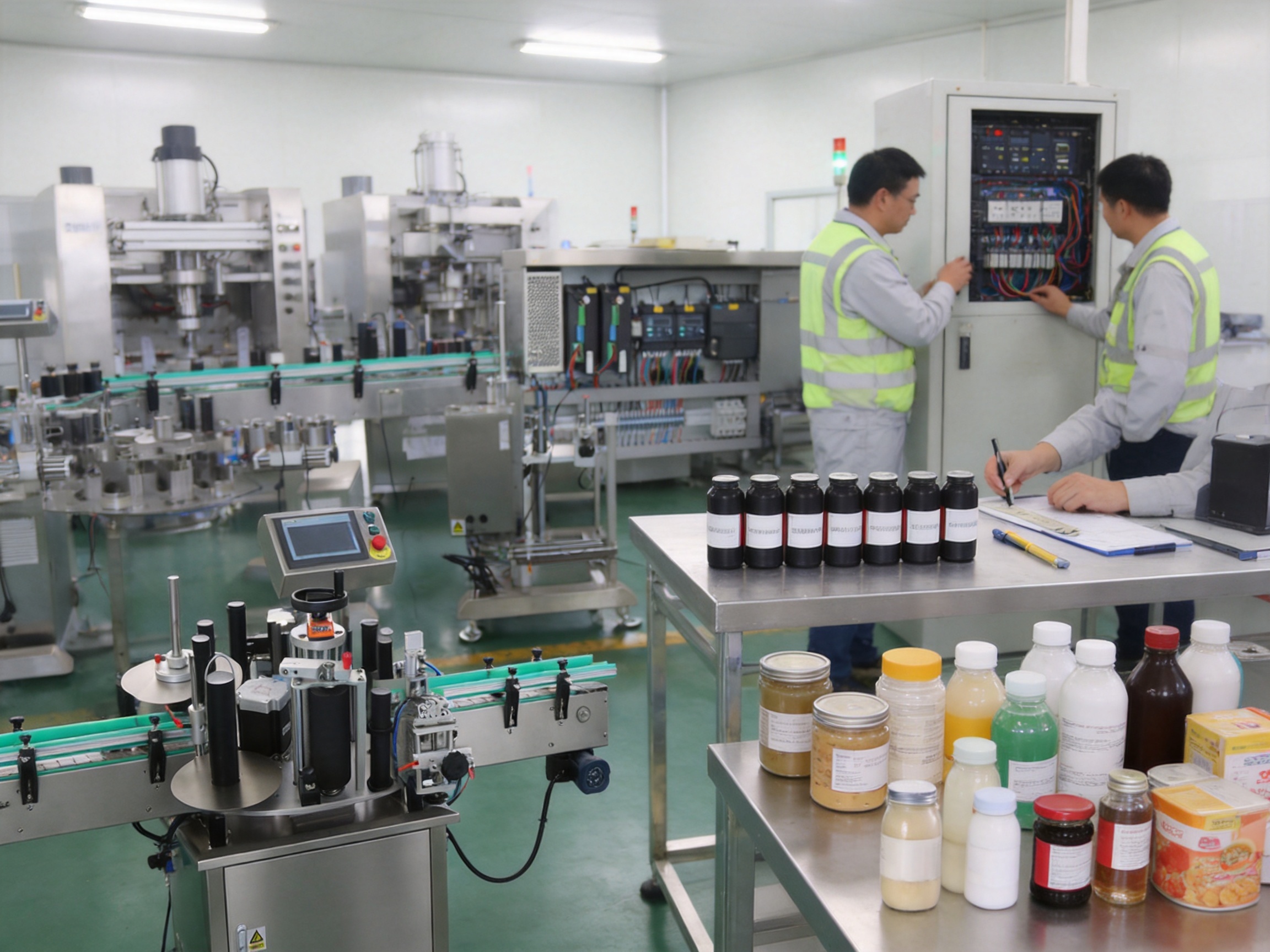
Reliable labeling is an essential part of modern packaging operations. A label communicates product identity, supports regulatory compliance, presents instructions, and contributes directly to shelf appeal. For companies packaging bottles, jars, cans, and other cylindrical containers, achieving a consistent label position can be more difficult than it first appears. Variations in bottle diameter, surface condition, material hardness, seams, handles, caps, and label dimensions may all affect the final result.
The automatic round bottle positioning labeling machine is designed to address these challenges through controlled product handling, automatic label dispensing, and precise positioning. Model RXL-DW is intended for round containers that require a label to be applied at a defined location rather than simply wrapped at an uncontrolled starting point. Its positioning function is especially valuable when bottles include a logo, groove, handle, molded mark, cap feature, or other reference point that must align with the label.
With a compact footprint, adjustable operating parameters, and a production capacity of approximately 30 to 40 bottles per minute, this machine is suitable for small and medium-sized production lines. It can support applications in food and beverage, pharmaceuticals, healthcare, cosmetics, daily chemicals, and chemical packaging. The system is also designed with practical customization in mind, including adjustable conveyor width, adaptable bottle handling arrangements, and label specifications that can be modified for different products.
This article examines the machine’s operating concept, technical capabilities, competitive advantages, application value, and manufacturing quality. It also explains how Shanghai Ruixiao Packaging Technology Co., Ltd. develops and produces labeling equipment through in-house machining, technical integration, assembly, and commissioning.
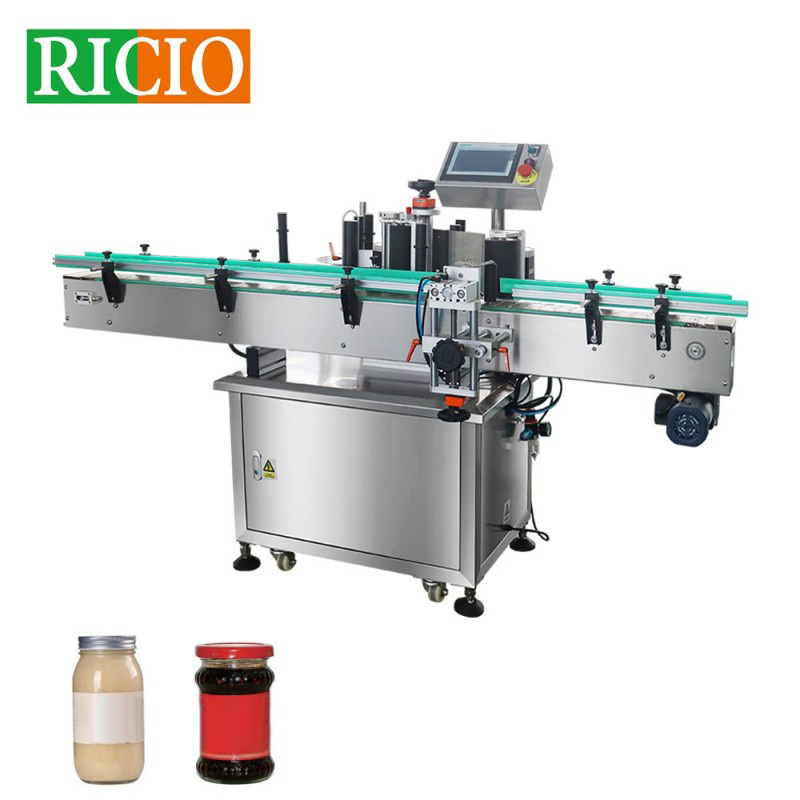
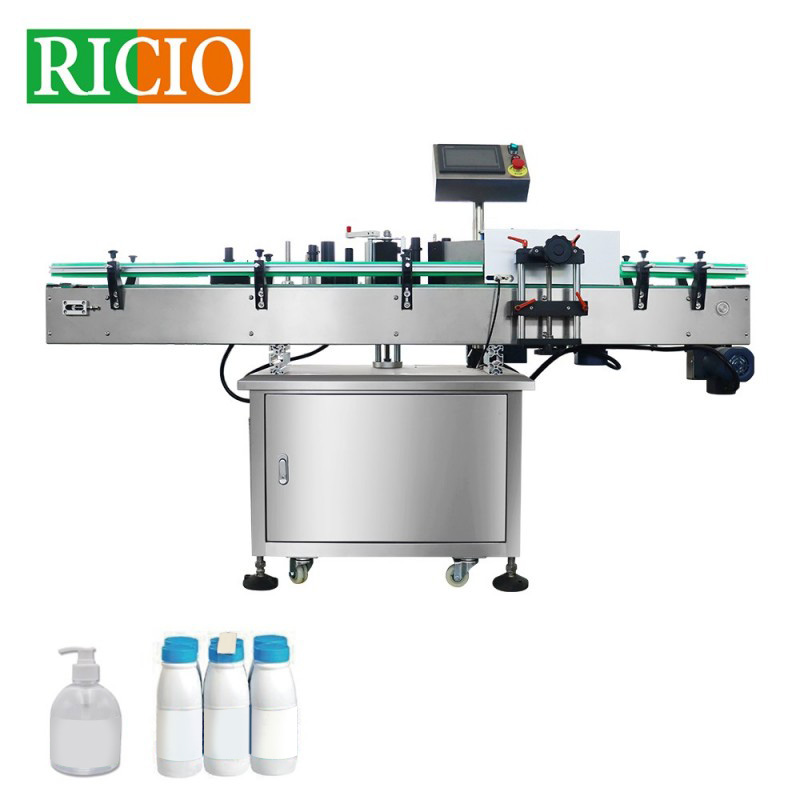
Automatic Round Bottle Positioning Labeling Machine
Why Positioning Matters in Round Bottle Labeling
Round bottles are often considered easy to label because their surfaces are continuous and cylindrical. However, a standard wrap-around application does not always provide the alignment accuracy required by modern packaging designs. A label may need to face a molded bottle feature, align with a front panel, avoid a seam, match a closure design, or be placed at a repeatable angular position on every container.
Manual application can produce inconsistent results because operators may handle each bottle at a slightly different angle. Even when an operator works carefully, differences in product spacing, bottle rotation, and label release timing can lead to visible variation. In high-volume production, manual labeling also creates fatigue and makes it difficult to maintain stable output.
Conventional non-positioning labelers may apply labels quickly but may not control the rotational orientation of every round container. This can be acceptable for simple products where the label may begin at any point around the circumference. It is less suitable when the product has a defined front, a narrow application zone, or a requirement for a label to align with another printed or molded feature.
An automatic positioning labeling machine combines product detection, controlled conveying, bottle stabilization, and label dispensing. The container is guided into a repeatable position before the label is released. Depending on the product design and tooling arrangement, the machine can use clamping, rotating, or other positioning methods to control the container during application. This reduces random label placement and creates a more uniform finished package.
Product Overview
The RXL-DW automatic round bottle positioning labeling machine is developed for cylindrical containers with an outer diameter range of approximately 30 to 130 millimeters. It can be configured for bottles, jars, cans, and similar round packaging formats. The standard product height range is approximately 100 to 300 millimeters, although the final range can be adjusted according to the user’s product requirements.
The machine uses a 220-volt, 50/60-hertz single-phase power supply as its default configuration. Alternative electrical specifications, including 110-volt or 380-volt arrangements, can be considered with a suitable power supply converter device. Its rated power consumption is approximately 1.0 kilowatt, providing an appropriate balance between operating capability and energy demand for a compact automatic labeling system.
Depending on container characteristics, label length, and the selected operating parameters, the machine can achieve approximately 30 to 40 bottles per minute. The actual production rate should be confirmed through product testing because bottle geometry, surface material, label adhesive, label length, and positioning requirements influence the cycle time.
The machine is designed for an approximate labeling precision of plus or minus 1 millimeter. This value is dependent on the hardness, roundness, dimensional consistency, surface finish, and stability of the product. Flexible or irregular containers may require additional testing and specialized clamping or guiding components to achieve the best possible result.
Main Technical Specifications
The following table summarizes the principal specifications supplied for the automatic round bottle positioning labeling machine.
Specification |
Standard Information |
Model description |
RXL-DW automatic round bottle positioning labeling machine |
Power supply |
AC220V, 50/60Hz, single-phase; other electrical standards may be available with a power supply converter device |
Power consumption |
Approximately 1.0 kilowatt |
Labeling speed |
Approximately 30 to 40 bottles per minute, adjustable according to the product and label |
Labeling precision |
Approximately ±1 millimeter, subject to product characteristics |
Air pressure |
Approximately 0.4 to 0.6 MPa |
Machine net weight |
Approximately 200 kilograms |
Container diameter |
Approximately 30 to 130 millimeters |
Container height |
Approximately 100 to 300 millimeters, subject to user requirements |
Label height |
Approximately 20 to 150 millimeters |
Label length |
Approximately 15 to 300 millimeters |
Label roll inner diameter |
Approximately 76 millimeters |
Label roll outer diameter |
Approximately 300 millimeters |
Minimum label spacing |
Approximately 3 millimeters or more |
Packaging size |
Approximately 2000 × 1300 × 1500 millimeters |
Conveyor width |
Adjustable or customizable according to the end user’s products |
Specifications should be treated as a configuration reference rather than a substitute for a product trial. Before final production, the labeling system should be evaluated using representative containers, actual labels, the intended adhesive, and the desired production speed.
How the Machine Works
Product Feeding and Separation
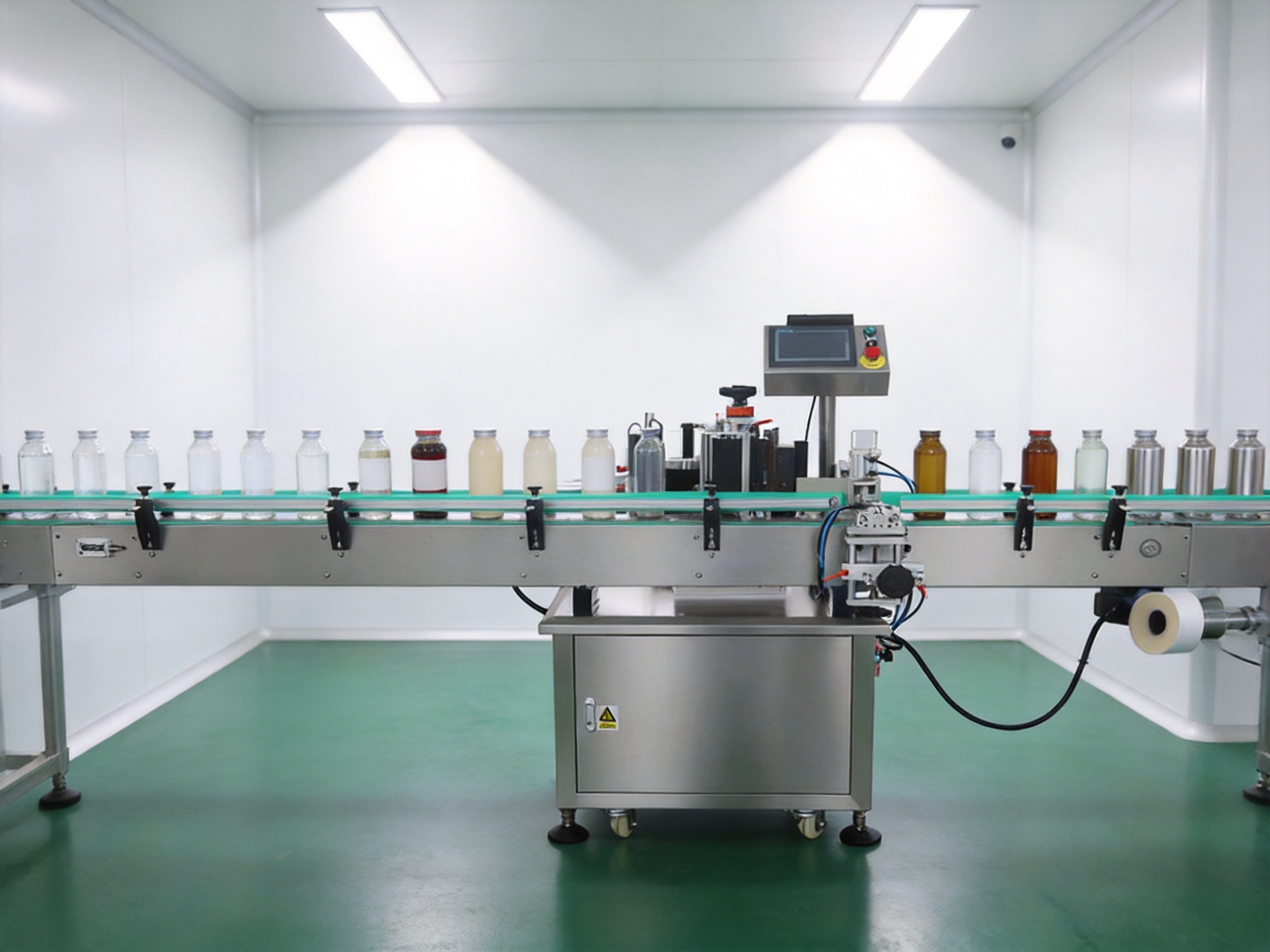
Containers enter the machine through a conveyor system. The conveyor transports products toward the labeling area while maintaining a controlled flow. Guides and spacing arrangements help prevent bottles from touching one another in a way that could affect label timing or positioning.
Conveyor width can be customized or adjusted according to the end user’s products. This feature is important because a narrow bottle, a wide jar, and a large can may require different guide positions. Proper guide adjustment helps keep the container centered and stable as it approaches the application mechanism.
Container Detection
Automatic sensors identify the arrival of each container and coordinate the labeling cycle. Detection timing determines when the machine prepares the label, stabilizes the container, and releases the label. Accurate sensing is particularly important when bottles are close together or when the label length is relatively long.
Sensor settings may be adjusted to accommodate changes in container color, transparency, reflectivity, or surface shape. During commissioning, the technical team can evaluate the product and select an appropriate sensing arrangement. Stable detection helps reduce missed labels, double labeling, and inconsistent spacing between products.
Positioning and Stabilization
The defining feature of the machine is its ability to control the position of a round container before or during label application. A positioning mechanism can help align the bottle with a required reference point. The appropriate mechanism depends on the container’s diameter, material, shape, surface condition, and positioning requirement.
For products that have a known orientation feature, the machine can be configured to locate or control that feature. For products that simply require consistent wrap placement, the system can maintain stable contact while the container passes through the application section. In both cases, the objective is to prevent uncontrolled movement during the critical labeling moment.
Label Dispensing
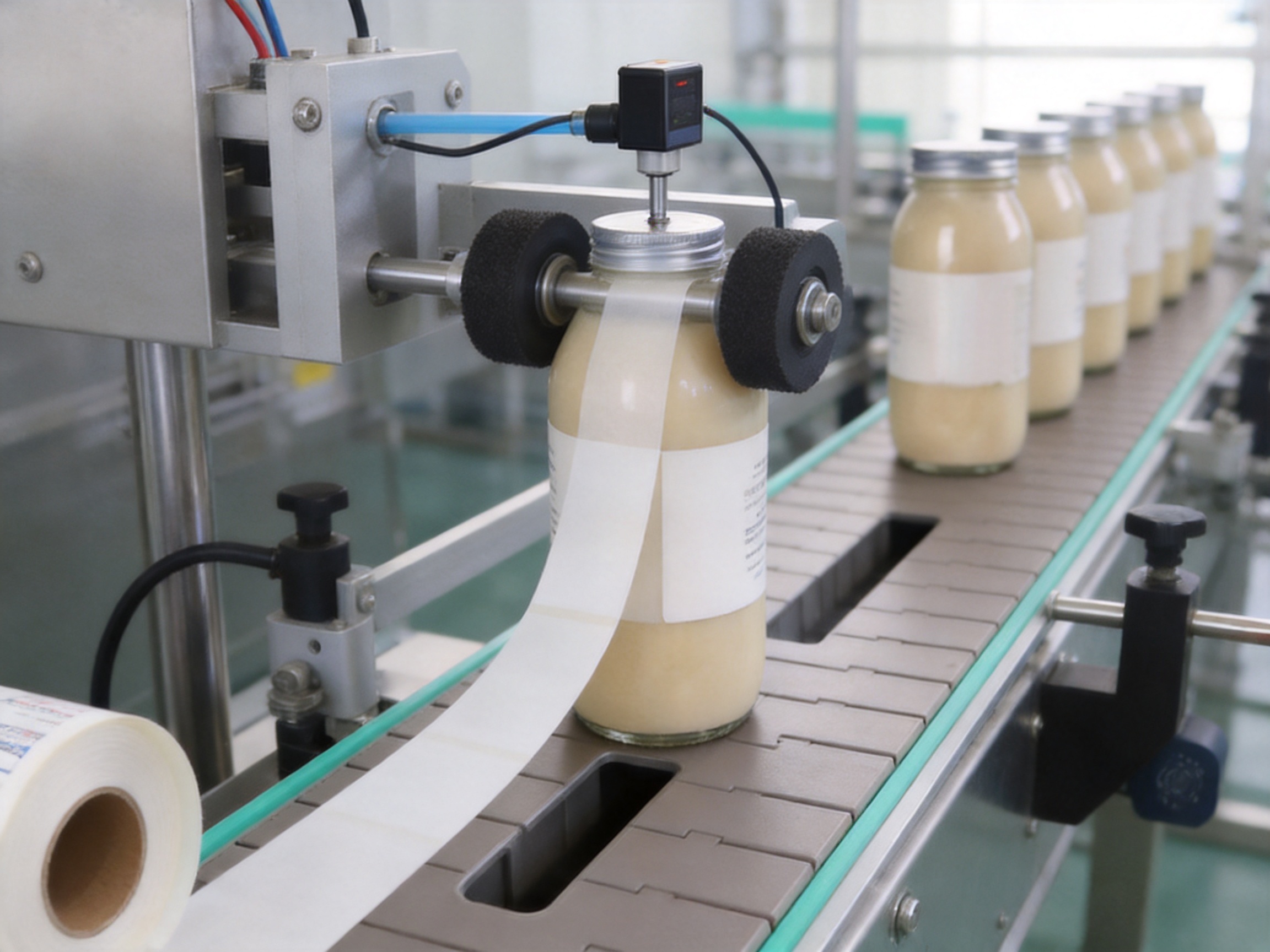
The label roll is installed on a dispensing assembly designed to unwind the backing material and present the adhesive label at the correct time. The standard label roll inner diameter is approximately 76 millimeters, while the maximum outer diameter is approximately 300 millimeters. These dimensions support practical production runs while limiting the need for frequent label roll replacement.
The label system accommodates label heights of approximately 20 to 150 millimeters and label lengths of approximately 15 to 300 millimeters. Labels should have a minimum spacing of approximately 3 millimeters between individual pieces to support reliable separation and detection.
Application and Pressing
After the product is positioned and the label is released, the label contacts the container surface. Rollers, belts, pads, or other contact components press the label against the round surface. Consistent pressure helps remove air pockets and supports full adhesion across the label area.
Application components must be matched to the bottle material and label construction. Glass, rigid plastic, flexible plastic, and metal containers may require different contact pressure and guide settings. Likewise, paper labels, synthetic labels, transparent films, and specialty adhesives may behave differently during dispensing and application.
Finished Product Discharge
Once labeling is complete, the container continues along the conveyor toward the next packaging process. Depending on the production line, the output may be connected to an inspection station, date coder, case packer, accumulation table, or manual collection area.
The compact machine format allows it to fit into many existing production layouts. It can serve as a standalone unit for smaller operations or as part of a more complete automated packaging line for companies that require continuous material flow.
Advantages Over Conventional Labeling Methods
Improved Positioning Consistency
The primary advantage is controlled placement. A manual process depends heavily on operator technique, while a basic wrap-around machine may not control the angular position of a round container. The positioning system creates a more repeatable relationship between the bottle and the label.
This consistency is valuable for products where front-facing presentation matters. A label that remains aligned across a batch gives the product a more professional appearance and can support a consistent brand presentation at retail. It may also help ensure that required information remains visible and correctly oriented.
Better Suitability for Cylindrical Products
The machine is purpose-built for round containers rather than being a general-purpose flat-surface applicator adapted to a cylindrical product. Its product diameter range, stabilization arrangement, and labeling process are designed around the characteristics of bottles, jars, cans, and similar packaging.
Because the container is supported during application, the machine can be more suitable for cylindrical products than simple conveyor-based systems that allow the bottle to drift or rotate freely. The design also allows tooling and guide components to be adapted for different product sizes.
Reduced Labor Dependence
Manual labeling requires an operator to feed, orient, label, inspect, and sometimes correct every container. Automation reduces the amount of repetitive handling and allows personnel to focus on material preparation, quality monitoring, machine adjustment, and other production duties.
Lower labor dependence can be especially useful where production volumes fluctuate or where it is difficult to maintain a stable workforce. Automation also helps standardize the labeling method across shifts and operators.
Adjustable Operating Speed
The stated speed range of approximately 30 to 40 bottles per minute provides a practical level of output for many small and medium-sized operations. The speed can be adjusted according to bottle stability, label length, product spacing, adhesive behavior, and the required positioning precision.
A machine that can operate at a controlled moderate speed may be more useful than a faster system that creates excessive rejects. Production efficiency should be measured not only by theoretical speed but also by usable output, labeling accuracy, changeover time, and the amount of rework required.
Flexible Product Accommodation
The machine can handle containers across a diameter range of approximately 30 to 130 millimeters and a height range of approximately 100 to 300 millimeters, subject to the final configuration. This flexibility allows one machine to serve multiple products when the appropriate guides, clamping components, or molds are available.
When a product diameter changes significantly, the bottle clamping mold may need to be replaced. This is a practical approach because dedicated contact components can provide more stable handling than a single universal mechanism forced to accommodate every shape.
Compact Integration
With an approximate packaging size of 2000 × 1300 × 1500 millimeters, the machine offers a relatively compact solution compared with a complete high-speed packaging line. Its footprint makes it easier to place in a production workshop, especially where floor space is limited.
The compact design can also simplify line planning. It may be installed near a filling machine, capping machine, inspection system, or packing station without requiring a major restructuring of the factory layout.
Practical Label Roll Capacity
A label roll outer diameter of approximately 300 millimeters allows the machine to use a substantial roll size while maintaining a manageable dispensing assembly. Larger rolls can reduce the frequency of roll changes, which helps minimize interruptions during production.
The label roll should be wound consistently and should match the machine’s core and material requirements. Correct roll installation, suitable backing paper strength, and appropriate label spacing are important for stable dispensing.
Label and Product Compatibility
Labeling performance depends on more than the machine itself. The container, label material, adhesive, backing paper, and environmental conditions all affect the final result. A labeler should therefore be selected and configured as part of a complete application system.
Container Diameter and Roundness
The standard container diameter range is approximately 30 to 130 millimeters. Products should be sufficiently round and dimensionally stable for the selected positioning method. Containers with significant ovality may rotate unevenly or create changing contact pressure during application.
Where a product has a large diameter variation or a special profile, a dedicated clamping mold or customized guide arrangement may be required. Testing can determine whether the container needs additional support to maintain a stable centerline.
Container Height
The stated product height range is approximately 100 to 300 millimeters. The usable range may change depending on bottle shape, label height, label location, and the machine’s conveyor and guide configuration.
Tall and narrow containers may require additional support against tipping. Short and wide containers may require a different clamping arrangement. A product sample evaluation helps identify these requirements before final machine production.
Label Dimensions
The machine can accommodate labels with a height of approximately 20 to 150 millimeters and a length of approximately 15 to 300 millimeters. Label dimensions should be evaluated together with the circumference of the container. A label that is too long for the intended application may overlap excessively, while a label that is too short may not provide the desired coverage.
The minimum label spacing is approximately 3 millimeters. Adequate spacing helps the sensor identify the gap between labels and allows the dispensing edge to separate each label correctly from the backing paper.
Label Thickness and Backing Paper
The supplied information identifies a minimum label thickness of approximately 8 micrometers and a minimum backing paper thickness of approximately 5 micrometers, with sufficient tensile strength required. These values should be verified against the actual label material because extremely thin or fragile materials may require special handling.
The backing paper must withstand the tension generated during unwinding and peeling. If the liner stretches, tears, or releases inconsistently, the label position may become unstable. For transparent films and other flexible materials, a product trial is particularly important.
Adhesive and Surface Condition
The adhesive must be compatible with the bottle surface and the expected operating environment. Dust, oil, moisture, condensation, and low surface energy plastics may reduce initial tack or long-term adhesion. Bottles should be clean and dry when they enter the labeling area.
Temperature can also affect adhesive performance. A label that works well in a warm workshop may behave differently in a cold warehouse or refrigerated supply chain. Testing should include the relevant environmental conditions whenever possible.
Manufacturing Strengths and Engineering Capabilities
Shanghai Ruixiao Packaging Technology Co., Ltd., operating under the RICIO product identity, specializes in the research, development, and manufacture of labeling machinery. The company is headquartered in Shanghai, China, and has developed from an equipment assembly background into a source manufacturer with in-house precision machining capabilities.
In-House Precision Machining
The company operates multiple CNC machining centers and maintains an experienced technical team. In-house machining gives the manufacturer greater control over the dimensional accuracy and consistency of important mechanical parts. Components such as brackets, rollers, support plates, shafts, guide structures, and custom tooling can be produced and refined within the company’s own manufacturing system.
This capability provides several advantages. First, engineering staff can modify components more quickly when a customer’s bottle requires a special configuration. Second, the company can monitor the relationship between part drawings, machining results, and machine assembly. Third, the manufacturer can reduce its dependence on external suppliers for critical mechanical parts.
Control from Components to Complete Equipment
The company manages the process from core component machining to complete machine assembly and commissioning. This integrated approach supports better communication between design, machining, electrical integration, mechanical assembly, and service teams.
When an issue appears during trial operation, the manufacturer can evaluate whether the cause is related to a machined component, a sensor position, a software parameter, a guide adjustment, or a product-specific tooling requirement. Having these activities managed within one organization can shorten the feedback cycle and support more effective corrective action.
ISO 9001 Quality System Approach
Machine production is carried out in accordance with the ISO 9001 international quality system. A quality management approach helps organize documentation, process control, inspection, assembly procedures, and corrective actions. For customers, this is important because reliable machine performance depends on repeatable manufacturing practices rather than on final assembly alone.
Quality control may include incoming material checks, dimensional verification of machined parts, inspection of assemblies, electrical testing, operating trials, and final commissioning. The exact inspection plan can vary according to the equipment configuration and customer requirements.
Application-Oriented Engineering
Labeling machinery must be engineered around actual products. A technically advanced machine may not deliver satisfactory results if it is not correctly matched to the container, label, and production conditions. The manufacturer’s experience across different labeling categories supports a practical application-oriented approach.
Its product range includes equipment for syringes, round bottles, square bottles, double-sided applications, high-speed labeling, and real-time print-and-apply systems. This range exposes the engineering team to different product geometries, materials, label constructions, and line integration requirements.
Export Experience
The company exports labeling equipment to more than 40 countries and regions. International project experience can be valuable because overseas installations often involve different electrical standards, languages, factory layouts, production regulations, and shipping conditions.
Export capability also requires attention to machine packaging, documentation, remote technical communication, spare parts planning, and commissioning support. These factors are important when selecting equipment for a factory that may be located far from the manufacturer.
Why the Manufacturing Process Matters to Buyers
Buyers often compare labeling machines primarily by speed and price. These factors are important, but the long-term value of an automatic machine also depends on its mechanical construction, serviceability, control stability, and ability to handle real production conditions.
A manufacturer with in-house machining capabilities can respond more effectively to requests for custom bottle holders, special guides, modified conveyors, and application-specific components. This is particularly useful for companies that have several bottle formats or plan to launch new products.
In-house production can also help protect the continuity of replacement parts. When key dimensions and drawings are controlled by the equipment manufacturer, future components can be produced with closer reference to the original design. This can simplify maintenance and reduce uncertainty during repairs.
Integrated assembly and commissioning provide another advantage. The machine is not simply shipped as a collection of unrelated parts. Mechanical, electrical, pneumatic, and control systems are evaluated together. This integrated testing helps identify problems that may not be visible when individual components are tested separately.
Application Areas
Food and Beverage
Round bottles and jars are common in sauces, beverages, condiments, oils, supplements, and specialty food products. A consistent label position supports product recognition and helps maintain an orderly appearance across a production batch.
The machine can be considered for glass bottles, plastic containers, and metal cans when their dimensions and surface conditions fall within the configured operating range. Hygiene, washdown conditions, condensation, and adhesive selection should be reviewed during application planning.
Pharmaceutical and Healthcare Packaging
Pharmaceutical and healthcare containers often require clear presentation of product names, strengths, usage instructions, batch information, and regulatory details. A repeatable application position can support readability and quality inspection.
For sensitive products, the machine may be integrated with additional inspection, coding, or rejection equipment. The final configuration should reflect the applicable production, validation, and traceability requirements of the customer.
Cosmetics and Daily Chemicals
Cosmetic bottles, personal care containers, cleaning products, and household chemicals frequently use round packaging with decorative labels. Appearance consistency is a major consideration in these markets because packaging contributes strongly to perceived product quality.
Positioning is useful when labels must align with a front-facing design, embossed feature, pump, cap, or molded bottle panel. The machine’s adjustable bottle handling components allow the system to be adapted to different product formats.
Chemical Packaging
Small and medium-sized chemical containers may require durable labels with strong adhesion and resistance to handling. The machine can support such products when the container shape, label material, and environmental conditions are suitable.
Because chemical packaging may involve aggressive contents or challenging storage environments, label and adhesive selection should be validated separately from machine performance. The labeling system applies the label, but long-term label durability depends on the complete packaging specification.
Installation and Commissioning Considerations
The machine requires a stable installation surface, appropriate electrical power, and compressed air within the approximate range of 0.4 to 0.6 MPa. The customer should confirm that the available air supply is clean, dry, and sufficient for the required operating cycle.
Before installation, the production area should provide enough space for the machine, product loading, label roll replacement, operator access, maintenance, and downstream equipment. The approximate machine packaging size is 2000 × 1300 × 1500 millimeters, but the operating clearance should be greater than the shipping dimensions.
Product samples and actual label materials should be supplied for testing. Important samples include the smallest and largest bottles, products with different surface finishes, and labels with the most demanding dimensions. If multiple products will be run on one machine, each format should be included in the validation process.
Commissioning normally includes mechanical leveling, conveyor adjustment, sensor alignment, label path setup, parameter configuration, bottle tooling adjustment, trial production, and operator training. The machine should be evaluated at different speeds to determine the best balance between output and accuracy.
Changeover and Maintenance
Changeover requirements depend on the differences between product formats. Minor changes may involve guide adjustment, sensor repositioning, and parameter selection. Larger diameter changes may require replacement of the bottle clamping mold or other dedicated contact components.
Clear adjustment scales, accessible fasteners, and organized control settings can help reduce changeover time. Operators should record proven settings for each product, including conveyor speed, label position, sensor sensitivity, clamping pressure, and product spacing.
Routine maintenance should include cleaning the label path, checking rollers and belts, inspecting guide components, confirming sensor alignment, and examining pneumatic connections. Adhesive residue should be removed before it accumulates and affects label travel or product contact.
The label roll holder, backing paper path, and dispensing edge should be kept free from dust and debris. Worn rollers, damaged guides, loose fasteners, and deteriorated pneumatic tubing should be corrected before they create unstable labeling results.
Maintenance intervals should be established according to production volume and environmental conditions. A machine operating continuously in a dusty environment may require more frequent cleaning than a machine installed in a controlled packaging room.
Quality and Productivity Benefits
Accurate labeling can reduce several types of waste. Products with labels placed outside the required position may need to be reworked or discarded. Incorrect label application can also interrupt the production line, consume additional labor, and delay order fulfillment.
Automated positioning contributes to stable quality by reducing variation between operators and shifts. When the machine is correctly configured, the process can be monitored through measurable settings rather than relying entirely on visual judgment.
The machine’s moderate output range is appropriate for companies that need more than manual capacity but do not require a high-speed industrial line. It can help growing businesses establish a repeatable packaging process while leaving room for future integration with other automated equipment.
Productivity should be evaluated using total effective output. This includes startup time, material changes, adjustments, rejected products, maintenance stops, and operator intervention. A reliable machine with stable application quality may provide greater practical value than a faster system with a high rejection rate.
Comparison with Alternative Solutions
Labeling approach |
Typical strength |
Potential limitation |
Positioning machine advantage |
Manual labeling |
Low initial equipment cost and simple setup |
High labor dependence and greater variation |
Automates product handling and improves repeatability |
Basic wrap-around labeling |
Suitable for simple cylindrical applications |
May not control angular orientation |
Provides controlled placement for products with a defined reference position |
General flat-surface labeler |
Effective for cartons, panels, or flat containers |
May require additional adaptation for round products |
Designed specifically around cylindrical container handling |
High-speed integrated line |
Very high output for large-scale production |
Higher investment, larger footprint, and more complex integration |
Offers a compact and practical option for small and medium production volumes |
Positioning labeling machine |
Controlled orientation and automatic application |
Requires suitable product samples and setup validation |
Combines cylindrical product handling, positioning, and adjustable labeling in one system |
This comparison is general and should not replace a technical evaluation. The most suitable equipment depends on product dimensions, output requirements, label design, available labor, factory space, and future expansion plans.
How to Select the Correct Configuration
Buyers should begin by documenting every product format that the machine must handle. Important information includes bottle diameter, height, material, weight, roundness, surface finish, cap style, seam location, and any feature that must align with the label.
Label information should include label height, length, thickness, material, adhesive type, backing paper, roll core, roll diameter, gap, winding direction, and whether the label is transparent, opaque, laminated, or specially shaped.
The required output should be expressed as usable bottles per minute rather than only maximum machine speed. Allowances should be made for product loading, label roll changes, quality checks, cleaning, and changeovers.
Customers should also identify their future requirements. If new bottle formats may be introduced, it is useful to discuss adjustable conveyors, interchangeable molds, reserved installation positions, and control-system flexibility at the beginning of the project.
Finally, the customer should request a sample test. A proper test should use actual bottles and labels and should evaluate both the first products after startup and a sustained production run. The results should include positioning accuracy, label adhesion, product stability, speed, changeover method, and operator usability.
Safety and Operator Training
Operators should receive training in machine startup, emergency stopping, label roll installation, sensor adjustment, bottle format changeover, cleaning, and basic troubleshooting. Training should emphasize that guards and protective devices must remain in place during operation.
Compressed air should be isolated before work is carried out on pneumatic components. Electrical panels should only be opened by qualified personnel. Moving rollers, belts, clamps, and conveyor components can create pinch points, so operators should not reach into the machine while it is running.
Clear operating procedures help prevent damage caused by incorrect parameter changes. Product-specific settings should be documented, and only authorized personnel should modify advanced control parameters.
Customer Support and Project Service
Successful labeling automation involves more than delivering hardware. Technical communication before production helps confirm the product range, label design, speed target, electrical standard, and installation conditions.
During machine preparation, the supplier can review samples, define tooling requirements, confirm label roll specifications, and evaluate the expected positioning result. After assembly, commissioning verifies that the complete system performs with representative materials.
For international customers, support may include technical documentation, packing instructions, spare parts recommendations, remote troubleshooting, and guidance for local installation. The manufacturer’s experience exporting to more than 40 countries and regions provides a foundation for managing different project environments.
Frequently Asked Questions
What products can the automatic positioning labeling machine handle?
The machine is designed for round bottles, jars, cans, and other cylindrical containers. The standard diameter range is approximately 30 to 130 millimeters, and the standard height range is approximately 100 to 300 millimeters, subject to the final product configuration.
What is the expected labeling speed?
The stated speed is approximately 30 to 40 bottles per minute. Actual speed depends on bottle shape, label length, label material, product spacing, positioning requirements, and the selected operating parameters.
What labeling precision can be expected?
The stated precision is approximately plus or minus 1 millimeter. Actual results depend on product roundness, hardness, dimensional consistency, surface condition, label construction, and machine adjustment.
Can the machine align a label with a bottle feature?
The machine is specifically designed for positioning applications and can be configured to control the relationship between the label and a suitable product reference feature. The exact method depends on the bottle design and should be confirmed through sample testing.
Can the conveyor width be changed?
Yes. The conveyor can be customized or adjusted according to the end user’s products. The required range should be confirmed during technical evaluation.
Will a different bottle diameter require new tooling?
A different diameter may require adjustment of the guides or replacement of the bottle clamping mold. Large diameter changes are more likely to require dedicated product-contact components for stable handling.
What label roll dimensions are supported?
The standard label roll inner diameter is approximately 76 millimeters, and the outer diameter is approximately 300 millimeters. The label roll should also meet the required spacing, backing strength, winding, and material conditions.
What utilities are required?
The standard electrical supply is AC220V, 50/60Hz, single-phase, with approximately 1.0 kilowatt power consumption. Compressed air of approximately 0.4 to 0.6 MPa is also specified. Alternative electrical configurations may be available with an appropriate converter device.
Is the machine suitable for small production lines?
Yes. Its compact design and moderate output range make it suitable for small and medium-sized production lines. It can operate as a standalone labeling unit or be integrated with other packaging equipment.
How should the machine be maintained?
Maintenance should include cleaning the label path, checking rollers and guides, inspecting sensors, confirming pneumatic connections, tightening loose components, and replacing worn parts. The maintenance frequency should reflect production volume and environmental conditions.
Why is sample testing important?
Sample testing confirms whether the bottle, label, adhesive, positioning method, and speed are compatible. It also helps determine whether special molds, guides, sensor arrangements, or control settings are required.
Conclusion
The automatic round bottle positioning labeling machine provides a practical solution for manufacturers that need repeatable label placement on cylindrical products. By combining controlled product handling, adjustable conveyor guidance, automatic label dispensing, and positioning capability, the machine addresses limitations associated with manual application and basic non-positioning labelers.
Its approximate capacity of 30 to 40 bottles per minute, precision of around plus or minus 1 millimeter, container diameter range of approximately 30 to 130 millimeters, and adaptable product height range make it suitable for a broad group of packaging applications. Customizable conveyor width and replaceable bottle clamping components further improve its ability to support different product formats.
The machine’s value is strengthened by the manufacturing capabilities of Shanghai Ruixiao Packaging Technology Co., Ltd. The company’s in-house CNC machining centers, technical team, integrated assembly process, commissioning capability, and ISO 9001 quality system approach provide a solid foundation for producing application-specific labeling equipment.
For businesses in food and beverage, pharmaceutical, healthcare, cosmetics, daily chemical, and chemical packaging, this machine can support improved presentation, reduced manual handling, stable production, and more consistent quality. The best results are achieved when the customer provides complete product and label information and participates in a thorough sample testing and commissioning process.
References
1. Product technical specification sheet for the automatic round bottle positioning labeling machine, model RXL-DW.
2. Manufacturer-provided information on labeling machine design, assembly, commissioning, and application categories.
3. ISO 9001 quality management system principles for manufacturing process control and continual improvement.
4. General engineering practices for pressure-sensitive label application and cylindrical container handling.
5. Packaging line planning principles for product spacing, label roll management, conveyor integration, and operator safety.
Product: Automatic Round Bottle Positioning Labeling Machine

related products
-
Automatic Round Bottle Positioning Tabletop Labeling Machine
-
Automatic Round Bottle Positioning Labeling Machine
-
Automatic Round Bottle Tabletop Labeling Machine
-
Automatic Round Bottle Side and Top Labeling Machine
-
Automatic High Speed Vertical Round Bottle Labeling Machine
-
Automatic Round Bottle Labeling Machine
related News
 +86 13681850339
 sales@raxpack.com
 Building 6, No. 477 Tiefeng Road, Baoshan District, Shanghai, China
- Tabletop Labeling Machine
- Round Bottle Labeling Machine
- Automatic Tube Labeling Machine
- Pouch Labeling Machine
- Rotary Labeling Machine
- Syringe Labeling Machine
- Top Labeling Machine
- Single Side Sticker Labeling Machine
- Double Side Labeling Machine
- Bucket Labeling Machine
- Bottom Labeling Machine
- Corner Label Applicator
- Waist Sealing Labeling Machine
- Square Bottle Labeling Machine
