 English
 русский
 Español
 عربى



Automatic Single-Side Sticker Labeling Machine for Flexible Industrial Packaging
2026-10-20
Content
- 1 Understanding Single-Side Sticker Labeling Requirements
- 2 How the Automatic Labeling Process Works
- 3 Product Compatibility and Application Range
- 4 Key Technical Specifications
- 5 Advantages Over Basic or Competitor Labeling Solutions
- 6 Control System and Operator Experience
- 7 Label Material and Roll Requirements
- 8 Manufacturing Strength and Engineering Capabilities
- 9 Industries and Typical Products
- 10 Optional Functions for Traceability and Production Control
- 11 Installation, Changeover, and Maintenance Considerations
- 12 Why Source-Manufacturer Capability Matters
- 13 Evaluating the Machine Before Purchase
- 14 Operational Benefits for Manufacturers
- 15 Safety and Responsible Use
- 16 Frequently Asked Questions
- 16.1 What type of products can this machine label?
- 16.2 Can it apply labels to two sides of a bottle?
- 16.3 What is the maximum labeling speed?
- 16.4 What labeling accuracy can be expected?
- 16.5 Can the machine handle transparent labels?
- 16.6 Can dates and batch numbers be printed during labeling?
- 16.7 Can QR codes or barcodes be checked?
- 16.8 How are different product formats stored?
- 16.9 What are the applicable product dimensions?
- 16.10 What label sizes are supported?
- 16.11 Does the machine require three-phase power?
- 16.12 How does the no-bottle-no-label function work?
- 16.13 Can the conveyor width be customized?
- 16.14 Why is sample testing important?
- 16.15 What manufacturing capabilities support this machine?
- 16.16 Where can the machine be used?
- 17 Conclusion
- 18 References
- 19 Product: Automatic Single Side Sticker Labeling Machine
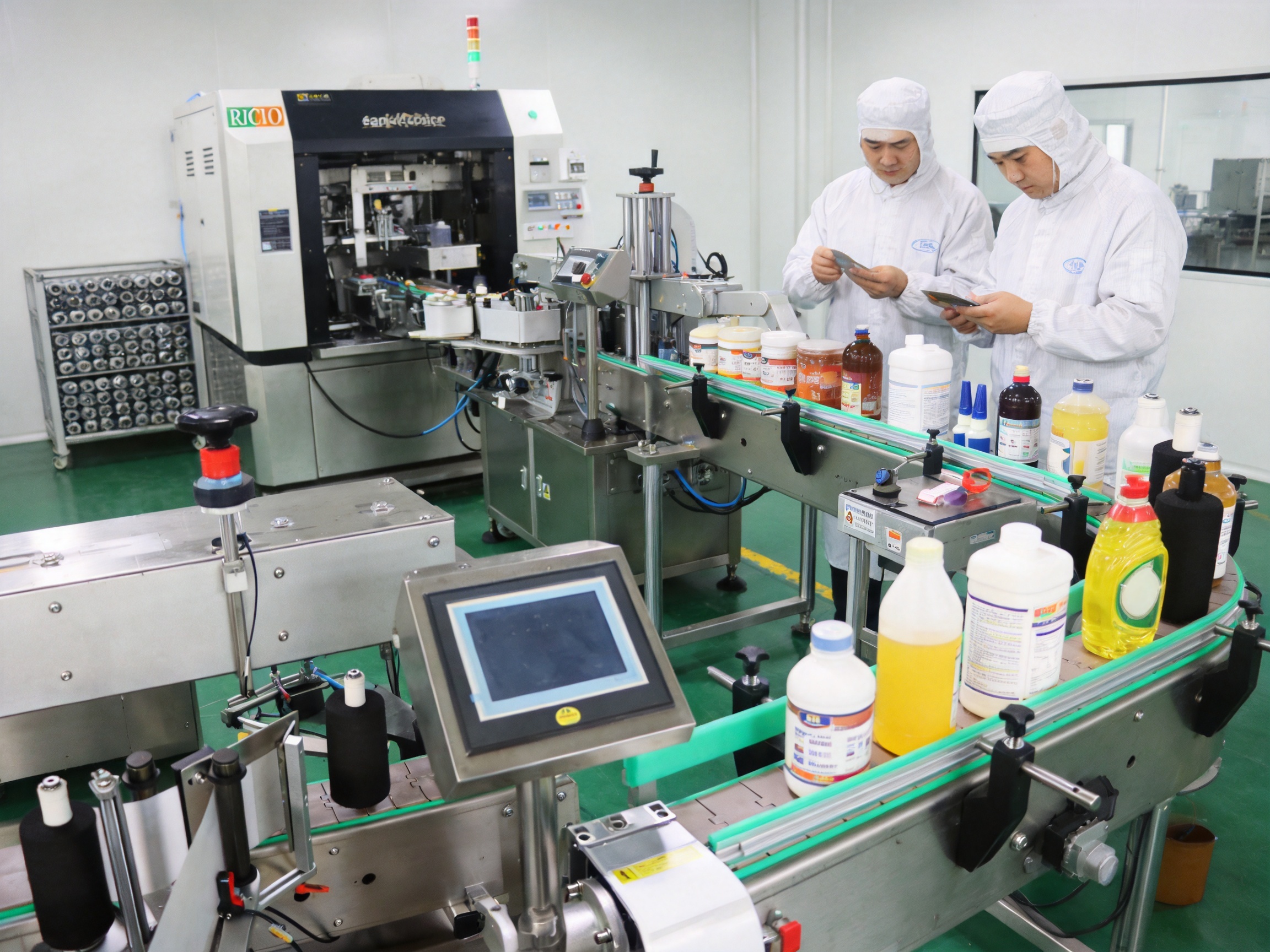
Modern packaging operations require more than simply attaching a label to a container. A successful labeling process must position every label accurately, maintain a consistent visual appearance, minimize material waste, protect product information, and operate reliably as part of a larger production line. These requirements become especially demanding when a manufacturer handles square bottles, flat containers, irregular packages, or products with only one clearly defined labeling surface.
The automatic single-side sticker labeling machine is designed to address these challenges. Developed for single-surface applications, the machine automatically conveys products, separates them, aligns their position, detects their arrival, dispenses labels, and presses the labels smoothly onto the package. It is suitable for many packaging formats used in food and beverage, daily chemical, personal care, pharmaceutical, healthcare, household chemical, seasoning, disinfectant, lubricant, and light industrial applications.
Unlike basic labeling equipment that depends heavily on manual alignment or limited container compatibility, this machine combines product handling, photoelectric detection, label dispensing, pressing, and control functions in one coordinated system. The result is a practical solution for manufacturers that need stable single-sided labeling, faster production, lower labor dependence, and a more professional package appearance.
Understanding Single-Side Sticker Labeling Requirements
Single-side labeling may appear simple because only one label is applied to each product. In actual production, however, the process can be technically demanding. A bottle may arrive in a slightly different orientation, a flat container may shift sideways on the conveyor, or an irregular package may have a surface that changes in height or angle. If the container is not stabilized before labeling, the result may be a skewed label, uneven edge, trapped air, wrinkles, or incomplete adhesion.
Manual labeling creates additional inconsistencies. Operators may place labels at different heights, apply different amounts of pressure, or work at different speeds. These variations are particularly noticeable when products are displayed together on retail shelves. In industries such as pharmaceuticals, cosmetics, food, and household chemicals, packaging consistency influences customer confidence and can also affect the readability of important product information.
The automatic single-side sticker labeling machine is intended for products that require a label on the front, side, or another single flat surface. It can process square bottles, flat bottles, selected irregular bottles, and some round containers, depending on the product shape and labeling configuration. The equipment is also suitable for production lines where the same type of product must be labeled repeatedly with stable positioning and limited operator intervention.
The machine model is identified as RXL-D. Its working principle is based on coordinated product separation, positioning, detection, label dispensing, and pressing. Each stage contributes to more dependable label placement and helps the operator maintain an organized production flow.
How the Automatic Labeling Process Works
Product Conveying and Infeed
Products enter the machine through a conveyor system. The conveyor transports bottles or containers toward the separation and labeling areas at a controlled speed. Conveyor width can be customized according to customer sample bottles, cases, or boxes, allowing the equipment to be adapted to different packaging formats.
The conveyor provides a continuous path through the machine and reduces the need for operators to manually position each container. Depending on the production layout, the labeling machine can be integrated into an upstream filling, capping, inspection, or packaging process. It can also be used as an independent labeling station in a semi-automatic or fully automatic line.
Automatic Product Separation
Before the label is applied, products must be separated at a suitable distance. If containers are too close together, the label may be dispensed at the wrong moment or the pressing mechanism may affect more than one product. If products are too far apart, line efficiency may be reduced.
The separation area automatically adjusts product spacing and helps establish a more predictable interval between containers. This is important for square and flat bottles, which may not move as naturally as round bottles on a conveyor. Stable spacing supports accurate photoelectric detection, synchronized label dispensing, and consistent machine speed.
Alignment and Position Adjustment
After separation, the products are guided into an appropriate position for labeling. The alignment system helps keep the selected labeling surface facing the label applicator. For flat and square bottles, this function helps maintain label direction and reduces the possibility of labels being applied across a corner or outside the intended panel.
Product alignment is particularly valuable when containers have a defined front panel. A container that is only slightly rotated may cause the label to appear visibly crooked. The machine’s adjustment structure can be configured according to the product sample, container dimensions, and desired labeling position.
Photoelectric Detection
A photoelectric sensor detects the arrival of each product at the labeling station. When the sensor identifies a container, the control system calculates the correct timing for label dispensing. This allows the label to be released in relation to the actual position of the product rather than relying only on a fixed time interval.
The photoelectric detection system also supports the no-bottle-no-label function. If no product is detected, the machine does not unnecessarily dispense a label. This reduces label waste and helps prevent adhesive labels from sticking to machine components or the conveyor when a product is missing.
Label Dispensing and Application
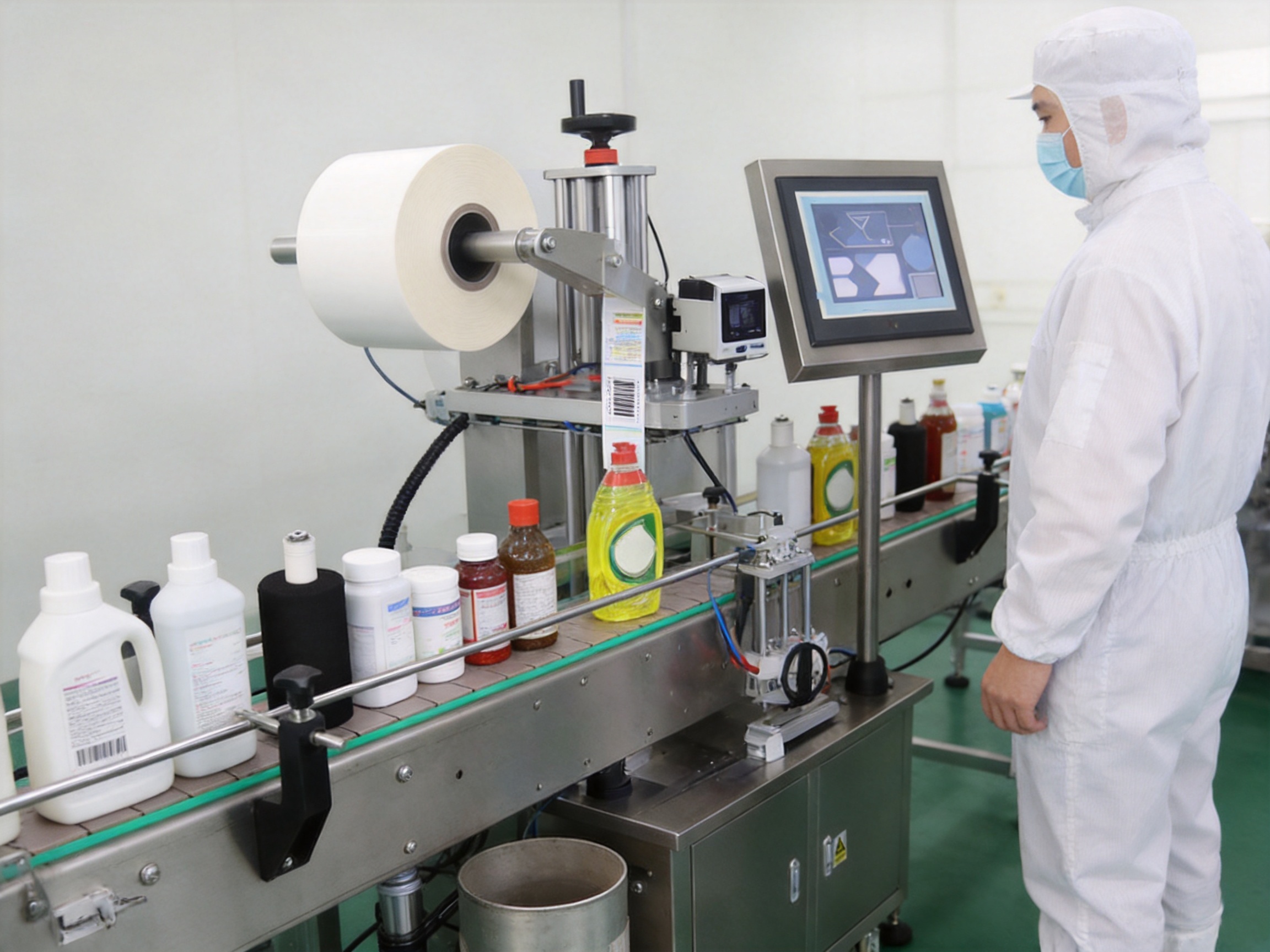
Once the product is detected, the label dispensing mechanism feeds one label from the roll and presents it to the surface of the container. The label is then transferred onto the selected side of the product.
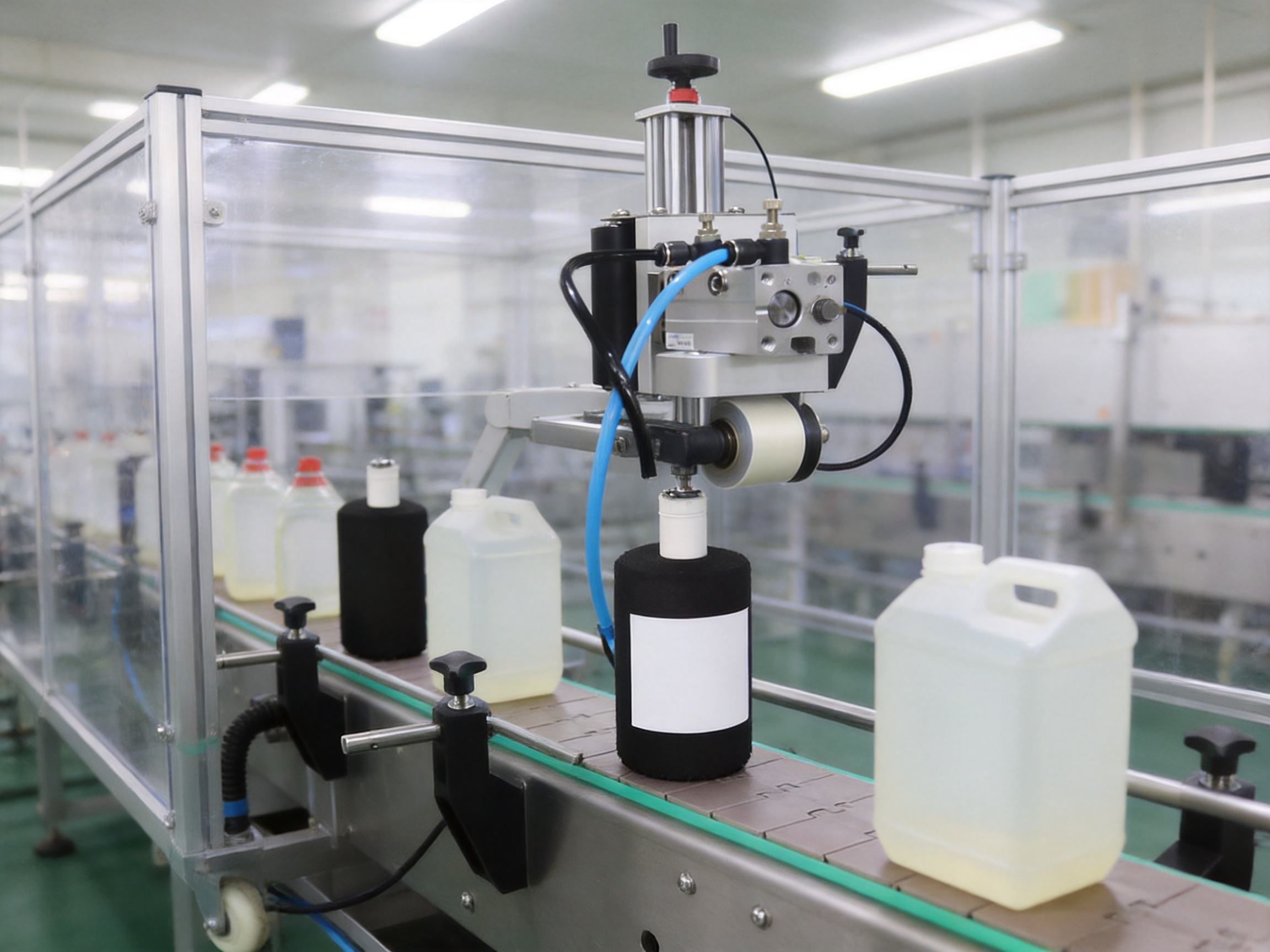
The pressing and rolling mechanism completes the application process by pressing the label against the product surface. This helps improve contact between the adhesive and the package, while reducing bubbles, wrinkles, edge lifting, and other common manual application problems. The pressing method can be adjusted according to the shape, hardness, and surface characteristics of the product.
For appropriate label and container combinations, the machine can achieve a stated labeling accuracy of approximately ±1 mm. Actual accuracy depends on the product’s dimensions, softness, hardness, roundness, surface condition, label material, label quality, and production settings.
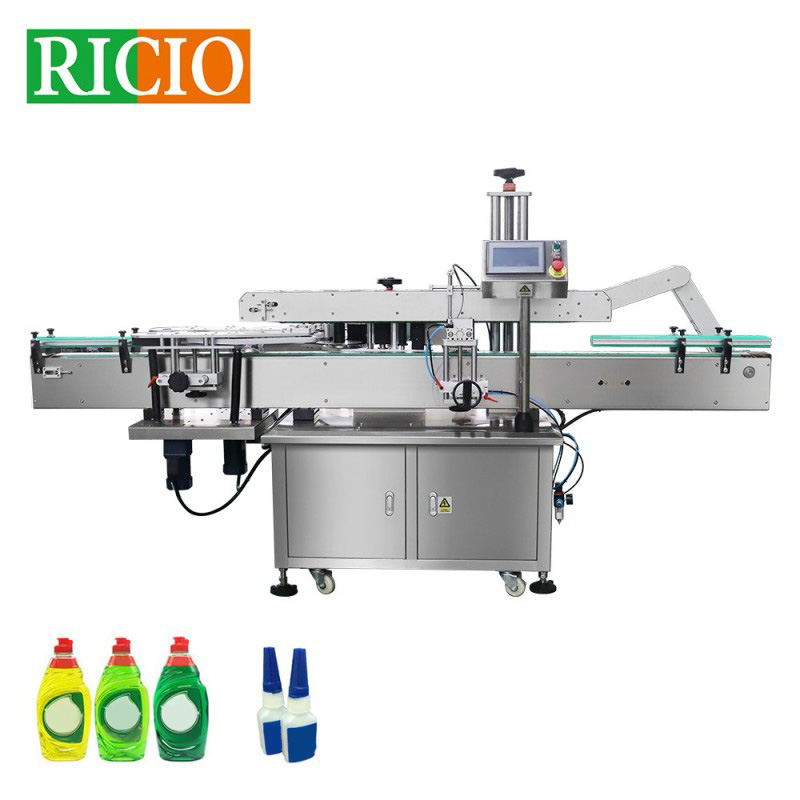
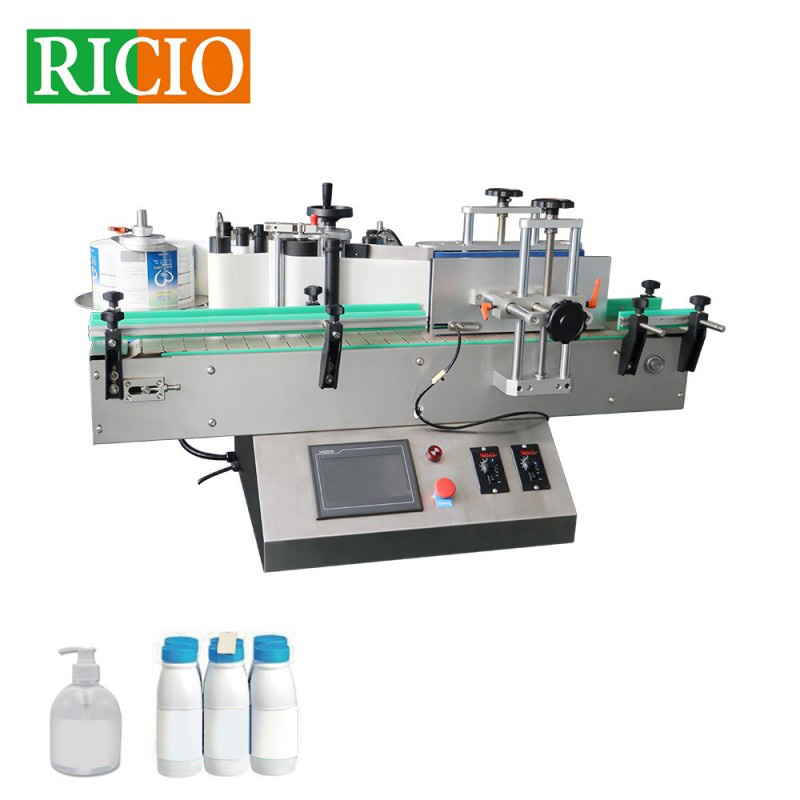
Automatic Single Side Sticker Labeling Machine
Product Compatibility and Application Range
The machine is designed for a broad range of packaging containers rather than one fixed bottle shape. Its stated object range covers products with a height of approximately 40 to 400 mm and a bottle diameter of about 25 to 120 mm. Special dimensions can be discussed and customized according to customer samples.
Square Bottles
Square bottles often require careful alignment because their front and side panels are clearly defined. A label applied too close to a corner can damage the visual appearance of the container and may reduce the usable information area. The automatic alignment and pressing functions help place the label on the intended flat surface.
Typical square bottle applications include detergent containers, disinfectant bottles, seasoning bottles, food packages, personal care products, and household chemical packaging. The machine is especially useful when the label must face forward consistently across a large batch.
Flat Bottles
Flat bottles are commonly used for shampoos, lotions, medicines, cleaning products, and other liquid goods. Their broad front panel provides a suitable labeling area, but the product may shift or rotate during conveying. Automatic separation and surface alignment help the label reach the correct position with less operator involvement.
Irregular Bottles
Irregular packages may include containers with asymmetrical profiles, recessed areas, angled shoulders, or unusual side contours. Not every irregular container can be labeled with the same configuration, so sample testing is important. When the selected surface is sufficiently stable and accessible, the machine can be adjusted with suitable guides, pressing components, sensor positions, and labeling parameters.
Selected Round Containers
The equipment is primarily intended for single-sided applications, but some round or partially rounded containers may also be processed when they have a suitable labeling area or when the production requirement permits a single-side application. Product testing should confirm whether the container can be stabilized and whether the label surface supports the required appearance.
Key Technical Specifications
The following specifications provide a general reference for the automatic single-side sticker labeling machine. Actual configurations may be modified according to product samples, label construction, production speed, and customer requirements.
| Specification | Standard or Stated Value |
| Power supply | AC 380 V, 50 Hz, three-phase; variable if required |
| Power consumption | 2500 W |
| Labeling speed | 30–120 bottles per minute, adjustable according to product and label size |
| Labeling accuracy | Approximately ±1 mm, depending on product and label characteristics |
| Applicable bottle diameter | Approximately 25–120 mm |
| Applicable product height | Approximately 40–400 mm; customizable |
| Label height | Approximately 10–150 mm |
| Label length | Approximately 10–300 mm; special specifications may be customized |
| Minimum single-label spacing | At least 3 mm |
| Label thickness | At least 8 micrometers |
| Backing paper thickness | At least 5 micrometers with suitable tensile strength |
| Paper roll core inner diameter | Approximately 76 mm |
| Maximum paper roll outer diameter | Approximately 350 mm |
| Machine net weight | Approximately 280 kg |
| Packaging dimensions | Approximately 2800 × 1400 × 1400 mm |
| Conveyor width | Customizable according to customer sample products |
The listed speed range of 30 to 120 bottles per minute is adjustable. Actual throughput depends on the bottle shape, label length, label gap, conveyor speed, product stability, operator loading conditions, and the requirements of the complete production line. A smaller container with a short label may be processed faster than a large or unstable container with a long label.
The electrical configuration is listed as AC 380 V, 50 Hz, three-phase. Power supply options may be discussed when the machine is installed in a region with different electrical standards. Before shipment, the power requirements should be confirmed with the supplier and matched to the customer’s facility.
Advantages Over Basic or Competitor Labeling Solutions
More Consistent Label Placement
A major advantage of automatic operation is repeatability. Manual operators may achieve good results for limited quantities, but consistent placement becomes difficult during long production runs. Fatigue, variation in hand pressure, changes in working speed, and inconsistent product orientation can all affect the final package.
The automatic single-side sticker labeling machine uses controlled conveying, product detection, mechanical alignment, and a repeatable pressing process. This creates a more stable labeling position from one container to the next. Consistency is especially important for products sold in multiple flavors, fragrances, sizes, or formulations, where all packages must maintain a uniform visual standard.
Broader Container Flexibility
Some entry-level labeling machines are designed for only one bottle diameter or one container profile. Such machines may require major changes when the manufacturer introduces a new product. The RXL-D configuration is designed for a wider range of heights and diameters, while its conveyor width and selected components can be customized according to sample products.
The ability to process square, flat, selected irregular, and some round containers gives manufacturers greater flexibility. It can reduce the need to purchase separate machines for every packaging shape, provided the products remain within the machine’s working range and pass compatibility testing.
Reduced Label Waste
Label waste can increase when products are missing, incorrectly spaced, or not detected. The no-bottle-no-label function prevents the dispensing mechanism from releasing a label when no container is present. The photoelectric sensor also helps synchronize application with product arrival.
Reducing label waste has both financial and environmental benefits. Pressure-sensitive labels may be costly, especially when they contain specialty materials, security features, variable data, or high-quality printing. Better control of label dispensing helps manufacturers use materials more efficiently.
Improved Appearance and Adhesion
The pressing and rolling mechanism supports smooth contact between the label and the product. It helps reduce visible defects such as air bubbles, wrinkles, skewed application, and lifted edges. A cleaner label surface can improve shelf presentation and reduce the number of packages requiring manual rework.
The final result depends on adhesive compatibility, surface cleanliness, product temperature, label material, and storage conditions. Nevertheless, controlled mechanical pressure provides a more repeatable application method than hand labeling.
Faster Product Changeover
Manufacturers often need to switch between product sizes or label formats. Repeated manual adjustment can consume valuable production time. The touch screen control system can store multiple sets of labeling parameters, allowing operators to recall previously configured settings for different products.
Stored parameters can help reduce setup time for recurring orders. Operators still need to confirm the mechanical positions, product guides, label roll installation, sensor settings, and trial results, but the digital control system reduces the amount of repeated data entry and adjustment.
Optional Coding and Inspection Functions
The machine can be equipped with optional devices such as a thermal coding printer, inkjet printer, transparent label sensor, QR code reader, or barcode reader. These options allow the labeling process to become part of a broader information and traceability system.
Thermal or inkjet coding can be used for production dates, expiry dates, batch numbers, lot information, or other variable data. QR code and barcode readers can support product identification, verification, and traceability. A transparent label sensor may be useful when the label material makes conventional detection more difficult.
Practical Integration into Production Lines
The machine is not limited to stand-alone operation. Its conveyor design, sensor system, adjustable guides, and control functions support integration with upstream and downstream equipment. Depending on the customer’s layout, it may be combined with filling machines, capping machines, induction sealers, coding systems, inspection units, case packers, or collection conveyors.
This production-line compatibility is an important advantage over simple desktop equipment. A manufacturer can begin with a single automatic labeling station and later expand the surrounding line as output requirements increase.
Control System and Operator Experience
The touch screen control system provides an interface for setting and monitoring machine functions. Operators can adjust labeling speed, product detection timing, label dispensing parameters, and other relevant settings according to the product and label format.
Multiple parameter groups can be stored for different product specifications. This is useful for manufacturers producing several bottle sizes or labels on the same machine. A clearly organized parameter system also helps reduce dependence on individual operator experience. Instead of relying entirely on memory, the production team can use previously tested settings as a starting point.
The control system is supported by a fault alarm function. When the machine detects an abnormal condition, an alarm can alert the operator so that the cause can be investigated. Potential issues may include a missing label roll, product blockage, sensor interruption, abnormal conveying, or other operating conditions. Early response can help prevent extended downtime and reduce the number of incorrectly labeled products.
Operator training remains important. Personnel should understand safe machine operation, emergency stop procedures, label roll installation, sensor adjustment, cleaning requirements, and changeover methods. A user-friendly interface can improve efficiency, but safe and reliable production also depends on proper procedures.
Label Material and Roll Requirements
Label performance is influenced by more than the machine itself. Labels should be compatible with the dispensing mechanism, adhesive application surface, and product material. The stated label height range is approximately 10 to 150 mm, while label length is approximately 10 to 300 mm. Special label dimensions may be considered after technical evaluation.
The minimum single-label spacing is approximately 3 mm. Adequate spacing helps the sensor identify individual labels and allows the dispensing mechanism to separate one label from the next. If the label gap is too small, detection and dispensing may become less stable.
The stated label thickness is at least 8 micrometers, with backing paper thickness of at least 5 micrometers and suitable tensile strength. The exact label construction should be tested because very thin, soft, transparent, elastic, or unusually slippery materials may require special sensors or adjustments.
The paper roll core inner diameter is approximately 76 mm, and the maximum outer diameter is approximately 350 mm. Operators should install the roll evenly and confirm that the label web runs in the correct direction. A poorly wound roll, damaged edge, excessive tension, or weak backing paper can cause wrinkles, web deviation, label breaks, or unstable dispensing.
Manufacturing Strength and Engineering Capabilities
The quality of a labeling machine depends heavily on how its mechanical components are designed, manufactured, assembled, and tested. Shanghai Ruixiao Packaging Technology Co., Ltd., operating under the RICIO name, specializes in the research, development, and manufacturing of labeling machinery.
The company developed from the acquisition of Shanghai Zhenbao Machinery Parts Factory. This background provided a foundation in machinery parts manufacturing and precision mechanical production. Rather than functioning only as an equipment assembler, the company has developed in-house machining capabilities that support greater control over important machine components.
In-House Precision Machining
The company operates multiple CNC machining centers and employs an experienced technical team. CNC machining supports repeatable production of mechanical parts with controlled dimensions and consistent quality. For labeling machines, precision is important in guide rails, brackets, shafts, rollers, mounting plates, sensor supports, and other parts that influence alignment and movement.
In-house machining can also improve the speed of design modification. When a customer needs a different conveyor width, product guide, support structure, or special labeling configuration, the manufacturer can evaluate and produce customized parts within its own engineering and machining workflow. This provides an advantage over suppliers that depend entirely on external parts vendors.
Integrated Manufacturing Process
The company manages the process from core component machining to complete machine assembly and commissioning. This integrated approach supports communication between design, machining, assembly, electrical control, and testing teams.
When these stages are closely coordinated, mechanical and electrical adjustments can be addressed more efficiently. A sensor bracket can be modified to improve detection, a guide can be refined to stabilize a container, or a pressing roller can be adapted to match a product surface. Integrated manufacturing is particularly valuable for labeling machinery because final performance depends on the interaction of many small components.
Assembly and Commissioning
After parts are manufactured, the machine is assembled and commissioned. Commissioning includes checking conveyor movement, product separation, sensor response, label dispensing, pressing performance, control system operation, alarm functions, and overall synchronization.
Sample product testing is an important part of this process. The manufacturer can use customer bottles, containers, labels, and production information to evaluate how the machine performs with real materials. This helps identify adjustments that may be required before installation, such as guide positions, sensor sensitivity, roller pressure, label peel angle, or conveyor speed.
Quality Management
The company manages production in accordance with the ISO 9001 international quality system. A quality management system can support consistent procedures for design, purchasing, machining, assembly, inspection, documentation, and customer service.
For equipment buyers, quality management is valuable because machine reliability is not determined by one inspection at the end of production. It depends on the consistency of processes throughout the manufacturing cycle. Clear procedures and records can help reduce variation and support continuous improvement.
Industries and Typical Products
The automatic single-side sticker labeling machine can be used across a broad range of industries where containers require a front, side, or single flat-surface label.
Daily Chemical and Household Chemical Products
Shampoo bottles, laundry detergent bottles, surface cleaners, disinfectants, fabric care products, and other household chemical containers commonly use flat or square plastic packaging. These packages benefit from consistent front-panel labeling and smooth application over broad surfaces.
Food and Beverage Packaging
Seasoning bottles, sauces, food containers, and selected beverage packages may require labels containing brand information, ingredients, batch details, nutritional information, or usage instructions. The machine can support efficient labeling of suitable food containers, provided the product surface and label material are compatible.
Pharmaceutical and Healthcare Products
Medicine bottles, healthcare product containers, and related packaging often require clear and accurate placement of regulatory and identification information. Optional coding and reading devices can support date printing, batch coding, barcode identification, and traceability processes.
Personal Care and Cosmetics
Cosmetic bottles, lotion containers, skin care products, and other personal care packages often depend on attractive label presentation. A straight, smooth, and repeatable label application process helps maintain a consistent appearance across product lines.
Chemical and Lubricant Products
Industrial chemical containers, lubricant bottles, and maintenance products may use square or flat packaging formats. The machine can help apply warning labels, technical information, product identification, and batch data to a defined surface.
Optional Functions for Traceability and Production Control
Many manufacturers require more than a basic label application. They need to associate every package with a production date, lot number, barcode, QR code, or internal tracking record. Optional accessories allow the machine to support these requirements.
A thermal coding printer can print selected variable information on compatible label materials or packaging surfaces. An inkjet printer can be used for dates, batch numbers, and other production codes, depending on the ink and substrate. The appropriate printer should be selected according to the required resolution, printing location, line speed, environmental conditions, and product material.
A barcode reader or QR code reader can verify whether the correct code is present or identify a product before labeling. This may be useful when multiple products are produced on the same line or when a manufacturer wants to reduce the risk of applying the wrong label.
Transparent labels can be difficult for standard sensors to detect. A transparent label sensor may improve the reliability of label gap detection for selected transparent or semi-transparent materials. Testing is recommended because transparency, backing paper, adhesive, printed graphics, and ambient light can all influence sensor performance.
Installation, Changeover, and Maintenance Considerations
Installation Planning
Before installation, the customer should confirm available floor space, electrical supply, conveyor direction, product flow, operator access, and connection requirements for upstream and downstream equipment. The stated packaging size is approximately 2800 × 1400 × 1400 mm, while the machine net weight is approximately 280 kg. Sufficient space should be reserved for installation, maintenance, label roll replacement, and safe operator movement.
The machine should be installed on a stable and level surface. Incorrect leveling can affect conveyor movement, product alignment, and label positioning. The electrical supply should be checked by qualified personnel before connection, especially when the machine is supplied for three-phase AC 380 V operation.
Product Changeover
Changeover normally involves adjusting product guides, conveyor width, sensor position, label dispensing position, pressing components, and control parameters. The exact steps depend on the difference between the two product formats.
Stored touch screen parameters can shorten the digital setup process. However, operators should always run trial products after a changeover. Trial testing confirms label position, adhesion, spacing, detection, and product stability before full production begins.
Routine Maintenance
Routine maintenance helps preserve labeling accuracy and reduce unplanned downtime. Operators should keep the conveyor, rollers, sensor surfaces, label web path, and product guides clean. Adhesive residue should be removed using an appropriate method that does not damage machine surfaces or electrical components.
Wear components should be inspected regularly. These may include conveyor belts, pressing rollers, guide elements, sensor brackets, bearings, and other parts subject to continuous movement. The label roll should be mounted correctly, and excessive web tension should be avoided.
Lubrication, fastener inspection, electrical checks, and control system backup should be performed according to the manufacturer’s maintenance recommendations. Any unusual noise, vibration, label deviation, or repeated alarm should be investigated rather than ignored.
Why Source-Manufacturer Capability Matters
Purchasing from a source manufacturer can provide advantages in customization, technical communication, spare parts, and after-sales support. A trading company may offer several machine types, but it may not have direct control over the internal design, machining, assembly, or testing process.
Shanghai Ruixiao Packaging Technology Co., Ltd. combines engineering development, CNC machining, machine assembly, and commissioning within its manufacturing organization. This structure allows technical questions to be communicated directly to personnel familiar with the machine’s mechanical and electrical systems.
Customization is another important benefit. Labeling applications vary significantly between customers. A container may have a special shoulder, soft wall, narrow base, unusual label position, transparent label material, or a requirement for additional coding. A manufacturer with in-house engineering and machining resources is better positioned to evaluate these requirements and develop suitable modifications.
The company exports labeling equipment to more than 40 countries and regions. International experience can help a manufacturer understand different production environments, packaging standards, electrical requirements, and customer expectations. It also supports the development of equipment for industries with different levels of automation and line integration.
Evaluating the Machine Before Purchase
Customers should provide accurate product and label information before requesting a final machine configuration. Recommended information includes product dimensions, product weight, material, surface shape, label dimensions, label gap, label material, adhesive type, required labeling position, production speed, and photographs or physical samples.
Sample testing is strongly recommended for square, flat, irregular, soft, or partially rounded products. Testing can determine whether the product moves stably, whether the label adheres correctly, whether the label position meets expectations, and whether the selected pressing mechanism is suitable.
Customers should also clarify whether optional functions are required. These may include thermal printing, inkjet printing, transparent label detection, barcode reading, QR code verification, product counting, rejection systems, or communication with a central production control system.
It is also useful to define the expected operating schedule. A machine used for occasional production may have different requirements from a machine operating continuously across multiple shifts. Production volume, changeover frequency, operator skill, environmental conditions, and future product expansion should all be considered.
Operational Benefits for Manufacturers
The automatic single-side sticker labeling machine can produce several operational benefits when correctly configured and maintained. Automatic product handling reduces repetitive manual work. Consistent labeling reduces the need for rework. Parameter storage can shorten product changeovers. No-bottle-no-label control can reduce material loss. Optional printing and scanning devices can support traceability.
The machine also helps improve the presentation of finished products. A consistent label position makes different packages look as though they belong to the same product family. This is valuable for companies building a recognizable retail image or supplying customers with strict packaging requirements.
Automation does not eliminate the need for quality control. Instead, it creates a more stable foundation for quality control. Operators can inspect sample products, monitor machine alarms, check label rolls, and respond to changes before a large quantity of defective packages is produced.
Safety and Responsible Use
Operators should receive training before using the machine. Guards and protective devices should remain in place during operation. Hands should be kept away from moving conveyors, rollers, label dispensing areas, and product separation mechanisms. Adjustments should be performed only when the machine is in a safe state and according to approved procedures.
Emergency stop devices should be identified and tested during commissioning. Electrical work should be completed by qualified personnel. The machine should not be operated outside its intended product, label, speed, or environmental range without technical evaluation.
Labels, adhesives, cleaning agents, and printed coding materials should be handled according to their respective safety instructions. Proper ventilation may be required when using certain inks, solvents, or chemical products.
Frequently Asked Questions
What type of products can this machine label?
It is designed for square bottles, flat bottles, selected irregular bottles, and some round containers that require a label on one front, side, or flat surface. Suitable examples include shampoo bottles, detergent bottles, disinfectant bottles, medicine bottles, seasoning bottles, food containers, personal care packages, and lubricant bottles.
Can it apply labels to two sides of a bottle?
The standard configuration is intended for single-side labeling. Products requiring simultaneous front-and-back or double-sided labeling should be evaluated separately and may require a different machine configuration or an additional labeling station.
What is the maximum labeling speed?
The stated adjustable speed range is approximately 30 to 120 bottles per minute. Actual speed depends on product dimensions, label size, container stability, label material, spacing, and the requirements of the complete production line.
What labeling accuracy can be expected?
The stated accuracy is approximately ±1 mm under suitable conditions. Actual results depend on the product’s roundness, hardness, softness, dimensions, surface quality, label construction, adhesive performance, and machine adjustment.
Can the machine handle transparent labels?
Transparent label applications may be supported with an optional transparent label sensor. Because transparent materials vary significantly, sample testing should be completed to confirm reliable detection and dispensing.
Can dates and batch numbers be printed during labeling?
Yes. Optional thermal coding printers or inkjet printers can be added for production dates, expiry dates, batch numbers, supervision codes, and other variable information, subject to the selected printing technology and product requirements.
Can QR codes or barcodes be checked?
An optional QR code or barcode reader can be integrated according to the production requirement. The reader may be used for code identification, verification, or traceability, depending on the control configuration.
How are different product formats stored?
The touch screen control system can store multiple sets of labeling parameters. Operators can recall the relevant settings during product changeover and then confirm mechanical adjustments and trial results.
What are the applicable product dimensions?
The stated product height range is approximately 40 to 400 mm, and the bottle diameter range is approximately 25 to 120 mm. Customized solutions may be considered for products outside the standard range after sample evaluation.
What label sizes are supported?
The stated label height range is approximately 10 to 150 mm, and the label length range is approximately 10 to 300 mm. Special specifications may be evaluated for customized applications.
Does the machine require three-phase power?
The standard power supply is listed as AC 380 V, 50 Hz, three-phase. Electrical variations may be discussed when required by the customer’s facility or destination market.
How does the no-bottle-no-label function work?
A photoelectric sensor detects whether a product is present at the labeling position. If no product is detected, the machine can prevent unnecessary label dispensing. This helps reduce label waste and supports more reliable operation.
Can the conveyor width be customized?
Yes. Conveyor width can be customized according to customer sample bottles, cases, or boxes and the required production layout.
Why is sample testing important?
Sample testing confirms product stability, label adhesion, sensor detection, pressing performance, and achievable positioning accuracy. It is particularly important for soft, irregular, transparent, unusually shaped, or textured products.
What manufacturing capabilities support this machine?
The manufacturer has in-house precision machining capabilities, multiple CNC machining centers, an experienced technical team, integrated assembly and commissioning processes, and quality management based on the ISO 9001 international quality system.
Where can the machine be used?
It can be used in food and beverage, pharmaceutical, healthcare, daily chemical, household chemical, cosmetics, personal care, disinfectant, seasoning, lubricant, chemical, and light industry packaging applications.
Conclusion
The automatic single-side sticker labeling machine provides a practical solution for manufacturers that need accurate, repeatable, and efficient labeling of square, flat, selected irregular, and some round containers. Its automatic conveying, separation, alignment, photoelectric detection, label dispensing, pressing, and alarm functions help reduce the limitations of manual labeling.
Its main advantages include broad product compatibility, adjustable speed, approximately ±1 mm stated accuracy under suitable conditions, reduced label waste, stored labeling parameters, optional coding and scanning devices, and compatibility with larger production lines. These features make it suitable for companies that need dependable labeling performance without limiting themselves to one fixed container format.
The machine’s value is further supported by the manufacturer’s source-factory capabilities. Shanghai Ruixiao Packaging Technology Co., Ltd. combines product development, CNC machining, mechanical assembly, electrical integration, commissioning, and quality management. This manufacturing structure supports customization, technical responsiveness, and more direct control over equipment quality.
For the best result, every project should begin with accurate product and label information, followed by sample testing and a clear review of production targets. When properly configured, installed, and maintained, the automatic single-side sticker labeling machine can improve packaging efficiency, strengthen brand presentation, reduce repetitive labor, and provide a reliable foundation for continued production automation.
References
1. Shanghai Ruixiao Packaging Technology Co., Ltd. Product information for the automatic single-side sticker labeling machine, model RXL-D.
2. Shanghai Ruixiao Packaging Technology Co., Ltd. Technical specifications for automatic labeling equipment and customized packaging-line solutions.
3. ISO 9001. Quality management systems—Requirements.
4. General principles of pressure-sensitive label application, packaging automation, and industrial labeling equipment operation.
5. Manufacturer-provided information concerning CNC machining, machine assembly, commissioning, optional coding systems, and international labeling equipment applications.
Product: Automatic Single Side Sticker Labeling Machine

related products
related News
 +86 13681850339
 sales@raxpack.com
 Building 6, No. 477 Tiefeng Road, Baoshan District, Shanghai, China
- Tabletop Labeling Machine
- Round Bottle Labeling Machine
- Automatic Tube Labeling Machine
- Pouch Labeling Machine
- Rotary Labeling Machine
- Syringe Labeling Machine
- Top Labeling Machine
- Single Side Sticker Labeling Machine
- Double Side Labeling Machine
- Bucket Labeling Machine
- Bottom Labeling Machine
- Corner Label Applicator
- Waist Sealing Labeling Machine
- Square Bottle Labeling Machine
