 English
 русский
 Español
 عربى



Automatic Single-Side Sticker Labeling Machine for Flexible Packaging Lines
2026-10-16
Content
- 1 What Is an Automatic Single-Side Sticker Labeling Machine?
- 2 Why Single-Side Labeling Matters in Modern Packaging
- 3 Core Operating Principle
- 4 Product Compatibility and Application Range
- 5 Technical Specifications
- 6 Key Advantages Compared with Less Specialized Labeling Systems
- 7 Control System and Operator Experience
- 8 Manufacturing Strengths Behind the Equipment
- 9 Industries and Typical Products
- 10 Label and Product Conditions That Affect Performance
- 11 Installation, Setup, and Changeover Considerations
- 12 Maintenance and Long-Term Reliability
- 13 How the Machine Supports Production Efficiency
- 14 Why Choose an Application-Specific Manufacturer?
- 15 Selection Guide for Buyers
- 16 Q&A: Automatic Single-Side Sticker Labeling Machine
- 16.1 What type of products can the machine label?
- 16.2 Can it apply labels to a round bottle?
- 16.3 What is the maximum labeling speed?
- 16.4 What labeling accuracy can be expected?
- 16.5 What label sizes can the machine handle?
- 16.6 Does the machine prevent label waste?
- 16.7 Can the machine print dates or batch numbers?
- 16.8 Can the machine read QR codes or barcodes?
- 16.9 Can transparent labels be detected?
- 16.10 Is the conveyor width fixed?
- 16.11 How does the touch screen help operators?
- 16.12 What power supply is normally required?
- 16.13 Does the company manufacture the machine or only assemble it?
- 16.14 Can the machine be customized?
- 16.15 Why should sample products be provided before purchase?
- 17 Conclusion
- 18 References
- 19 Product: Automatic Single Side Sticker Labeling Machine
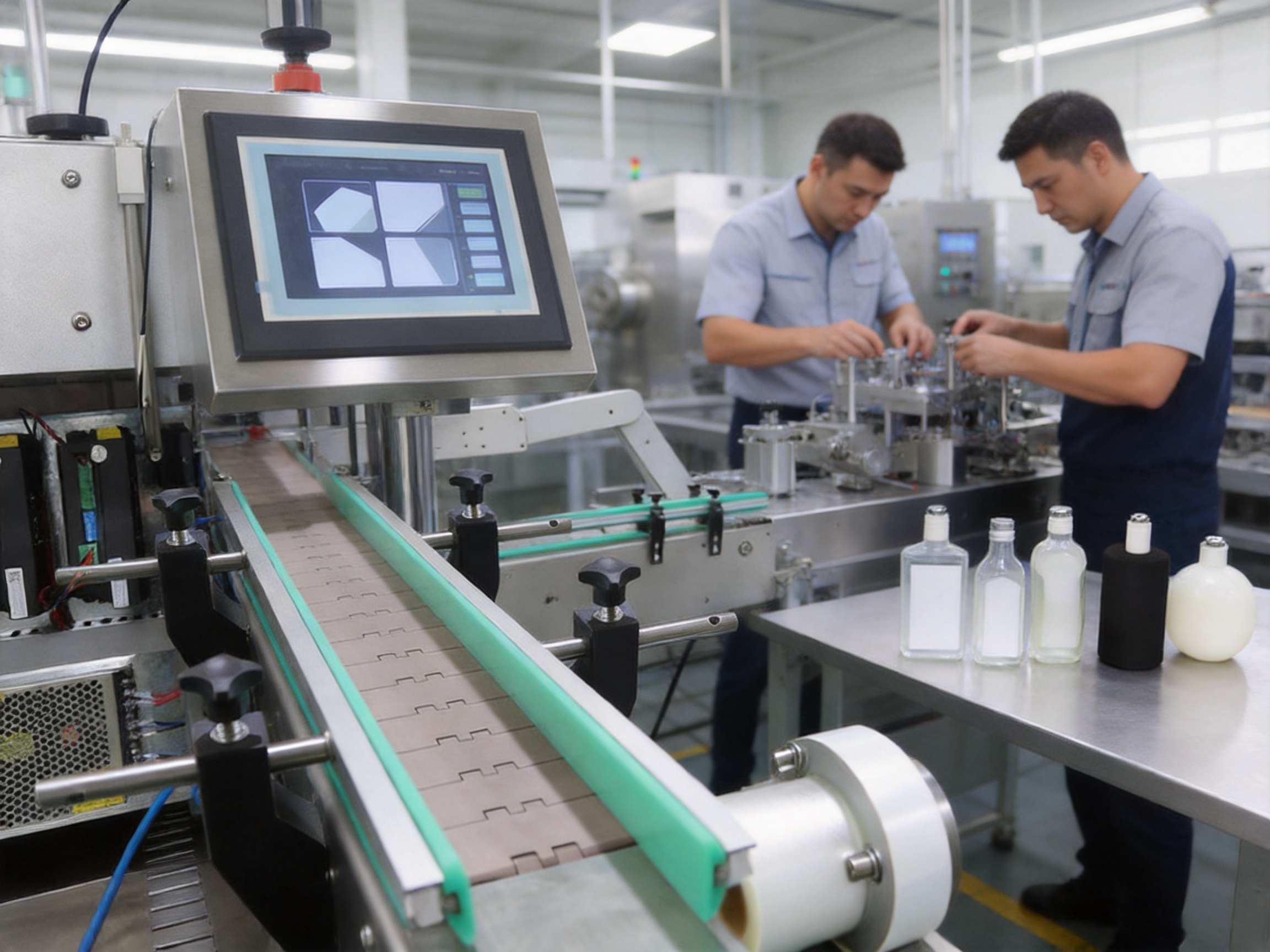
Modern packaging operations require more than simply attaching a label to a container. Manufacturers must achieve stable positioning, clean appearance, high throughput, low material waste, simple changeover, and reliable integration with the rest of the production line. These requirements become particularly challenging when one packaging line handles square bottles, flat containers, irregular packages, and round products with a defined labeling surface.
The automatic single-side sticker labeling machine is designed to address these requirements through controlled product conveying, bottle separation, positioning, label dispensing, and pressing. It applies one self-adhesive label to the front, side, or other selected flat surface of a product. The machine is suitable for packaging operations in daily chemicals, food and beverage, pharmaceuticals, healthcare, personal care, disinfectants, lubricants, seasoning, and other light industrial sectors.
With a labeling speed of up to 30–120 bottles per minute, an adjustable operating range, and a stated labeling accuracy of approximately ±1 mm under suitable product conditions, the equipment provides an effective alternative to manual application and less specialized labeling systems. Its design is particularly beneficial for manufacturers that require consistent single-sided presentation without investing in a highly complex multi-function labeling line.
Manufactured by Shanghai Ruixiao Packaging Technology Co., Ltd., the machine reflects a combination of mechanical engineering, precision component manufacturing, electrical control, and application-focused customization. The company operates as a source manufacturer with in-house machining capabilities, technical development experience, and complete machine assembly and commissioning. These capabilities allow the equipment to be adapted to different bottle dimensions, label specifications, conveyor layouts, and production requirements.
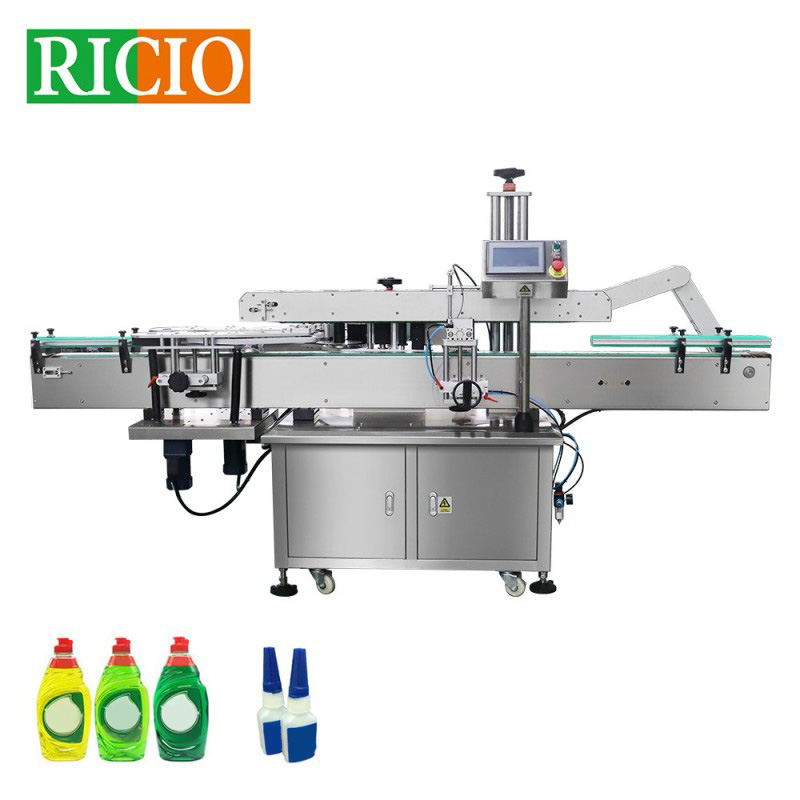
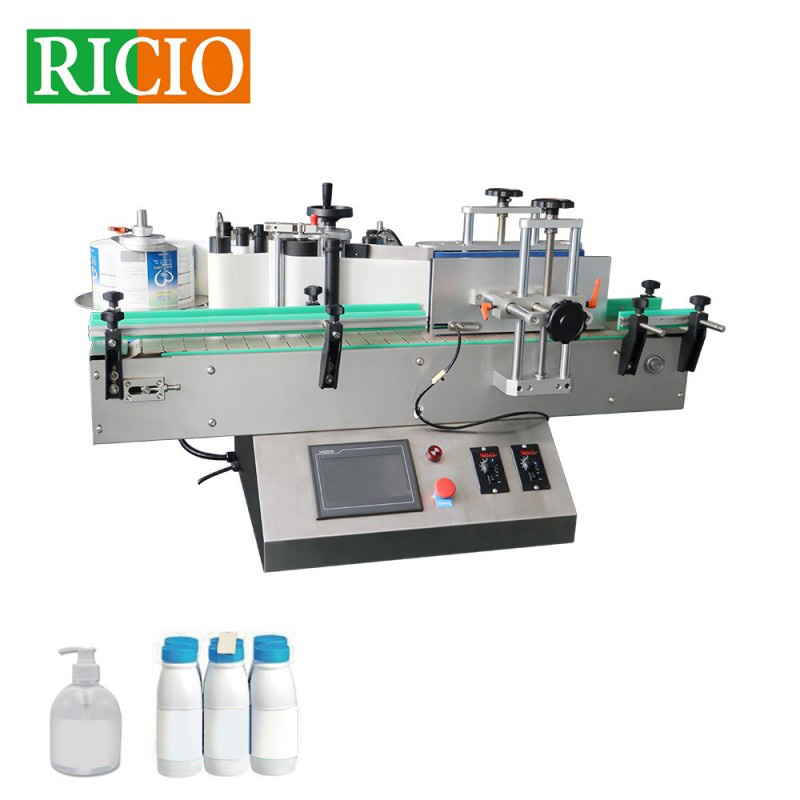
Automatic Single Side Sticker Labeling Machine
What Is an Automatic Single-Side Sticker Labeling Machine?
An automatic single-side sticker labeling machine is an industrial system that automatically applies one pressure-sensitive adhesive label to a single surface of a product. Unlike manual labeling, in which an operator must pick up each container, align a label, and press it onto the package, the automated system performs the complete process in a controlled sequence.
Products enter the machine through a conveyor. A separation mechanism creates a suitable distance between adjacent products, while guides or alignment components help maintain a stable position. A photoelectric sensor detects the arrival of each container and communicates with the control system. The label dispensing mechanism then releases a label from the backing paper at the required time. A pressing or rolling assembly makes contact with the package and smooths the label onto its surface.
The term “single-side” refers to the primary application function. The machine is intended to place a label on one selected side or one defined flat area. Depending on the configuration and product geometry, this can mean a front panel, side panel, broad flat surface, or another accessible area. It is especially appropriate for containers that do not require simultaneous front-and-back labeling or full-wrap labeling.
The equipment can handle square bottles, flat bottles, some irregular bottles, and selected round containers. For round containers, the machine is generally used when a label must be placed on a defined area rather than wrapped around the entire circumference. Final performance depends on the shape, stiffness, surface condition, label material, adhesive properties, and required placement position of the product.
Why Single-Side Labeling Matters in Modern Packaging
A product label communicates brand identity, product information, regulatory details, usage instructions, warnings, batch information, and traceability data. Even when the label contains only a limited amount of information, its position has a major effect on the appearance of the finished package. A crooked label, visible wrinkle, air bubble, or raised edge can make a product appear poorly manufactured.
Single-side labeling is widely used because many packages have one main presentation panel. A square detergent bottle may have a large front surface intended for the product label. A pharmaceutical or healthcare package may require a clearly visible identification label on one face. A seasoning container, disinfectant bottle, or personal care package may use one main panel for branding and product information.
Automating this operation provides several benefits:
First, the machine creates a repeatable labeling position. Once the product guides, sensor position, dispensing timing, and pressing mechanism have been adjusted, each product can pass through the same process with limited operator intervention.
Second, automatic separation reduces product congestion. Containers arriving too close together may cause missed labels, double labeling, or incorrect label placement. The separation area establishes a more controlled product flow before each container reaches the labeling station.
Third, automation improves production efficiency. Operators no longer need to manually orient and label every bottle. They can instead supervise material supply, inspect output quality, manage changeovers, and respond to alarms.
Fourth, automatic application can reduce common manual defects. Consistent pressure and movement help minimize skewing, wrinkling, bubbles, incomplete adhesion, and edge lifting. Although no labeling system can eliminate every defect under unsuitable material or product conditions, mechanical consistency significantly improves the probability of achieving a clean result.
Finally, the machine supports a more professional packaging image. Consistent label alignment is especially important for products displayed together on retail shelves, packed into cartons, or handled by distributors that expect uniform presentation.
Core Operating Principle
Product Conveying and Infeed
The labeling process begins when products are placed on or transferred to the conveyor. The conveyor moves the products toward the separation and labeling sections at a controlled speed. Conveyor width can be customized according to the dimensions of sample bottles, cases, boxes, or other packaging items.
A properly configured conveyor provides a stable foundation for the entire process. If the container moves sideways, rotates unexpectedly, or vibrates excessively, even a precise dispensing system may not place the label accurately. For this reason, the machine’s product guides and conveyor arrangement must be matched to the container profile.
Automatic Product Separation
Products entering from an upstream machine may not be evenly spaced. The separation mechanism adjusts the distance between individual containers so that each product reaches the labeling station at a predictable time. This function helps prevent contact between neighboring products and gives the photoelectric sensor a clear detection cycle.
Stable spacing also improves synchronization between the conveyor and label dispenser. The control system can calculate or respond to the product position more effectively when the product flow is organized. For operations handling different bottle sizes, separation settings can be adjusted during changeover.
Photoelectric Detection
A photoelectric sensor identifies the arrival of a product. When the sensor detects the container, the control system activates the label dispensing process according to the configured timing. Sensor selection and positioning are important because transparent, reflective, dark, glossy, or irregular products may interact with light differently.
The machine can also be equipped with a transparent label sensor when the label material requires more specialized detection. Optional barcode or QR code reading systems may be added when the production process requires identification, verification, or traceability.
Label Dispensing
The label roll is mounted on a reel with a standard inner diameter of approximately 76 mm and an outer diameter of up to approximately 350 mm. As the backing paper advances, the adhesive label separates at the dispensing edge and becomes available for application to the product surface.
The label dispensing speed and timing must correspond to the product speed, label length, spacing between labels, and application position. The machine is designed for labels with a height of approximately 10–150 mm and a length of approximately 10–300 mm. Special label specifications can be reviewed for customization.
Pressing and Rolling
After the label is released, a pressing or rolling mechanism applies it to the product. The rolling action helps distribute pressure across the label surface and supports smooth adhesion. This is particularly useful for flat bottles and square bottles with broad panels, where consistent contact improves appearance.
The pressing assembly must be adjusted according to the product’s shape and material. A rigid square bottle may require a different pressure and contact position than a flexible plastic pouch or a slightly irregular container. The ability to configure the contact method is one of the factors that allows the equipment to serve multiple packaging applications.
Product Compatibility and Application Range
The automatic single-side sticker labeling machine is intended for products with a height range of approximately 40–400 mm and a bottle diameter range of approximately 25–120 mm. These figures provide a general working range rather than a guarantee for every product shape. Product trials and sample testing remain important when containers have unusual surfaces or flexible walls.
The machine can be applied to many common packaging formats, including:
• Square plastic bottles for laundry detergent, household chemicals, disinfectants, and cleaning products.
• Flat bottles used for personal care, shampoo, lotion, and other daily chemical products.
• Medicine and healthcare containers requiring a clear identification panel.
• Seasoning and food containers with a broad front-facing surface.
• Irregular packaging bottles with a suitable accessible labeling area.
• Selected round containers where the label is applied to a defined side or front position.
• Light industrial containers for chemical, lubricant, and maintenance products.
The machine is most effective when the product has a reasonably stable surface and the selected label area is accessible to the application mechanism. Products with severe tapering, deep recesses, highly flexible walls, or significant surface contamination may require specialized tooling or a different labeling configuration.
Technical Specifications
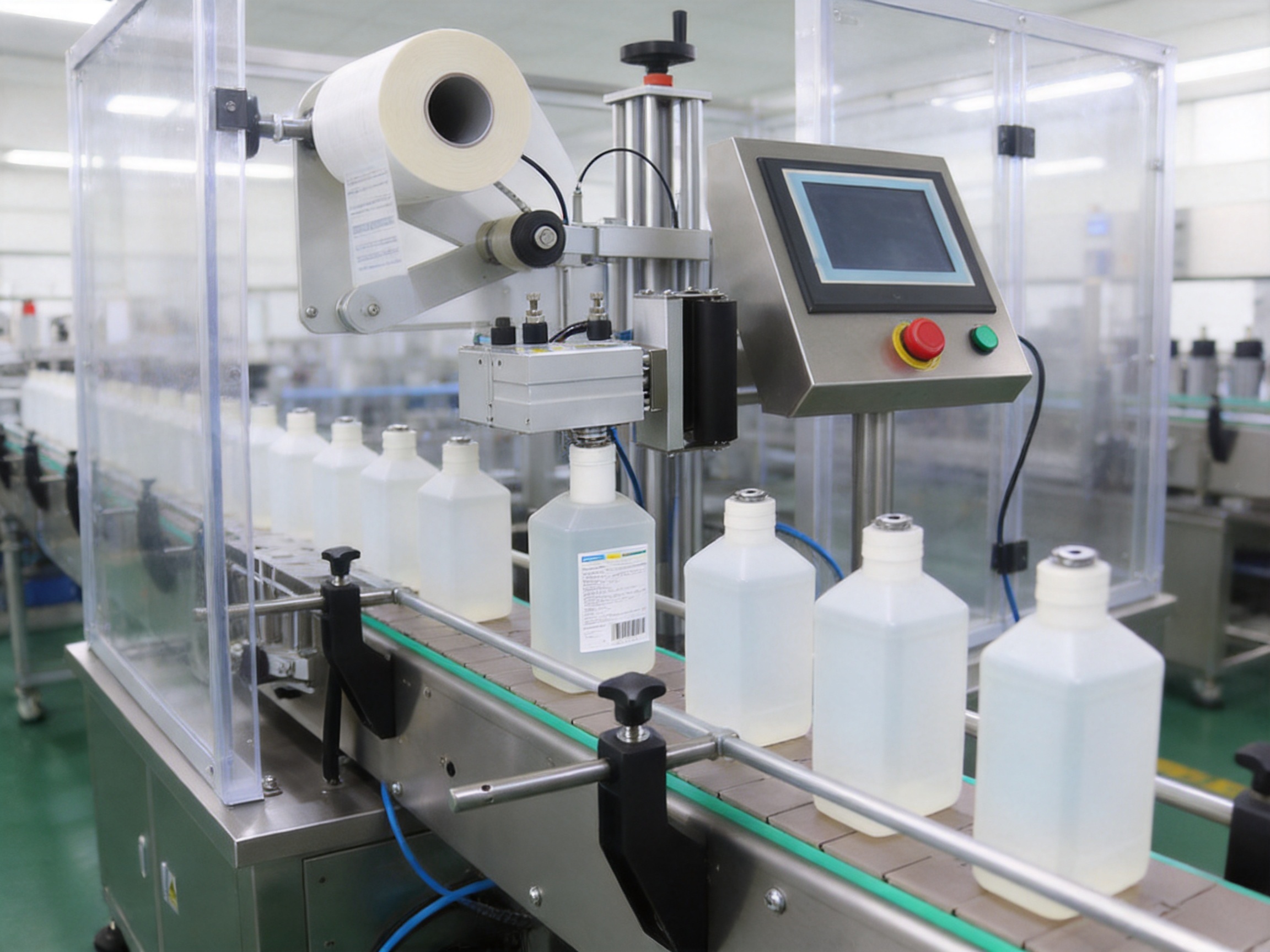
The following table summarizes the principal specifications supplied for the automatic single-side sticker labeling machine. Actual performance may vary according to product geometry, label material, line layout, and operating conditions.
| Specification | Details |
|---|---|
| Machine type | Automatic single-side sticker labeling machine |
| Application | Front, side, or single flat-surface labeling |
| Power supply | AC 380 V, 50 Hz, three-phase; variable configurations available when required |
| Power consumption | Approximately 2500 W |
| Labeling speed | Approximately 30–120 bottles per minute, adjustable according to product and label size |
| Labeling accuracy | Approximately ±1 mm, depending on product characteristics |
| Product diameter range | Approximately 25–120 mm |
| Product height range | Approximately 40–400 mm; customization available |
| Label height | Approximately 10–150 mm |
| Label length | Approximately 10–300 mm; customization available for special specifications |
| Minimum single-label spacing | Approximately 3 mm |
| Label thickness | Approximately 8 micrometers or above, subject to suitable backing-paper strength |
| Backing paper requirement | Approximately 5 micrometers or above with sufficient tensile strength |
| Label roll inner diameter | Approximately 76 mm |
| Maximum label roll outer diameter | Approximately 350 mm |
| Machine net weight | Approximately 280 kg |
| Packaging dimensions | Approximately 2800 × 1400 × 1400 mm |
| Conveyor width | Customizable according to sample bottles, cases, or boxes |
The stated speed range should be interpreted as an adjustable operating range rather than a fixed output promise for every product. A short label on a stable rigid bottle may allow faster production than a long label applied to a flexible or irregular container. The actual line speed should be established through product testing and a review of the required label position and finish quality.
Key Advantages Compared with Less Specialized Labeling Systems
More Consistent Than Manual Labeling
Manual labeling depends heavily on operator skill, attention, fatigue, and working posture. Even experienced operators may produce variation over a long shift. Small differences in alignment become visible when products are placed next to one another in a carton or on a retail display.
The automatic machine standardizes the timing and movement of each application. Product detection, label release, and pressing are controlled as part of a repeatable sequence. This reduces dependence on individual operator technique and helps maintain a more consistent result across multiple shifts.
More Flexible Than Dedicated Single-Format Equipment
Some basic labeling machines are designed around one product size or one container shape. Such equipment may perform well in a narrow application but can require extensive modification when the manufacturer introduces a new bottle or label.
The automatic single-side sticker labeling machine is designed for a broader range of product heights, diameters, and surface types. Adjustable guides, sensor positions, conveyor settings, and labeling parameters allow the machine to accommodate multiple products. This flexibility can improve asset utilization for contract packers and manufacturers with several product lines.
Less Complex Than Unnecessary Multi-Sided Systems
A manufacturer that only needs one front or side label may not benefit from purchasing a more complex multi-sided or wraparound system. Additional labeling stations can increase equipment cost, footprint, setup requirements, and maintenance demands.
A single-side system focuses resources on the required application. It provides the necessary conveying, positioning, dispensing, and pressing functions without adding mechanisms that are not needed for the product. This can make the equipment a practical choice for companies seeking automation with a controlled investment.
Improved Material Utilization
The no-bottle-no-label function prevents the label dispenser from releasing a label when no product is present. Combined with photoelectric detection and stable product spacing, this feature helps reduce unnecessary label consumption.
Lower label waste is beneficial not only from a material-cost perspective but also from an environmental and operational perspective. Fewer discarded labels mean less cleanup, fewer interruptions for roll replacement, and more efficient use of printed packaging materials.
Suitable for Product Changeovers
The touch screen control system can store multiple groups of labeling parameters. These may include conveyor speed, dispensing timing, sensor settings, and other application values. When a manufacturer changes from one product to another, the operator can recall the relevant settings and complete final adjustments rather than starting from zero.
Stored parameters are especially valuable when a line handles several bottle formats during the same week. Faster changeover reduces idle time and allows production teams to respond more efficiently to varying orders.
Optional Coding and Verification Functions
The system can be configured with optional equipment such as a thermal coding printer, inkjet printer, transparent label sensor, QR code reader, or barcode reader. These additions expand the machine from a basic labeling unit into a more integrated packaging station.
Printing functions can add production dates, expiry dates, lot numbers, batch codes, supervision codes, and other variable information. Reading functions can help confirm that the correct product or label is being processed. The exact combination should be selected according to the manufacturer’s traceability, compliance, and quality-control requirements.
Control System and Operator Experience
The touch screen interface provides a central point for operating the machine and managing labeling parameters. A clear control system is important because it reduces the time required for setup and helps operators understand the status of the equipment.
Typical operator functions may include starting and stopping the conveyor, adjusting the labeling speed, selecting stored product settings, monitoring alarms, and controlling the label dispensing sequence. The interface also supports troubleshooting by indicating abnormal conditions that require attention.
A fault alarm system can alert the operator to problems such as a missing product, label material interruption, sensor detection issue, or other abnormal operating condition. Prompt notification helps reduce the duration of downtime and prevents extended production with an unresolved fault.
The no-bottle-no-label function is another important control feature. If the sensor does not detect an object in the expected position, the system can withhold label dispensing. This prevents labels from being released onto the conveyor or into open space and supports more economical production.
Manufacturing Strengths Behind the Equipment
The performance of an automatic labeling machine depends not only on its visible frame and label head but also on the quality of its internal components, machining accuracy, electrical integration, and commissioning process. Shanghai Ruixiao Packaging Technology Co., Ltd. has developed its manufacturing capabilities through experience in labeling machinery and precision mechanical parts.
Source-Manufacturer Capabilities
The company developed from the acquisition of Shanghai Zhenbao Machinery Parts Factory and has progressed from equipment assembly toward source manufacturing with in-house precision machining capabilities. This background is important because a labeling machine is a coordinated system of mechanical and electrical components rather than a collection of unrelated modules.
In-house manufacturing allows the company to maintain greater control over the production of selected core parts. It can also support quicker engineering communication when a customer requires a modified guide, conveyor width, sensor bracket, product fixture, or other application-related adjustment.
CNC Precision Machining
The company operates multiple CNC machining centers. CNC manufacturing supports repeatable production of mechanical parts with controlled dimensions and consistent fit. In a labeling machine, the accuracy of brackets, shafts, rollers, guide assemblies, and mounting surfaces can influence the stability of product movement and label placement.
Precision machining also makes it easier to produce customized components for unusual bottle shapes or special line layouts. Rather than relying entirely on standard parts, the engineering team can design and manufacture selected components that better match the customer’s sample products.
Integrated Assembly and Commissioning
Mechanical assembly, electrical installation, control-system integration, and final commissioning are managed as connected stages. This approach helps ensure that the conveyor, sensors, dispensing mechanism, pressing unit, and control software operate as one system.
Commissioning is especially important for labeling equipment because the final result depends on interaction between multiple variables. A label head may be mechanically accurate, but the machine still requires correct sensor timing, product separation, conveyor speed, pressing pressure, and label tension. Complete testing provides an opportunity to adjust these factors before shipment.
ISO 9001 Quality-System Foundation
The company manages its process in accordance with the ISO 9001 international quality system. A quality-management framework supports documentation, process control, inspection, corrective action, and continuous improvement. For industrial buyers, this provides a structured basis for evaluating the consistency of manufacturing and service practices.
Quality-system management does not remove the need for product-specific testing, but it helps establish repeatable procedures across design, machining, assembly, testing, and delivery. This is particularly useful for export customers that require organized technical documentation and stable supplier communication.
Application-Oriented Engineering
Labeling equipment must be selected according to the product rather than only by catalog specifications. The company’s technical team can assess sample bottles, labels, line speed, desired label position, and optional coding requirements. This application-oriented approach helps reduce the risk of selecting a machine that appears suitable on paper but performs poorly with the actual packaging material.
Customization may involve conveyor width, product guides, label sensor selection, label-head arrangement, printing equipment, bottle separation, or other mechanical and control features. Such flexibility is valuable for manufacturers with unique packaging designs or frequent product changes.
Industries and Typical Products
Daily Chemical and Household Products
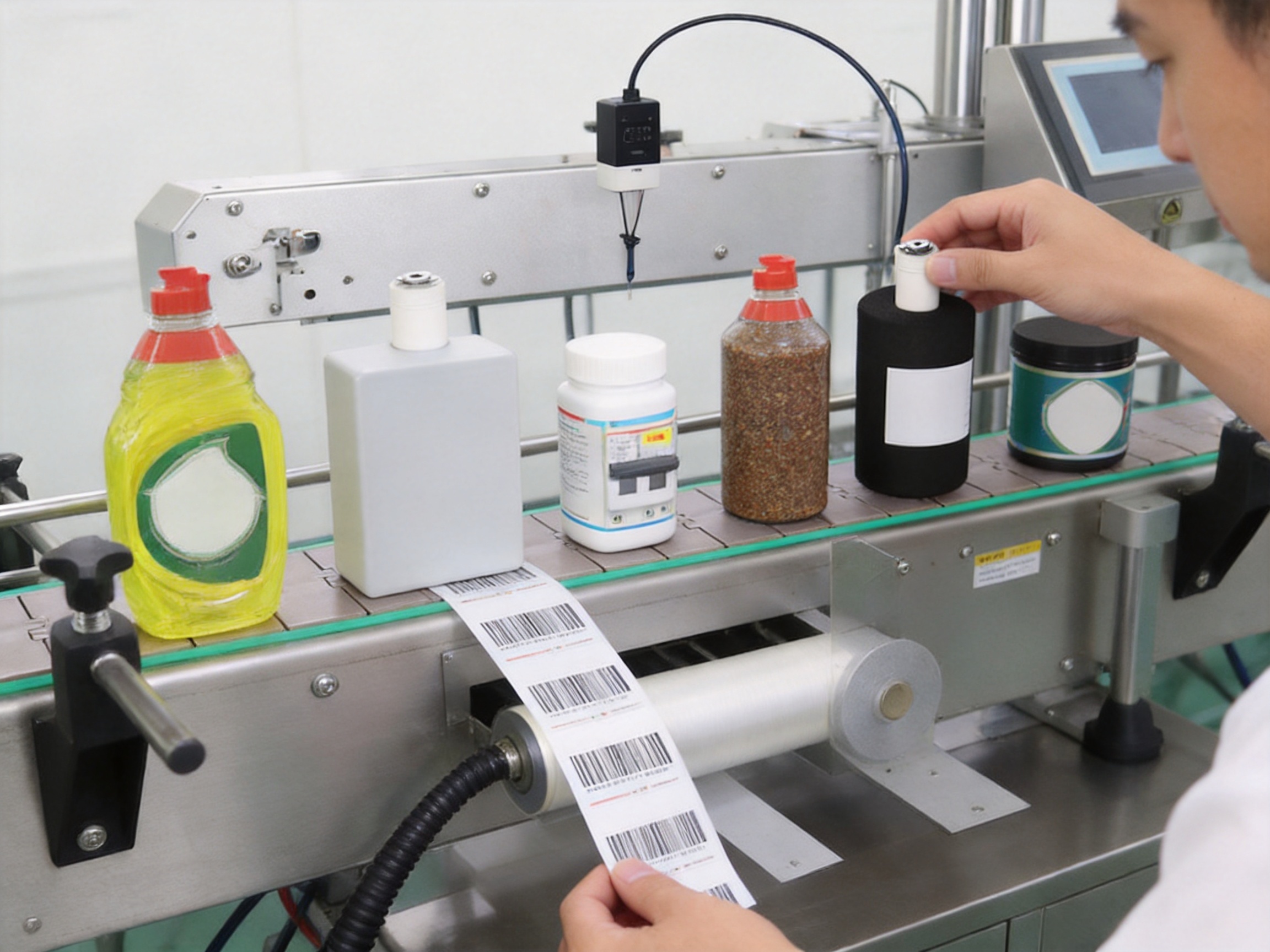
Shampoo bottles, laundry detergent bottles, surface cleaners, disinfectants, and other household products frequently use flat or square plastic containers. These products often require a large, visually prominent front label. The machine can apply the label to the selected panel while maintaining a controlled product flow.
Food, Beverage, and Seasoning
Seasoning bottles, food containers, sauces, and selected beverage packages may have a flat or defined front surface. A consistent label position helps consumers read product information and creates a uniform appearance across a product family.
Pharmaceutical and Healthcare Packaging
Medicine bottles, healthcare containers, and related products often require readable labels containing product names, usage details, lot numbers, expiry dates, or traceability information. Optional printing and reading systems can support variable-data applications, subject to the customer’s validation and compliance requirements.
Personal Care and Cosmetics
Personal care packaging often places strong emphasis on appearance. Clean application without wrinkles, skewing, or edge lifting is important for products such as lotions, liquid soaps, skin-care products, and hair-care products. The pressing and rolling mechanism supports a smooth finish on suitable bottle surfaces.
Chemical and Lubricant Packaging
Industrial chemicals, lubricants, and maintenance products may be packaged in containers with larger dimensions or more robust walls. The stated product height and diameter ranges allow the machine to serve many small and medium-sized industrial packages, while customized conveying and guides can be considered for special formats.
Label and Product Conditions That Affect Performance
Although the machine is designed for stable automatic operation, labeling quality depends on the interaction between the equipment, product, and label materials. Buyers should evaluate these factors before final installation.
The product surface should be reasonably clean, dry, and free from oil, dust, moisture, or excessive release agents. Contamination can reduce adhesive performance and may cause edge lifting or partial detachment.
Product rigidity also matters. A rigid bottle maintains its shape as it passes through the pressing mechanism. A soft or flexible container may deform under pressure, causing the label to shift or wrinkle. Such products may require lower pressure, modified support, or special application tooling.
Label dimensions and spacing must fall within the machine’s working range. The supplied information specifies a minimum single-label spacing of approximately 3 mm. Labels with insufficient gap, weak backing paper, excessive curl, or inconsistent die cutting may affect detection and dispensing.
Label thickness and backing-paper strength should also be considered. The stated material guidance refers to label thickness of approximately 8 micrometers or above and backing paper of approximately 5 micrometers or above with sufficient tensile strength. Very thin or fragile materials may require testing before production approval.
Transparent labels can be more difficult to detect with standard sensors. An optional transparent label sensor may be appropriate. Reflective products, dark packaging, and highly glossy surfaces should likewise be tested so that the photoelectric detection system can be configured correctly.
Installation, Setup, and Changeover Considerations
Before installation, the customer should confirm that the production area has sufficient floor space for the machine and its packaged delivery dimensions. The approximate machine packaging size is 2800 × 1400 × 1400 mm, while the net machine weight is approximately 280 kg. Appropriate access, lifting equipment, and floor conditions should be considered during delivery planning.
The power requirement is normally AC 380 V, 50 Hz, three-phase, with variable configurations available when needed. The customer’s electrical team should confirm local power standards, grounding, protection devices, and installation requirements before commissioning.
Initial setup includes conveyor alignment, product-guide adjustment, sensor positioning, label-roll installation, label-web threading, dispensing-edge adjustment, and pressing-mechanism positioning. Operators should begin at a moderate speed and use representative product samples and production labels.
For a new product, the recommended process is to load the appropriate stored parameter group, place sample containers on the conveyor, check product separation, confirm sensor detection, and inspect the first labels for position and adhesion. Small adjustments can then be made to speed, timing, guide width, or pressing pressure.
During changeover, operators should verify that the new product’s height, diameter, label size, and label position are compatible with the selected settings. The label roll should be correctly installed, and the label path should be free from twists or unnecessary tension. A short test run should be completed before full production begins.
Maintenance and Long-Term Reliability
Routine maintenance supports stable labeling performance and helps protect the machine from avoidable wear. Operators should keep the conveyor, label path, sensor surfaces, pressing rollers, and surrounding frame clean. Adhesive residue can accumulate over time and affect smooth label movement or product contact.
Photoelectric sensors should be checked regularly for dust, adhesive particles, or misalignment. A sensor that becomes obstructed may fail to detect products correctly. The label roll and backing paper should also be inspected for damage, excessive curl, or uneven winding.
Mechanical fasteners, guide assemblies, rollers, and moving parts should be inspected according to the maintenance schedule. Any unusual noise, vibration, slippage, or change in label position should be investigated rather than ignored. Early correction can prevent a minor adjustment issue from becoming a larger production problem.
Electrical cabinets and control components should be maintained by qualified personnel. Power should be isolated before internal inspection or service. Operators should follow the machine’s operating and maintenance documentation and should not bypass safety or alarm functions without authorization.
Proper maintenance is also a competitive advantage because it protects output consistency over the service life of the equipment. A machine that is easy to inspect, adjust, and clean can reduce the total cost of ownership compared with equipment that requires complicated servicing for routine tasks.
How the Machine Supports Production Efficiency
Production efficiency is not determined only by maximum speed. It also includes uptime, changeover time, material waste, defect rate, operator requirements, and the ability to maintain a stable process. The automatic single-side sticker labeling machine addresses these factors through several coordinated features.
Adjustable speed allows the machine to be matched to the product and upstream equipment. Running too quickly may increase defects, while running too slowly may create a bottleneck. The 30–120 bottles-per-minute range gives users room to balance output and quality according to the application.
Stored touch-screen parameters shorten product changeover. No-bottle-no-label control reduces unnecessary label consumption. Product separation improves the regularity of the input stream. Fault alarms help operators respond to abnormal conditions. Together, these features create a more predictable packaging operation.
The machine can also be integrated into a broader production line. It may receive products from a filling, capping, or inspection process and send labeled products to a packing or case-handling system. The exact integration method depends on the customer’s line layout and communication requirements.
Why Choose an Application-Specific Manufacturer?
Purchasing a labeling machine from a company that understands both mechanical manufacturing and packaging applications can simplify the selection process. A supplier that only provides a standard label head may not be able to address product orientation, conveyor design, sensor challenges, or special packaging geometry.
Shanghai Ruixiao Packaging Technology Co., Ltd. focuses on labeling machinery for several applications, including syringe labeling, round and square bottle labeling, double-sided labeling, high-speed labeling, and real-time print-and-apply systems. This broader product experience provides useful knowledge when customers need to compare different labeling methods or plan future equipment upgrades.
The company exports to more than 40 countries and regions. International experience can support communication regarding electrical standards, documentation, shipping, commissioning, spare parts, and application requirements. For overseas buyers, supplier responsiveness and technical understanding are important considerations alongside the machine’s basic specifications.
The company’s combination of CNC machining, technical development, in-house assembly, commissioning, and quality-system management also supports more direct control over the final equipment. If an application requires an adjustment, the engineering and manufacturing teams can communicate within the same organization instead of relying entirely on unrelated external suppliers.
Selection Guide for Buyers
Before ordering an automatic single-side sticker labeling machine, buyers should prepare representative product and label samples. Sample-based evaluation is the most reliable way to confirm whether the proposed machine can meet the required label position and appearance.
The buyer should provide product height, width, diameter, weight, material, surface finish, and dimensional tolerances. Photographs or drawings are useful, but physical samples are preferable when the product has irregular curves, flexible walls, handles, seams, or recessed panels.
Label information should include height, length, material, adhesive type, backing-paper specification, roll inner diameter, roll outer diameter, label spacing, and printing requirements. Transparent, metallic, textured, or unusually thin labels should be identified at the beginning of the technical discussion.
Production information should include required bottles per minute, operating hours per shift, upstream and downstream machine speeds, expected changeover frequency, available floor space, electrical supply, and the desired level of operator involvement.
Buyers should also define quality expectations. A requirement of ±1 mm may be suitable for many applications, but the practical result depends on bottle stability, label dimensions, surface geometry, and product handling. Acceptance criteria should be agreed through sample testing and documented before shipment.
Q&A: Automatic Single-Side Sticker Labeling Machine
What type of products can the machine label?
It is suitable for square bottles, flat bottles, irregular bottles, and some round containers with a defined labeling area. Typical products include shampoo bottles, laundry detergent bottles, disinfectant bottles, medicine bottles, seasoning containers, food packages, personal care products, lubricants, and selected chemical packages.
Can it apply labels to a round bottle?
Yes, selected round containers can be labeled when the required application is a single label on a defined surface. If the customer requires a complete wraparound label or precise circumferential orientation, a dedicated round-bottle labeling configuration may be more suitable.
What is the maximum labeling speed?
The stated adjustable speed range is approximately 30–120 bottles per minute. Actual speed depends on product size, label length, label spacing, bottle stability, required placement accuracy, and the overall production-line configuration.
What labeling accuracy can be expected?
The stated accuracy is approximately ±1 mm under suitable product and label conditions. The final result may be influenced by bottle roundness, surface softness, product movement, label material, adhesive behavior, and the stability of the application surface.
What label sizes can the machine handle?
The general label height range is approximately 10–150 mm, and the label length range is approximately 10–300 mm. Special specifications can be evaluated for customization. The label roll should have an inner diameter of approximately 76 mm and an outer diameter of no more than approximately 350 mm unless otherwise configured.
Does the machine prevent label waste?
The no-bottle-no-label function and photoelectric detection system help prevent labels from being dispensed when no product is present. This reduces avoidable waste, although correct sensor adjustment and routine maintenance remain necessary.
Can the machine print dates or batch numbers?
Optional thermal coding printers or inkjet printers can be added. These options may be used for production dates, expiry dates, batch numbers, supervision codes, and other variable information, subject to the selected printer and production requirements.
Can the machine read QR codes or barcodes?
Optional QR code or barcode reading equipment can be integrated when the application requires product identification, label verification, or traceability. The reader configuration should be selected according to code type, print quality, reading distance, and line speed.
Can transparent labels be detected?
A transparent label sensor is available as an option. Transparent labels should be tested because their optical characteristics can differ significantly from those of opaque paper or film labels.
Is the conveyor width fixed?
No. Conveyor width can be customized according to the customer’s sample bottles, cases, boxes, or other packages. Proper conveyor sizing is important for product stability and smooth transfer between machines.
How does the touch screen help operators?
The touch screen allows operators to manage labeling parameters, select stored product settings, adjust operating speed, monitor alarms, and control the production sequence. Stored parameter groups can reduce repeated setup work during product changeovers.
What power supply is normally required?
The default specification is AC 380 V, 50 Hz, three-phase, with alternative configurations available when needed. The customer should confirm the required electrical arrangement before ordering and installation.
Does the company manufacture the machine or only assemble it?
The company operates as a source manufacturer with in-house precision machining capabilities, multiple CNC machining centers, technical personnel, complete machine assembly, and commissioning. Its manufacturing process is managed in accordance with the ISO 9001 international quality system.
Can the machine be customized?
Customization may be available for product range, conveyor width, labeling components, sensors, printing systems, code readers, guides, and other application-related features. The final configuration should be determined through product samples and technical evaluation.
Why should sample products be provided before purchase?
Sample products allow the manufacturer to evaluate surface shape, flexibility, dimensions, label position, material behavior, and application quality. Testing reduces the risk of choosing a configuration that does not match the actual packaging requirements.
Conclusion
The automatic single-side sticker labeling machine provides a focused and adaptable solution for manufacturers that need reliable application of one label to a front, side, or single flat surface. It combines automatic conveying, product separation, photoelectric detection, label dispensing, pressing, and rolling in one production-oriented system.
Its principal advantages include adjustable output of approximately 30–120 bottles per minute, a stated accuracy of approximately ±1 mm under suitable conditions, compatibility with a broad range of square, flat, irregular, and selected round containers, no-bottle-no-label control, touch-screen parameter storage, and optional printing and code-reading functions.
Compared with manual labeling, the machine improves consistency and reduces labor dependence. Compared with highly specialized single-format equipment, it offers broader product flexibility. Compared with unnecessarily complex multi-sided systems, it focuses on the functions required for single-surface application while maintaining the possibility of optional coding and verification.
Its value is further supported by the manufacturer’s production capabilities. Shanghai Ruixiao Packaging Technology Co., Ltd. combines labeling-machine development with CNC precision machining, in-house component manufacturing, complete assembly, commissioning, and ISO 9001-based process management. This combination supports reliable equipment construction and practical customization for different industries and packaging formats.
For the best result, purchasers should evaluate real products and labels, define their production speed and quality requirements, and confirm the required configuration through sample testing. When correctly matched to the application, the machine can help manufacturers improve packaging efficiency, reduce manual errors, control label waste, and maintain a consistent professional appearance across the production line.
References
1. Shanghai Ruixiao Packaging Technology Co., Ltd., Automatic Single-Side Sticker Labeling Machine Technical Specifications.
2. Shanghai Ruixiao Packaging Technology Co., Ltd., Product Application and Configuration Information for Automatic Labeling Machinery.
3. ISO 9001, Quality Management Systems — Requirements.
4. General industrial guidance for pressure-sensitive label application, product conveying, sensor detection, and packaging-line integration.
5. General principles of preventive maintenance for automated packaging and labeling equipment.
Product: Automatic Single Side Sticker Labeling Machine

related products
related News
 +86 13681850339
 sales@raxpack.com
 Building 6, No. 477 Tiefeng Road, Baoshan District, Shanghai, China
- Tabletop Labeling Machine
- Round Bottle Labeling Machine
- Automatic Tube Labeling Machine
- Pouch Labeling Machine
- Rotary Labeling Machine
- Syringe Labeling Machine
- Top Labeling Machine
- Single Side Sticker Labeling Machine
- Double Side Labeling Machine
- Bucket Labeling Machine
- Bottom Labeling Machine
- Corner Label Applicator
- Waist Sealing Labeling Machine
- Square Bottle Labeling Machine
